
We read your photo as:
How do mutations contribute to genetic diversity and evolutionary change?
ScanSolve AI Answer
Answer
Mutations are changes in the DNA sequence of an organism, which can arise spontaneously during DNA replication or be induced by environmental factors. These alterations are the primary source of genetic variation within a species.
Mutations introduce new alleles, which are alternative forms of a gene. For example, a mutation might alter a gene responsible for a specific enzyme, leading to a modified or new version of that enzyme and thus a different metabolic pathway. This process directly increases the genetic diversity among individuals in a population.
The presence of new alleles results in phenotypic variations, meaning observable differences in traits such as physical characteristics, physiological functions, or susceptibility to diseases. While many mutations are neutral or harmful, some can be beneficial, providing an adaptive advantage that can be passed on to offspring and contribute to evolutionary change.
Still stuck on this one?
Ask a follow-up, and the answer starts from this question.
More Biology Questions
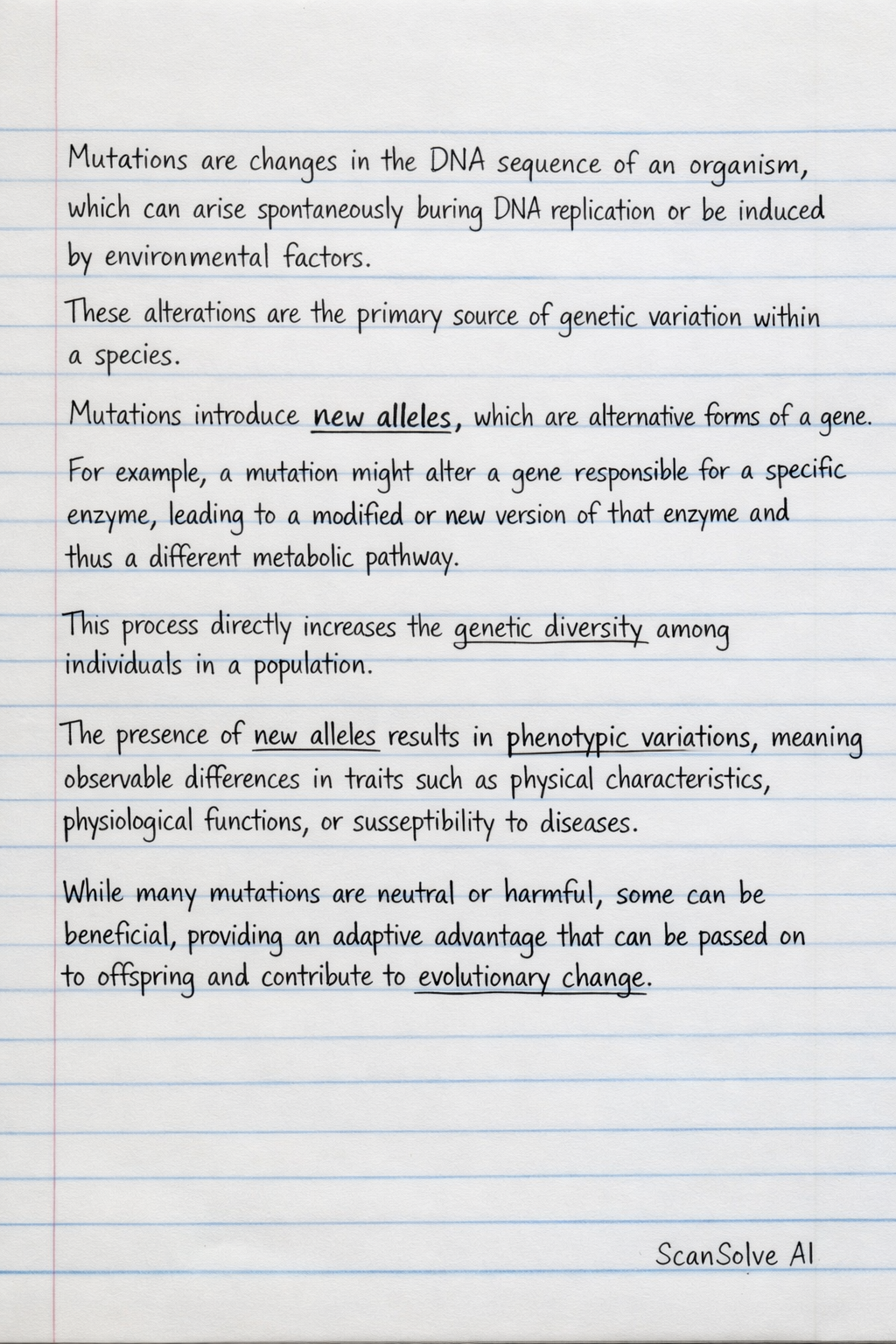
Handwritten Step-by-Step Solution
Get this as a handwritten image on WhatsApp — like a tutor wrote it for you.
Try on WhatsApp