
We read your photo as:
Name the structure where the endometrium normally develops. Explain why endometriosis in the Fallopian tubes may lead to infertility. Use the negative feedback mechanism to explain why the pills containing progesterone are successful in treating endometriosis.
ScanSolve AI Answer
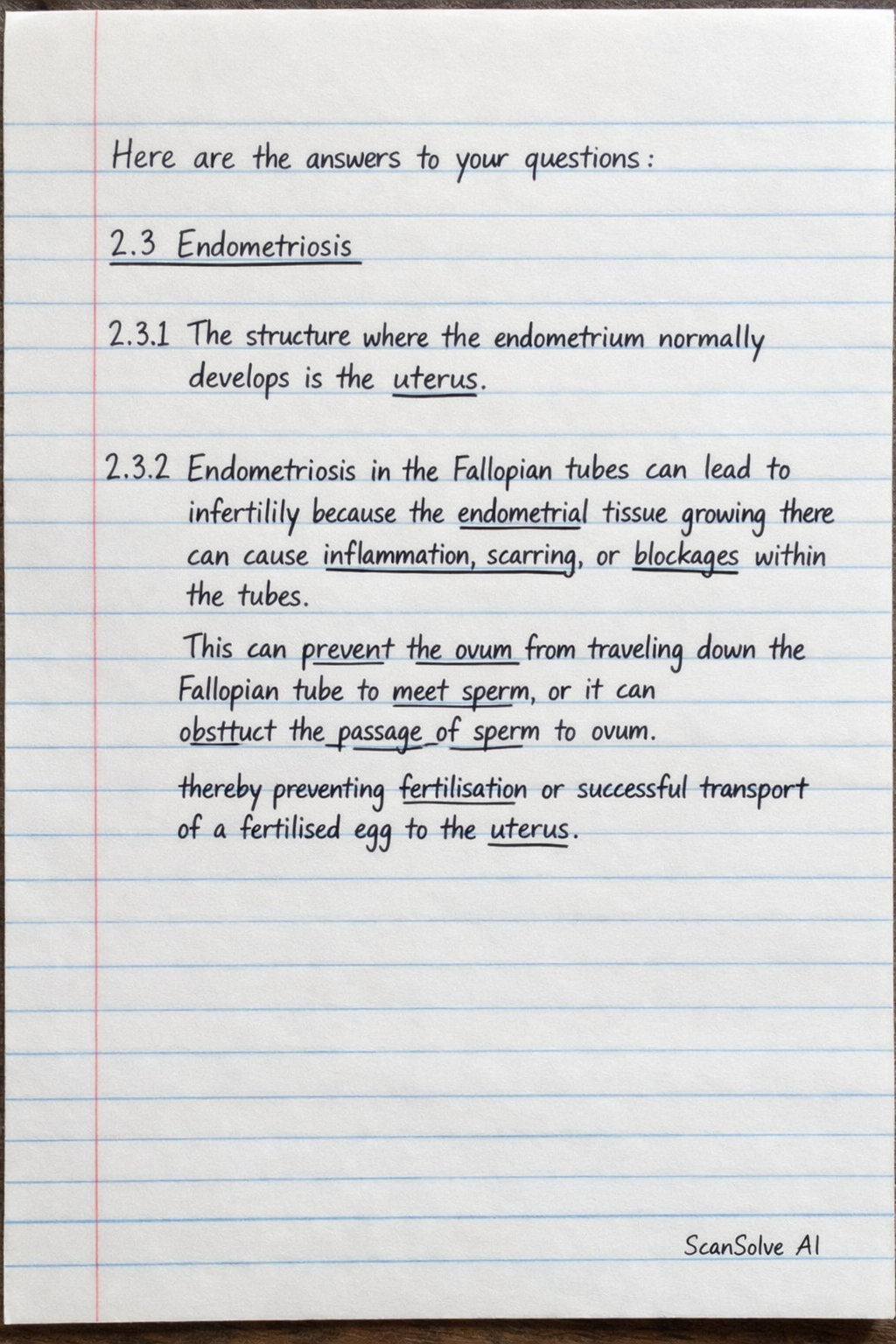
Here are the answers to your questions:
2.3 Endometriosis
2.3.1 The structure where the endometrium normally develops is the uterus.
2.3.2 Endometriosis in the Fallopian tubes can lead to infertility because the endometrial tissue growing there can cause inflammation, scarring, or blockages within the tubes. This can prevent the ovum from traveling down the Fallopian tube to meet sperm, or it can obstruct the passage of sperm to the ovum, thereby preventing fertilisation or successful transport of a fertilised egg to the uterus.
2.3.3 The contraceptive pills containing progesterone work through a negative feedback mechanism:
- The progesterone in the pills increases the levels of progesterone in the body.
- High progesterone levels inhibit the hypothalamus from releasing Gonadotropin-Releasing Hormone (GnRH).
- This, in turn, reduces the secretion of Follicle-Stimulating Hormone (FSH) and Luteinizing Hormone (LH) from the anterior pituitary gland.
- Lower levels of FSH and LH lead to reduced ovarian activity, specifically a decrease in oestrogen production by the ovaries.
- Since endometriosis is stimulated by high oestrogen levels, reducing oestrogen helps to slow down or stop the growth of endometrial tissue, thus treating the condition.
2.5 Developing Human Foetus
2.5.1 Part D is the placenta.
2.5.2 Two functions of the fluid in part C (amniotic fluid) are:
- To cushion the foetus against physical shocks and trauma.
- To maintain a constant temperature for the foetus.
- To allow freedom of movement for the foetus, aiding in muscular and skeletal development.
- To prevent adhesion of the foetus to the amnion.
2.5.3 The development of the zygote until implantation occurs:
- After fertilisation, the zygote undergoes rapid mitotic cell divisions called cleavage.
- This forms a solid ball of cells called a morula.
- The morula then develops into a hollow ball of cells called a blastocyst, which consists of an inner cell mass and an outer layer called the trophoblast.
- The blastocyst travels down the Fallopian tube and enters the uterus.
- Finally, the blastocyst implants into the endometrium (lining) of the uterus.
2.5.4 Two ways in which part A (the uterine wall/myometrium) functions in protecting the developing foetus are:
- It provides physical protection from external impacts and trauma.
- Its muscular walls help to contain and support the growing foetus.
2.5.5 Blood vessel B is the umbilical artery.
2.5.6 The nutrition of a human foetus differs from that of oviparous organisms as follows:
- Human foetus (viviparous): The foetus develops inside the mother's uterus. It receives all its nutrients (e.g., glucose, amino acids, oxygen) directly from the mother's bloodstream via the placenta and umbilical cord. Waste products (e.g., carbon dioxide, urea) are also transferred from the foetus to the mother's blood through the placenta for excretion.
- Oviparous organisms (e.g., birds, reptiles): The embryo develops outside the mother's body within an egg. All the nutrition required for development is stored within the yolk of the egg. There is no direct nutritional supply from the mother after the egg is laid. Waste products are stored within the allantois inside the egg.
Still stuck on this one?
Ask a follow-up, and the answer starts from this question.
More Biology Questions
Handwritten Step-by-Step Solution
Get this as a handwritten image on WhatsApp — like a tutor wrote it for you.
Try on WhatsApp