
We read your photo as:
Define and explain the role of specific hormones in maintaining homeostasis, including insulin, calcitonin, and ADH.
ScanSolve AI Answer
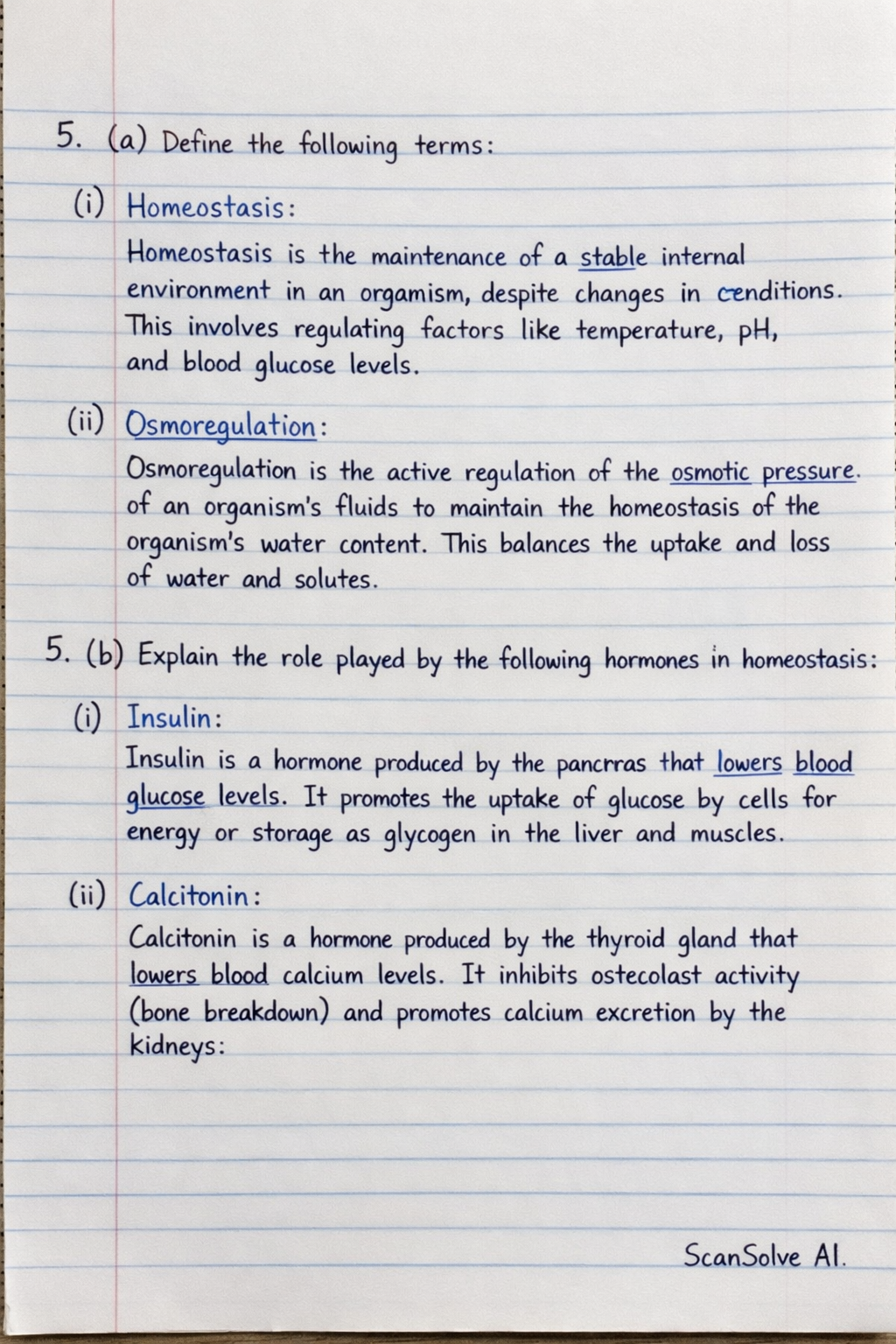
5. (a) Define the following terms:
-
(i) Homeostasis:
- Homeostasis is the maintenance of a stable internal environment in an organism, despite changes in external conditions. This involves regulating factors like temperature, pH, and blood glucose levels.
-
(ii) Osmoregulation:
- Osmoregulation is the active regulation of the osmotic pressure of an organism's fluids to maintain the homeostasis of the organism's water content. This balances the uptake and loss of water and solutes.
5. (b) Explain the role played by the following hormones in homeostasis:
-
(i) Insulin:
- Insulin is a hormone produced by the pancreas that lowers blood glucose levels. It promotes the uptake of glucose by cells for energy or storage as glycogen in the liver and muscles.
-
(ii) Calcitonin:
- Calcitonin is a hormone produced by the thyroid gland that lowers blood calcium levels. It inhibits osteoclast activity (bone breakdown) and promotes calcium excretion by the kidneys.
-
(iii) Antidiuretic hormone (ADH):
- Antidiuretic hormone (ADH), also known as vasopressin, is produced by the hypothalamus and released by the pituitary gland. It increases water reabsorption in the kidneys, leading to more concentrated urine and helping to maintain body fluid volume and blood pressure.
5. (c) Why do mammals produce large quantities of urine during fright?
During fright, the body enters a "fight or flight" response, mediated by the sympathetic nervous system and hormones like adrenaline. This response typically reduces blood flow to the kidneys and increases ADH secretion, which should lead to less urine production. However, the question describes "large quantities of urine," which is often associated with a nervous bladder or stress-induced urination. This is not a direct physiological response to fright for maintaining homeostasis but rather a reflex or loss of bladder control due to extreme stress, which can override normal regulatory mechanisms.
Still stuck on this one?
Ask a follow-up, and the answer starts from this question.
More Biology Questions
Handwritten Step-by-Step Solution
Get this as a handwritten image on WhatsApp — like a tutor wrote it for you.
Try on WhatsApp