
We read your photo as:
Define and list key terms and adaptations related to parasitology, including parasitism, mutualism, commensalism, host, immunological evasion, reproductive strategies, nutritional adaptations, site sp
ScanSolve AI Answer
Step-by-step solution
9 stepsHere are the answers to your questions:
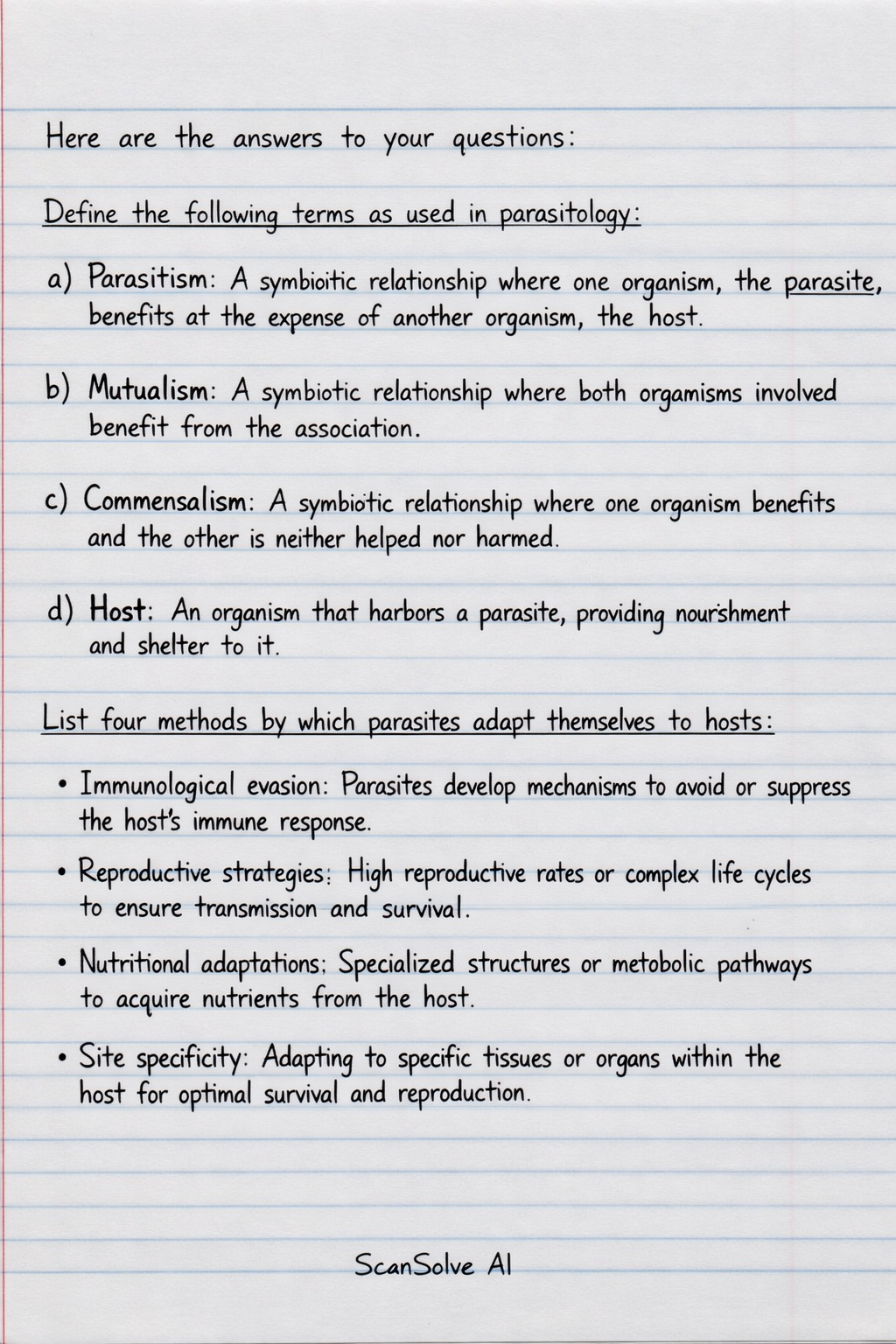
Define the following terms as used in parasitology:
a) Parasitism: A symbiotic relationship where one organism, the parasite, benefits at the expense of another organism, the host.
b) Mutualism: A symbiotic relationship where both organisms involved benefit from the association.
c) Commensalism: A symbiotic relationship where one organism benefits and the other is neither helped nor harmed.
d) Host: An organism that harbors a parasite, providing nourishment and shelter to it.
List four methods by which parasites adapt themselves to hosts:
- Immunological evasion: Parasites develop mechanisms to avoid or suppress the host's immune response.
- Reproductive strategies: High reproductive rates or complex life cycles to ensure transmission and survival.
- Nutritional adaptations: Specialized structures or metabolic pathways to acquire nutrients from the host.
- Site specificity: Adapting to specific tissues or organs within the host for optimal survival and reproduction.
Define the following parasitology terms as applied to parasitology:
e) Diurnal periodicity: The phenomenon where a parasite's activity or presence in the peripheral blood is highest during the daytime.
f) Nocturnal periodicity: The phenomenon where a parasite's activity or presence in the peripheral blood is highest during the nighttime.
g) Outline the procedure for staining thick film using field stain:
Prepare a thick blood film on a clean slide and allow it to air dry completely.
Dip the dried film into Field's Stain A (methylene blue) for 5 seconds.
Rinse the slide gently with buffered water for 5-10 seconds until the stain stops running.
Dip the slide into Field's Stain B (eosin) for 3 seconds.
Rinse again gently with buffered water for 5-10 seconds.
Allow the slide to air dry in a vertical position before microscopic examination.
1. Describe the morphological stages of African trypanosomiasis:
African trypanosomiasis, caused by Trypanosoma brucei, primarily involves two morphological forms:
- Trypomastigote: This is the infective and diagnostic stage found in the mammalian host's blood, lymph, and cerebrospinal fluid. It is an elongated, spindle-shaped cell with a central nucleus, a kinetoplast at the posterior end, and a flagellum originating from the kinetoplast, running along an undulating membrane, and extending as a free flagellum.
- Epimastigote: This stage is found in the midgut of the tsetse fly vector. It is shorter than the trypomastigote, with the kinetoplast located anterior to the nucleus, and a shorter undulating membrane.
2. Describe the life cycle of malaria in the human host:
The malaria life cycle in humans begins when an infected Anopheles mosquito injects sporozoites into the bloodstream during a blood meal.
Liver Stage (Exoerythrocytic Cycle):** Sporozoites rapidly travel to the liver and infect hepatocytes.
Inside liver cells, they undergo asexual reproduction, developing into schizonts. Each schizont matures and ruptures, releasing thousands of merozoites into the bloodstream. This stage is asymptomatic.
Blood Stage (Erythrocytic Cycle):** Merozoites invade red blood cells (RBCs).
Inside RBCs, they develop into ring forms, then trophozoites (which feed on hemoglobin), and finally schizonts. The schizonts mature, fill the RBC, and then rupture the RBC, releasing more merozoites, which then infect new RBCs. This cyclical rupture of RBCs causes the characteristic fever, chills, and anemia of malaria.
Gametocyte Formation:** Some merozoites, instead of continuing the asexual cycle, develop into sexual forms called gametocytes (male microgametocytes and female macrogametocytes) within the RBCs.
These gametocytes circulate in the peripheral blood, ready to be taken up by another mosquito.
3. Outline the purpose of the following:
a) Examining a wet preparation: To observe living, motile organisms (e.g., protozoa, helminth larvae) in their natural state, assess their motility, and detect their presence in fresh samples like stool, urine, or vaginal secretions.
b) Examining a thin stained blood smear: To identify and differentiate various blood cells (red blood cells, white blood cells, platelets), detect blood parasites (e.g., malaria, trypanosomes, microfilariae), and assess their morphology and density for diagnosis and species identification.
c) Fixing a smear before staining: To preserve the morphology of cells and microorganisms, adhere them firmly to the slide, and prevent their washing off during the staining process, allowing for accurate microscopic examination.
d) Concentration techniques: To increase the chances of detecting parasites (e.g., ova, cysts, larvae) that are present in small numbers in a large volume of sample (e.g., stool, urine, blood) by separating them from debris and concentrating them into a smaller volume.
Define the following terms, giving one example in each case:
a) Indirect life cycle: A life cycle that requires more than one host species for the parasite to complete its development and transmission.
Example: Schistosoma species, which require both humans and snails.b) Mechanical vector: An arthropod or other animal that transmits a pathogen from one host to another without the pathogen undergoing any development or multiplication within the vector.
Example: Flies transmitting Entamoeba histolytica cysts from feces to food.c) Zoonotic diseases: Diseases that can be naturally transmitted from animals to humans.
Example: Rabies, transmitted from infected animals (e.g., dogs, bats) to humans.d) Parasitism: A symbiotic relationship where one organism (the parasite) lives on or in another organism (the host) and benefits by deriving nutrients at the host's expense.
Example: Tapeworms living in the intestines of humans.Differentiate the following:
e) Plasmodium falciparum male gametocyte and P. falciparum female gametocyte: * Male gametocyte (microgametocyte): Crescent-shaped, typically shorter and broader, with a pale blue cytoplasm and a larger, diffuse, pinkish-purple nucleus. * Female gametocyte (macrogametocyte): Crescent-shaped, typically longer and more slender, with a darker blue cytoplasm and a smaller, compact, dark red nucleus.
f) Trypomastigote of T. cruzi and T. gambiense: * T. cruzi trypomastigote: C-shaped or U-shaped in blood smears, with a large, subterminal kinetoplast. It is typically found in the blood during the acute phase of Chagas disease. * T. gambiense trypomastigote: S-shaped or C-shaped in blood smears, with a small, terminal kinetoplast. It is found in the blood, lymph, and CSF during African sleeping sickness.
g) Early trophozoite of P. malariae and P. falciparum: * P. malariae early trophozoite: Typically compact, often forming a thick ring, and usually found in normal-sized red blood cells. Multiple infections per RBC are rare. * P. falciparum early trophozoite: Characteristically small, delicate ring forms with one or two chromatin dots, often seen at the periphery of the red blood cell (appliqué or accole forms). Multiple infections per RBC are common, and infected RBCs are not enlarged.
h) Microfilaria of Loa loa and Wuchereria bancrofti: * Loa loa microfilaria: Sheathed, with a continuous row of nuclei extending to the tip of the tail. It exhibits diurnal periodicity (present in peripheral blood during the day). * Wuchereria bancrofti microfilaria: Sheathed, with a clear space at the tip of the tail (nuclei do not extend to the tip). It exhibits nocturnal periodicity (present in peripheral blood at night).
Still stuck on this one?
Ask a follow-up, and the answer starts from this question.
More Biology Questions
Handwritten Step-by-Step Solution
Get this as a handwritten image on WhatsApp — like a tutor wrote it for you.
Try on WhatsApp