
We read your photo as:
Define and provide examples for the following anatomical movements: Dorsum faces anteriorly, supination, eversion, inversion, opposition, reposition, protrusion, retrusion, and elevation.
ScanSolve AI Answer
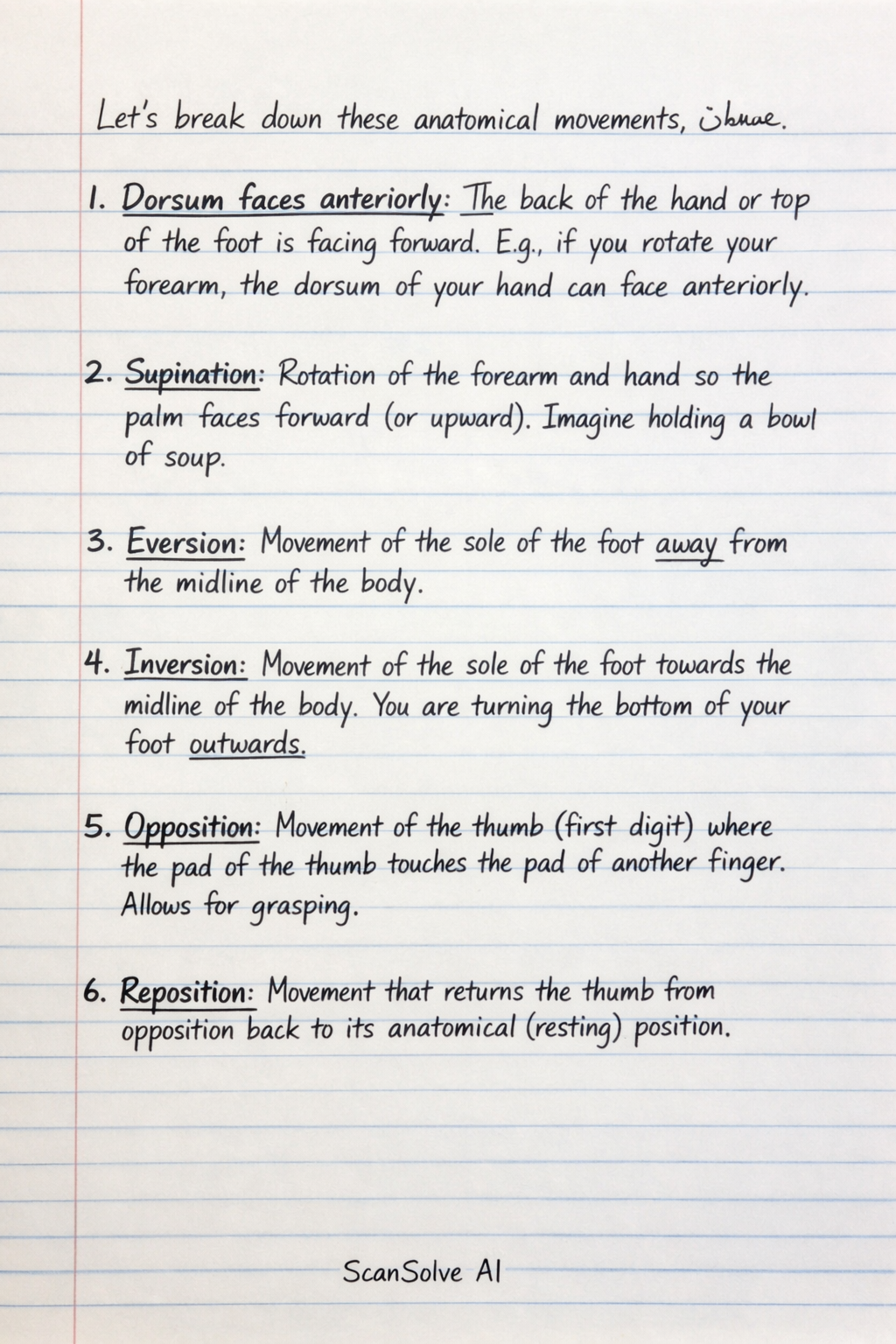
Let's break down these anatomical movements, عبمان.
-
Dorsum faces anteriorly: This describes the position of the back of the hand or top of the foot when it is facing forward. For example, in the anatomical position, the palms face anteriorly, but if you rotate your forearm, the dorsum of your hand can face anteriorly.
-
Supination: This is the rotation of the forearm and hand so that the palm faces forward (anteriorly) or upward. Imagine holding a bowl of soup.
-
Eversion: This is the movement of the sole of the foot away from the midline of the body. You are turning the bottom of your foot outwards.
-
Inversion: This is the movement of the sole of the foot towards the midline of the body. You are turning the bottom of your foot inwards.
-
Opposition: This is the unique movement of the thumb (first digit) where its pad touches the pad of another finger. This allows for grasping.
-
Reposition: This is the movement that returns the thumb from the position of opposition back to its anatomical (resting) position.
-
Protrusion: This is a movement forward or anteriorly. For example, sticking your jaw out.
-
Retrusion: This is a movement backward or posteriorly. For example, pulling your jaw back in.
-
Elevation: This is a movement that raises or moves a part superiorly (upwards). For example, shrugging your shoulders.
-
Depression: This is a movement that lowers or moves a part inferiorly (downwards). For example, dropping your shoulders after a shrug.
Still stuck on this one?
Ask a follow-up, and the answer starts from this question.
More Biology Questions
Handwritten Step-by-Step Solution
Get this as a handwritten image on WhatsApp — like a tutor wrote it for you.
Try on WhatsApp