
We read your photo as:
Observe the numbers in each cell:
ScanSolve AI Answer
Answer
Step-by-step solution
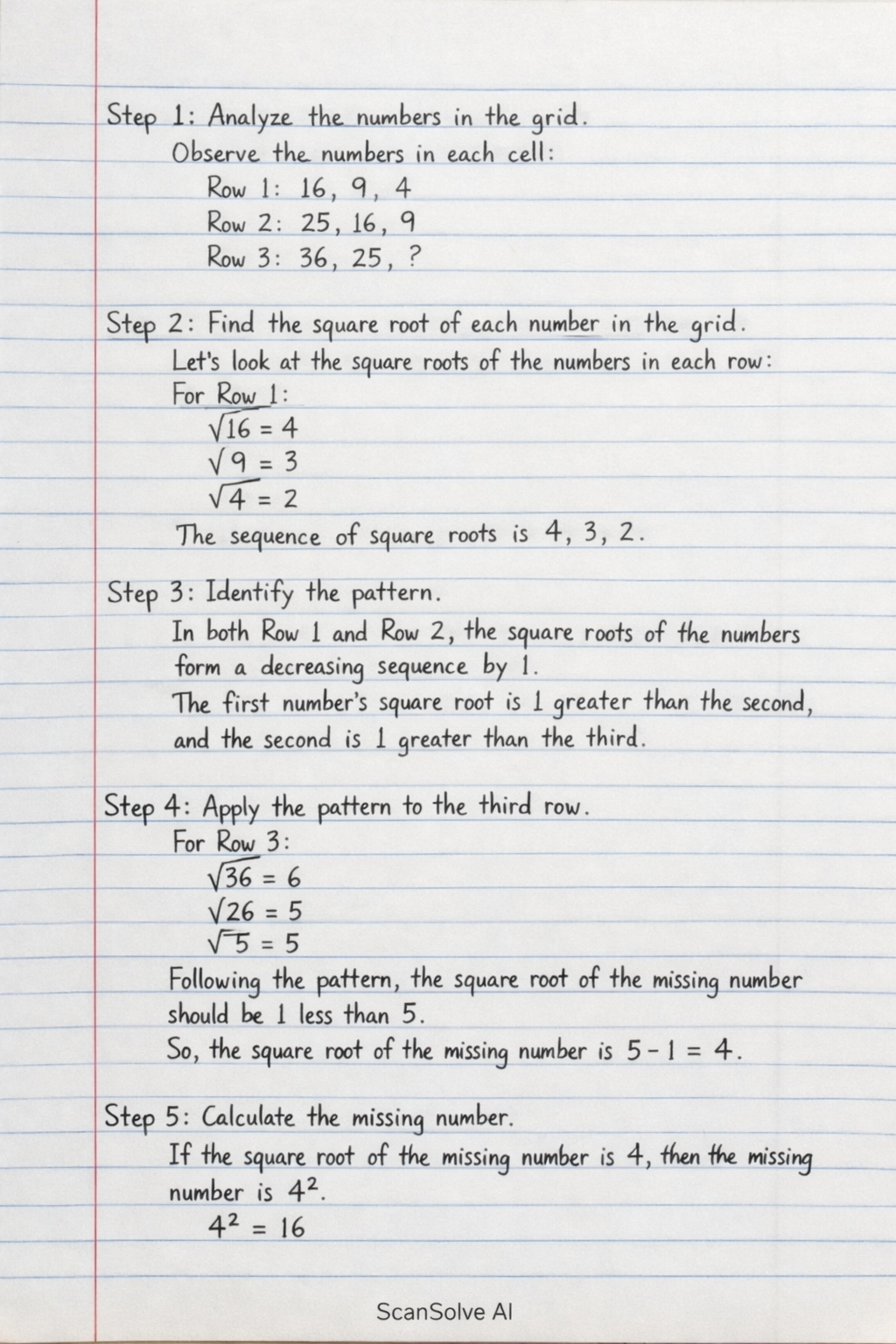
6 stepsAnalyze the numbers in the grid.
Observe the numbers in each cell:
Row 1: 16, 9, 4
Row 2: 25, 16, 9
Row 3: 36, 25, ?Find the square root of each number in the grid.
Let's look at the square roots of the numbers in each row:
For Row 1:
The sequence of square roots is .For Row 2:
The sequence of square roots is .Identify the pattern.
In both Row 1 and Row 2, the square roots of the numbers form a decreasing sequence by 1.
The first number's square root is 1 greater than the second, and the second is 1 greater than the third.Apply the pattern to the third row.
For Row 3:
Following the pattern, the square root of the missing number should be 1 less than 5.
So, the square root of the missing number is .Calculate the missing number.
If the square root of the missing number is 4, then the missing number is .
Compare with the given options.
The calculated missing number is 16.
The options are:
a. 49
b. 25
c. 9
d. 16The correct option is d.
The final answer is
Try one yourself
A new problem that tests the same skill.
Still stuck on this one?
Ask a follow-up, and the answer starts from this question.
More Biology Questions
Handwritten Step-by-Step Solution
Get this as a handwritten image on WhatsApp — like a tutor wrote it for you.
Try on WhatsApp