
We read your photo as:
Which of the following are plant divisions or related botanical terms? Identify the correct options and explain why the incorrect ones are wrong.
ScanSolve AI Answer
-
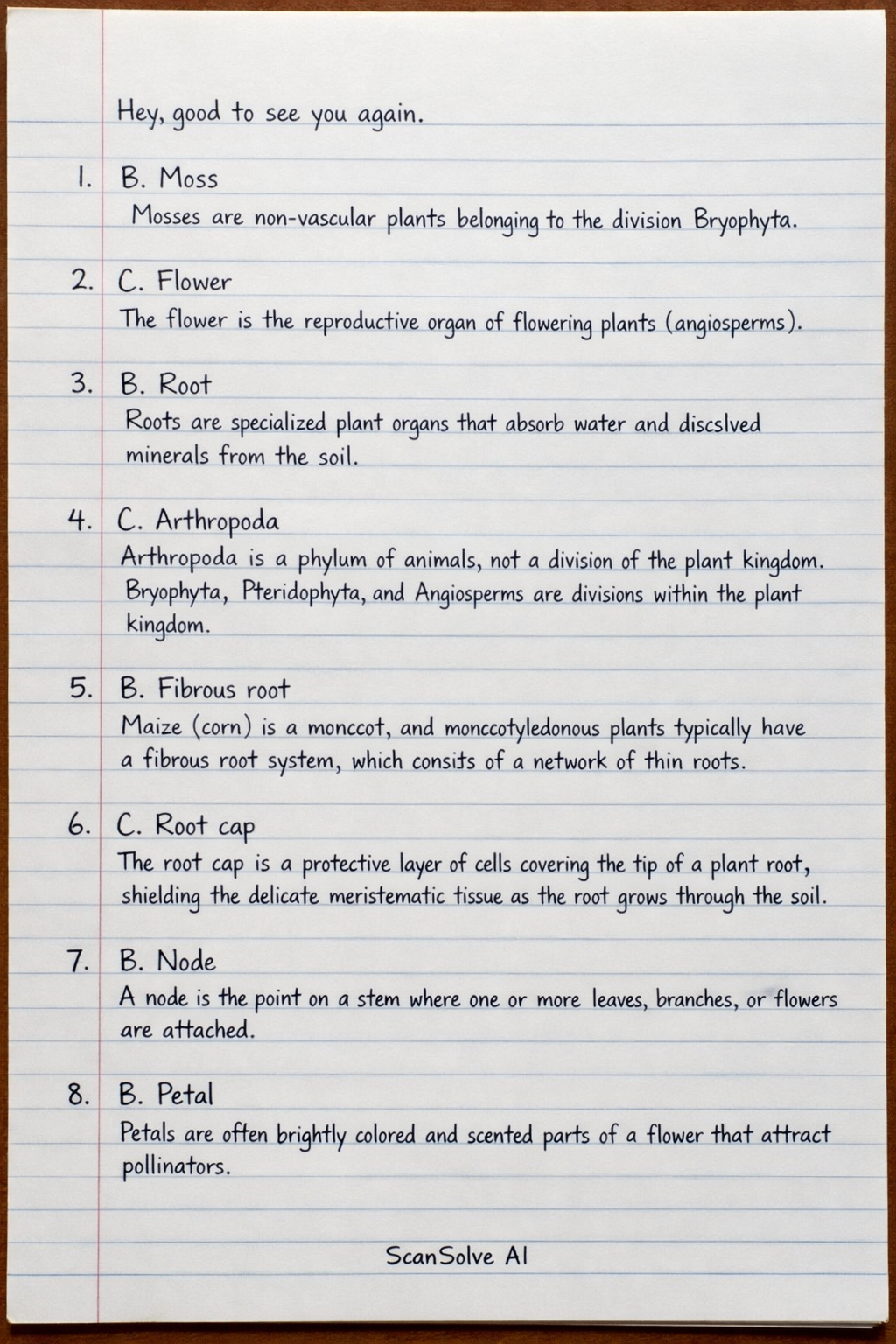
B. Moss Mosses are non-vascular plants belonging to the division Bryophyta.
-
C. Flower The flower is the reproductive organ of flowering plants (angiosperms).
-
B. Root Roots are specialized plant organs that absorb water and dissolved minerals from the soil.
-
C. Arthropoda Arthropoda is a phylum of animals, not a division of the plant kingdom. Bryophyta, Pteridophyta, and Angiosperms are divisions within the plant kingdom.
-
B. Fibrous root Maize (corn) is a monocot, and monocotyledonous plants typically have a fibrous root system, which consists of a network of thin roots.
-
C. Root cap The root cap is a protective layer of cells covering the tip of a plant root, shielding the delicate meristematic tissue as the root grows through the soil.
-
B. Node A node is the point on a stem where one or more leaves, branches, or flowers are attached.
-
B. Petal Petals are often brightly colored and scented parts of a flower that attract pollinators.
-
B. Fruit After successful fertilization, the ovary of a flower develops into a fruit, which encloses the seeds.
-
C. Crab Crabs are invertebrates belonging to the phylum Arthropoda, characterized by an exoskeleton, segmented body, and jointed appendages.
-
D. Plasmodium berghei Plasmodium berghei is a species of Plasmodium that primarily infects rodents and is used as a model organism for malaria research, but it does not typically infect humans. P. falciparum, P. vivax, and P. malariae are human malaria parasites.
-
A. Plasmodium The female Anopheles mosquito is the primary vector for the Plasmodium parasite, which causes malaria in humans.
-
A. Onchocerca volvulus Onchocerca volvulus, the parasitic worm responsible for onchocerciasis (river blindness), is transmitted to humans through the bites of infected blackflies (genus Simulium).
-
B. Ichthyology Ichthyology is the branch of zoology dedicated to the study of fish, including their biology, classification, and ecology.
-
B. Earthworm (Lumbricus) Earthworms are annelids and are true coelomates (eucoelomates), meaning they possess a body cavity (coelom) that is completely lined by mesodermal tissue. Flatworms are acoelomates, roundworms are pseudocoelomates, and Hydra lacks a coelom.
-
C. Shark Sharks are cartilaginous fish (Chondrichthyes) and typically have a heterocercal tail, which means the upper lobe of the caudal fin is longer than the lower lobe, resulting in an asymmetrical appearance. Salmon, Tilapia, and Catfish are bony fish (Osteichthyes) and generally have homocercal (symmetrical) tails.
-
The options for question 17 are not visible in the provided image, so I cannot answer this question.
Still stuck on this one?
Ask a follow-up, and the answer starts from this question.
More Biology Questions
Handwritten Step-by-Step Solution
Get this as a handwritten image on WhatsApp — like a tutor wrote it for you.
Try on WhatsApp