
We read your photo as:
Which of the following conditions is not classified under superficial mycoses?
ScanSolve AI Answer
Here are the answers to your questions:
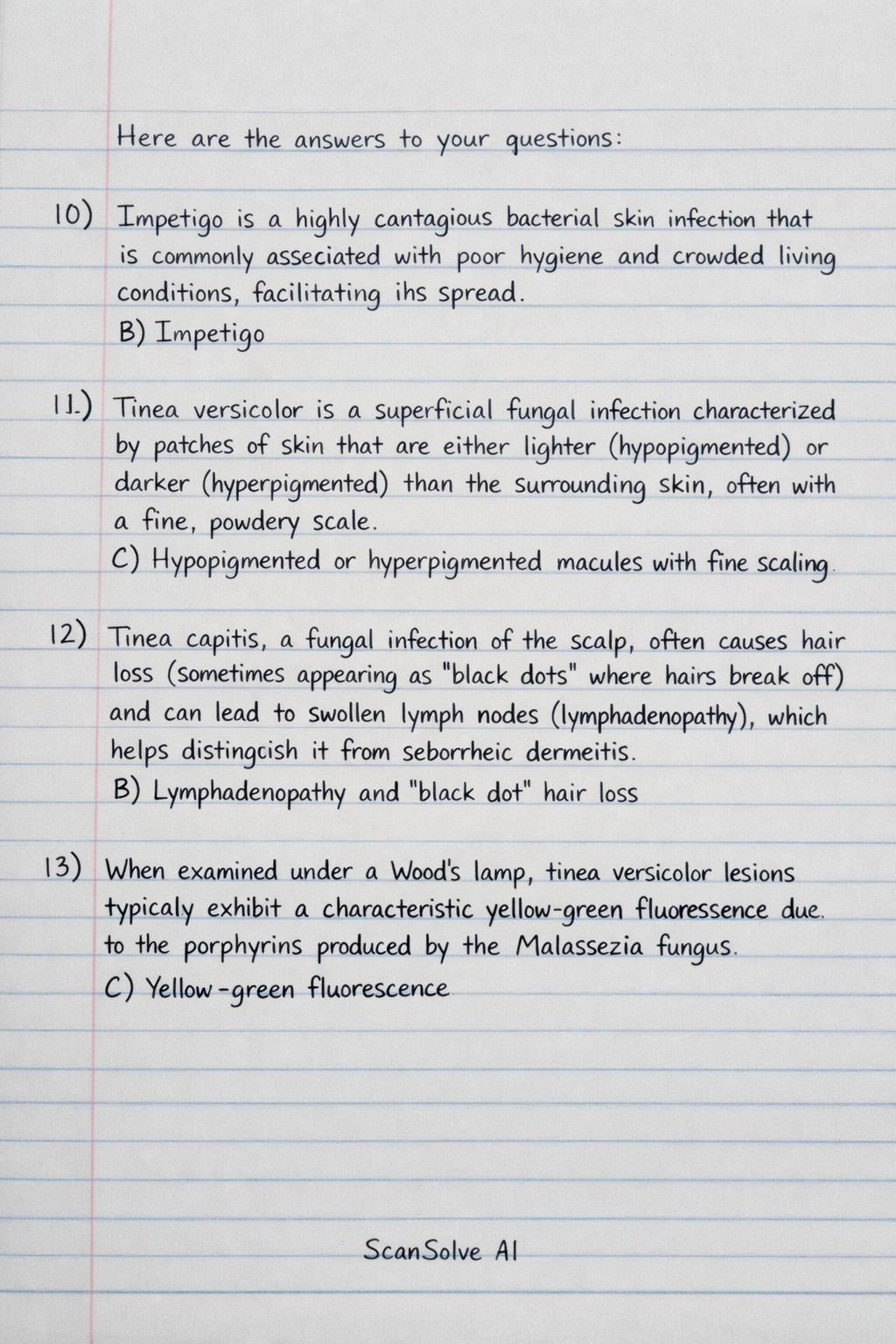
10) Impetigo is a highly contagious bacterial skin infection that is commonly associated with poor hygiene and crowded living conditions, facilitating its spread.
- B) Impetigo
11) Tinea versicolor is a superficial fungal infection characterized by patches of skin that are either lighter (hypopigmented) or darker (hyperpigmented) than the surrounding skin, often with a fine, powdery scale.
- C) Hypopigmented or hyperpigmented macules with fine scaling
12) Tinea capitis, a fungal infection of the scalp, often causes hair loss (sometimes appearing as "black dots" where hairs break off) and can lead to swollen lymph nodes (lymphadenopathy), which helps distinguish it from seborrheic dermatitis.
- B) Lymphadenopathy and "black dot" hair loss
13) When examined under a Wood's lamp, tinea versicolor lesions typically exhibit a characteristic yellow-green fluorescence due to the porphyrins produced by the Malassezia fungus.
- C) Yellow-green fluorescence
14) For extensive tinea unguium (onychomycosis), topical treatments are often insufficient. Oral antifungal medications, such as oral terbinafine, are generally required for effective treatment.
- C) Oral terbinafine
15) The most appropriate diagnostic test for confirming superficial dermatophytosis (fungal skin infections) is a potassium hydroxide (KOH) preparation of skin scrapings, which allows visualization of fungal hyphae under a microscope.
- B) KOH preparation with microscopy
16) A pruritic (itchy), annular (ring-shaped), scaly plaque with central clearing is the classic presentation of tinea corporis, commonly known as ringworm.
- B) Tinea corporis
17) Sporotrichosis is a subcutaneous mycosis, meaning it affects deeper layers of the skin and subcutaneous tissue, often following trauma. It is not classified as a superficial mycosis, unlike tinea pedis, onychomycosis, and tinea versicolor.
- C) Sporotrichosis
18) The presentation of greasy scaling over the scalp, eyebrows, and nasolabial folds is characteristic of seborrheic dermatitis, which is associated with the overgrowth of Malassezia furfur (now often referred to as Malassezia species).
- B) Malassezia furfur
Still stuck on this one?
Ask a follow-up, and the answer starts from this question.
More Biology Questions
Handwritten Step-by-Step Solution
Get this as a handwritten image on WhatsApp — like a tutor wrote it for you.
Try on WhatsApp