
We read your photo as:
Which of the following is an example of an acquired trait?
ScanSolve AI Answer
-
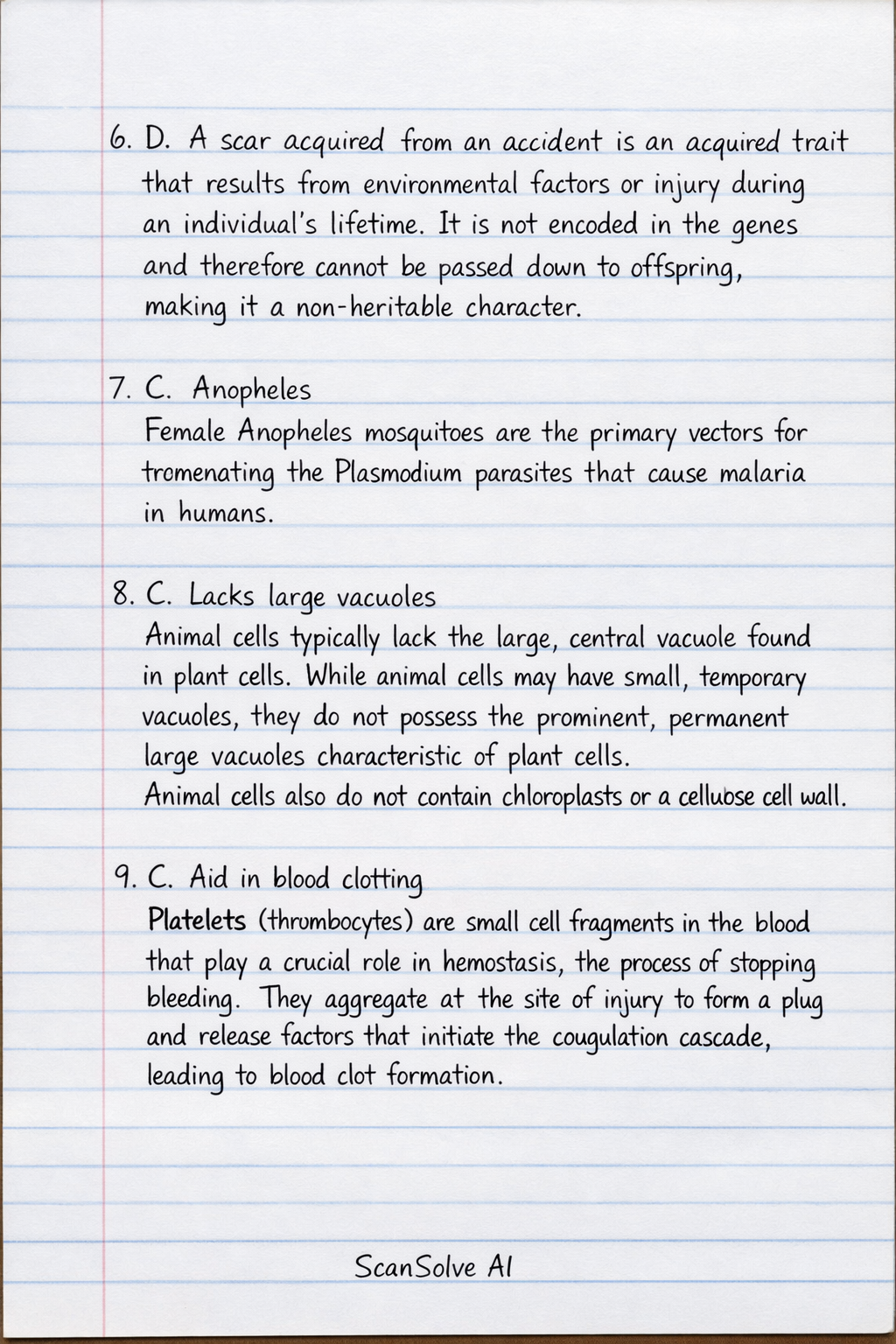
D. A scar acquired by an individual from an accident A scar acquired from an accident is an acquired trait that results from environmental factors or injury during an individual's lifetime. It is not encoded in the genes and therefore cannot be passed down to offspring, making it a non-heritable character.
-
C. Anopheles Female Anopheles mosquitoes are the primary vectors for transmitting the Plasmodium parasites that cause malaria in humans.
-
C. Lacks large vacuoles Animal cells typically lack the large, central vacuole found in plant cells. While animal cells may have small, temporary vacuoles, they do not possess the prominent, permanent large vacuoles characteristic of plant cells. Animal cells also do not contain chloroplasts or a cellulose cell wall.
-
C. Aid in blood clotting Platelets (thrombocytes) are small cell fragments in the blood that play a crucial role in hemostasis, the process of stopping bleeding. They aggregate at the site of injury to form a plug and release factors that initiate the coagulation cascade, leading to blood clot formation.
-
A. High water holding capacity leading to waterlogging Clay soil has very fine particles and small pore spaces, which gives it a high water-holding capacity. In areas with high rainfall, this can lead to waterlogging, where the soil becomes saturated with water, depriving plant roots of oxygen and hindering their growth.
Still stuck on this one?
Ask a follow-up, and the answer starts from this question.
More Biology Questions
Handwritten Step-by-Step Solution
Get this as a handwritten image on WhatsApp — like a tutor wrote it for you.
Try on WhatsApp