
We read your photo as:
Which of the following is most likely to encourage variation in a population? A. Inbreeding B. Outcrossing C. Random Mating D. Clines
ScanSolve AI Answer
Answer
outcrossing
Here are the solutions to the questions:
16. Which of the following is most likely to encourage variation in a population?
- Outcrossing involves mating between individuals from different populations or unrelated individuals within a population. This introduces new genetic combinations and alleles, thereby increasing genetic variation. Inbreeding, conversely, reduces variation. Random mating maintains existing variation but doesn't necessarily encourage new variation as much as outcrossing. Clines are patterns of variation, not a mechanism that encourages it.
The correct option is B. outcrossing
17. Which of the following statements is true regarding the "law of segregation"?
- A. Law of segregation is the law of purity of genes: This is an alternative name for the law of segregation, as alleles remain distinct and do not blend.
- B. Alleles separate from each other during gametogenesis: This is the fundamental principle of the law of segregation, stating that each gamete receives only one allele for each gene.
- C. Segregation of factors is due to the segregation of chromosomes during meiosis: This explains the cellular mechanism behind the law of segregation, as homologous chromosomes (carrying the alleles) separate during meiosis.
- Since all three statements are true descriptions or explanations of the law of segregation, "All of the above" is the correct choice.
The correct option is D. All of the above
18. Homozygosity and heterozygosity of an individual can be determined by
- A. Back cross: A cross between an F1 individual and one of its parental genotypes. If the parent is homozygous recessive, it becomes a test cross.
- B. Self-fertilization: If an individual is heterozygous (e.g., Aa), self-fertilization will produce offspring with different genotypes (AA, Aa, aa), revealing its heterozygous nature. If it's homozygous (AA or aa), self-fertilization will only produce offspring of that same homozygous genotype.
- C. Test cross: A cross between an individual of unknown genotype (but expressing a dominant phenotype) and a homozygous recessive individual. The phenotypes of the offspring reveal whether the unknown parent was homozygous dominant or heterozygous.
- All three methods can be used to determine the homozygosity or heterozygosity of an individual under appropriate circumstances.
The correct option is D. All of the above
19. Which of the following factors is most likely to contribute to gene flow between populations?
- Migration refers to the movement of individuals (and thus their genes) from one population to another. This direct movement of genetic material is the primary mechanism for gene flow, which is the transfer of alleles or genes from one population to another. Random mating, mutation, and genetic drift primarily affect allele frequencies within a population or create new alleles, but do not directly facilitate gene exchange between populations.
The correct option is B. migration
20. In the Hardy-Weinberg equation, the term represents the frequency of the
The Hardy-Weinberg equation is given by , where:
- represents the frequency of the homozygous dominant genotype.
- represents the frequency of the homozygous recessive genotype.
- represents the frequency of the heterozygous genotype.
The correct option is E. heterozygotes
21. An exception to Mendel's law is
- Linkage is an exception to Mendel's Law of Independent Assortment. This law states that alleles for different genes assort independently of one another during gamete formation. However, if genes are located close together on the same chromosome (i.e., they are linked), they tend to be inherited together, violating independent assortment. Independent assortment, dominance, and purity of gametes (another name for segregation) are all concepts consistent with or part of Mendel's laws.
The correct option is B. Linkage
22. Pea plants were used in Mendel's experiments because
- Mendel chose pea plants for his experiments primarily because they exhibited several distinct, easily observable traits (contrasting characters) such as tall/short, yellow/green seeds, smooth/wrinkled seeds, etc. This allowed him to clearly track the inheritance patterns of these traits across generations. While other factors like being easy to grow or having a short generation time were also advantageous, the presence of contrasting characters was crucial for his observations and the formulation of his laws.
The correct option is B. They had contrasting characters
Try one yourself
A new problem that tests the same skill.
Still stuck on this one?
Ask a follow-up, and the answer starts from this question.
More Biology Questions
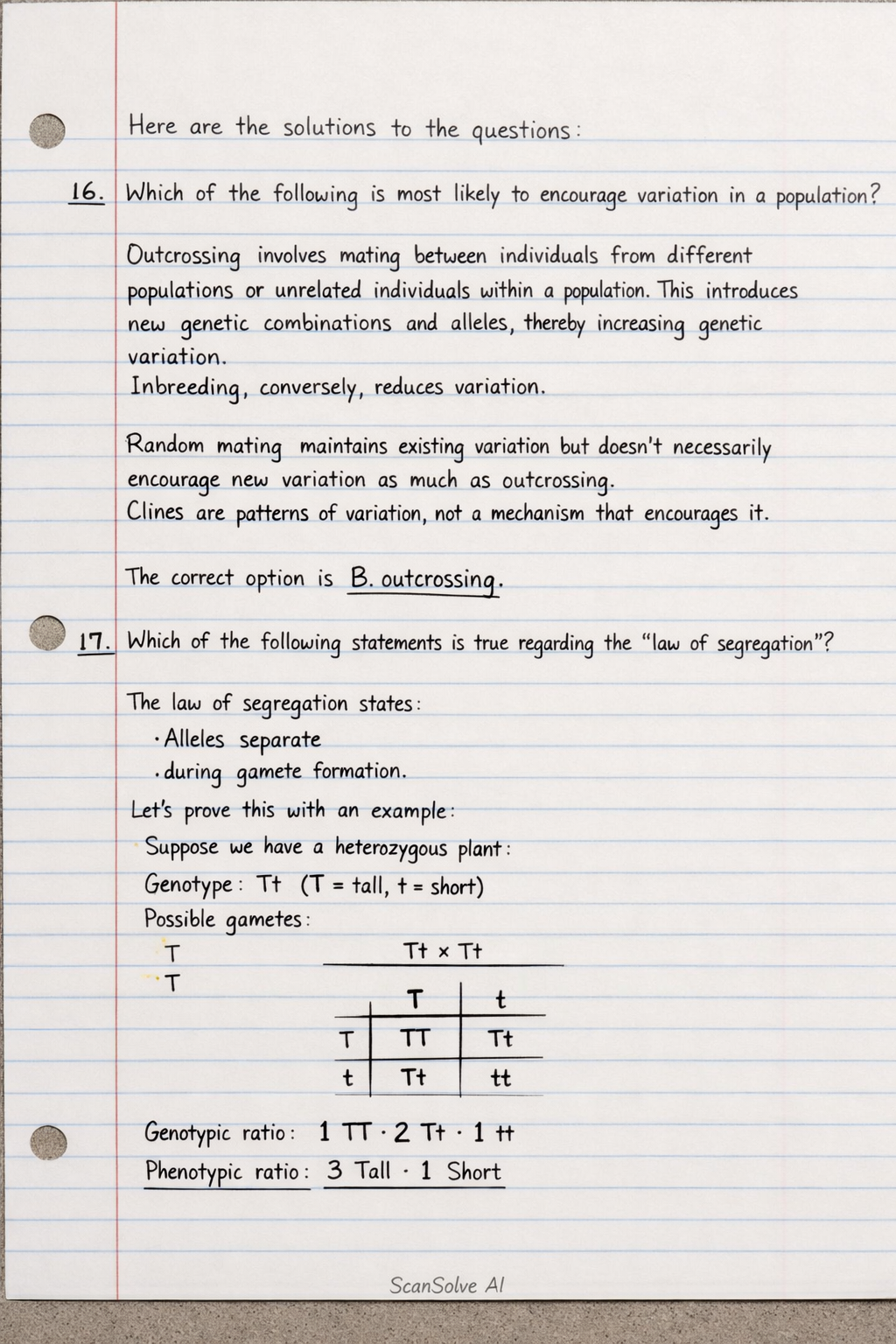
Handwritten Step-by-Step Solution
Get this as a handwritten image on WhatsApp — like a tutor wrote it for you.
Try on WhatsApp