
We read your photo as:
Which of the following is NOT an adaptation for endotherms to survive in a cold environment? 27) Which of the following is an adaptation for endotherms to survive in a hot environment?
Biology
ScanSolve AI Answer
Answer
D
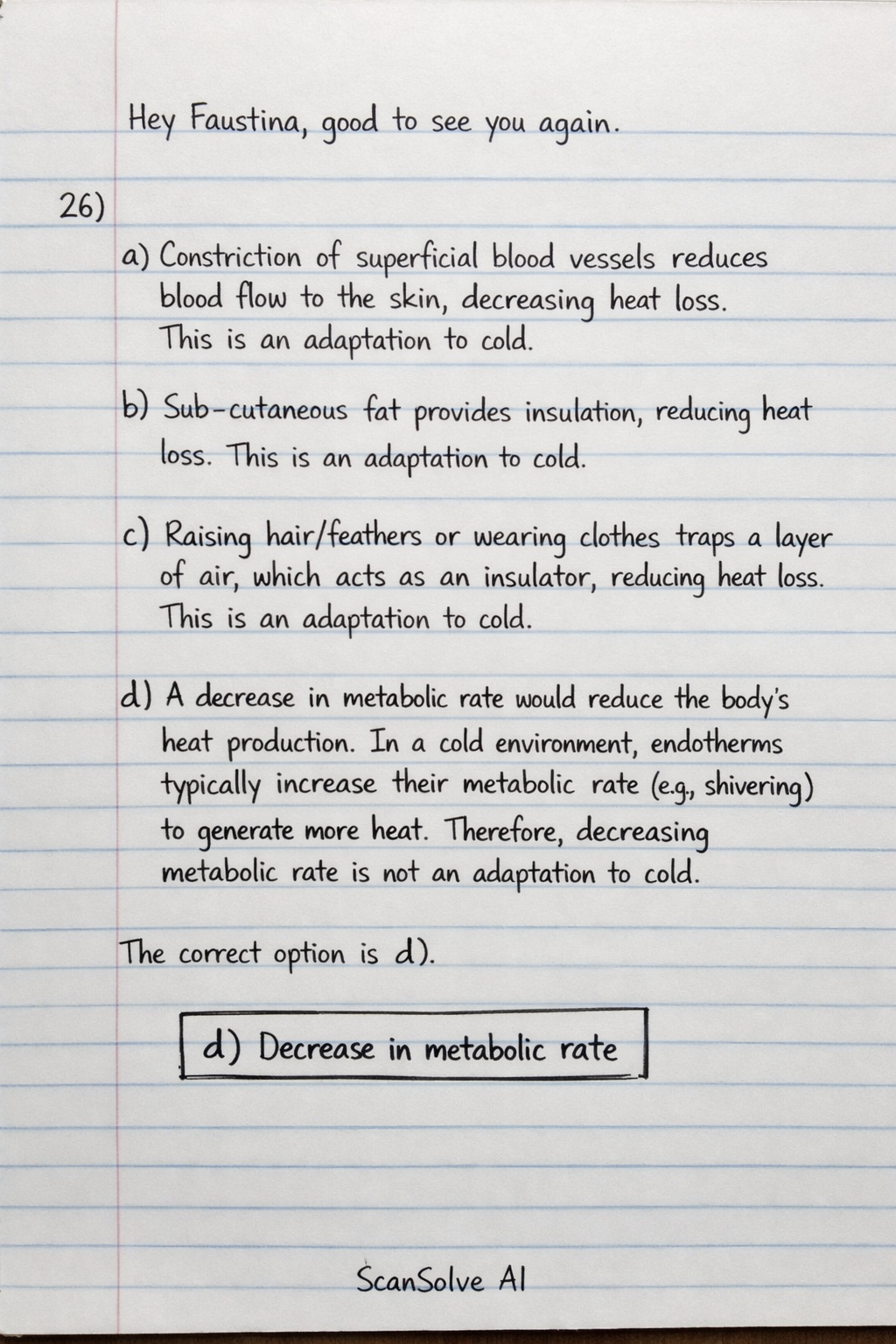
- To adapt to a cold environment, endothermic animals and humans aim to conserve heat or generate more heat.
- a) Constriction of superficial blood vessels reduces blood flow to the skin, decreasing heat loss. This is an adaptation to cold.
- b) Sub-cutaneous fat provides insulation, reducing heat loss. This is an adaptation to cold.
- c) Raising hair/feathers or wearing clothes traps a layer of air, which acts as an insulator, reducing heat loss. This is an adaptation to cold.
- d) A decrease in metabolic rate would reduce the body's heat production. In a cold environment, endotherms typically increase their metabolic rate (e.g., shivering) to generate more heat. Therefore, decreasing metabolic rate is not an adaptation to cold.
The correct option is d).
- To adapt to a hot environment, endothermic animals aim to lose heat or reduce heat production.
- a) Constriction of superficial blood vessels reduces heat loss. In a hot environment, the body needs to increase heat loss, so blood vessels would dilate (widen) to bring more blood to the surface. Constriction is an adaptation to cold, not hot.
- b) Little sub-cutaneous fat means less insulation, allowing heat to escape more easily. This is an adaptation to heat.
- c) A fall of metabolic rate reduces internal heat production. This is an adaptation to heat.
- d) Sweating or panting uses evaporative cooling to remove heat from the body. This is an adaptation to heat.
The correct option is a).
- Steps to reduce fatigue and stress aim to ease workload, provide recovery, or improve conditions.
- a) Reducing energetic workload by mechanization lessens physical effort, thereby reducing fatigue.
- b) Providing cold drinking water and adequate hydration prevents dehydration, which contributes to fatigue and stress.
- c) Engaging workers in continuous working devoid of rest periods would increase fatigue and stress, not reduce it.
- d) Providing air conditioning in rest areas improves comfort and allows for better recovery, reducing fatigue.
The correct option is c).
- Noise is classified by its frequency.
- a) Electromagnetic noise refers to interference from electromagnetic waves, which are not sound waves. Sound waves are mechanical waves.
- b) Infrasonic noise refers to sound frequencies below the human hearing range (typically below 20 Hz).
- c) Audible noise refers to sound frequencies within the human hearing range (typically 20 Hz to 20,000 Hz).
- d) Ultrasonic noise refers to sound frequencies above the human hearing range (typically above 20,000 Hz).
The correct option is a).
- Noise in mines is generated by various operational activities.
- a) Blasting involves explosives, which generate very high levels of noise.
- b) Processing machines (e.g., crushers, conveyors) used to process extracted materials generate significant noise.
- c) A foundry machine is used in a foundry, which is a factory for casting metal. While foundries are noisy, they are typically separate industrial facilities, not processes that generate noise in the mines themselves during extraction.
- d) Vehicular movement (e.g., trucks, loaders) within the mine generates noise.
The correct option is c).
Was this helpful?
Try one yourself
A new problem that tests the same skill.
Still stuck on this one?
Ask a follow-up, and the answer starts from this question.
Got a different question?Ask your own question
More Biology Questions
QAnimals that cannot regulate their body temperature internally and rely on environmental heat…QHow does human skin regulate body temperature on a cold day?QWhich of the following is the adaptation of white blood cells body protection?QDiagram below shows two types of animals. What will these two types of animals do in cold weather?QWhat are the functions and adaptations of epidermal cells, stomatal pores, guard cells, xylem…
Handwritten Step-by-Step Solution
Get this as a handwritten image on WhatsApp — like a tutor wrote it for you.
Try on WhatsApp