
We read your photo as:
Which of these is assessed to determine the course of prostate cancer?
ScanSolve AI Answer
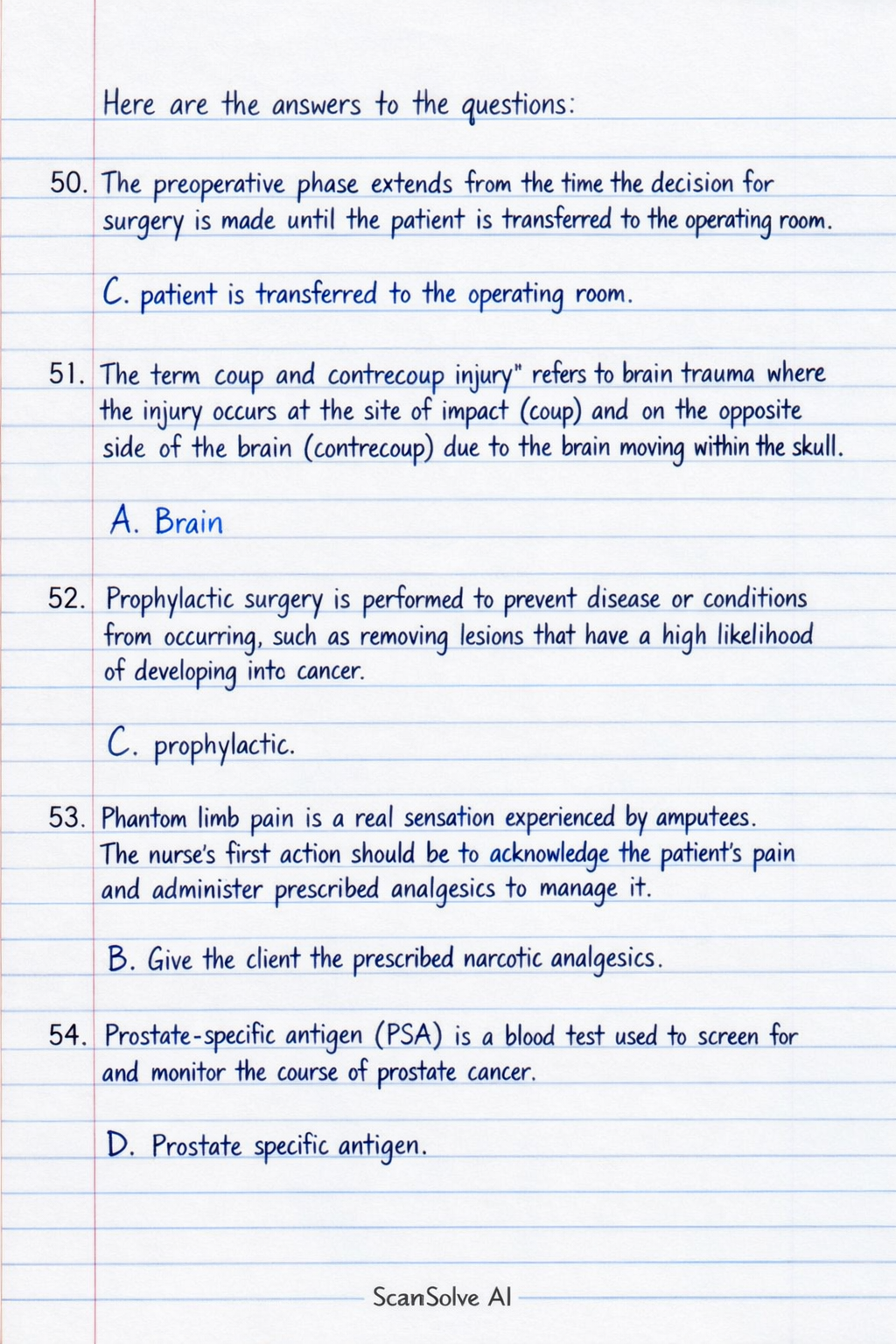
Here are the answers to the questions:
50. The preoperative phase extends from the time the decision for surgery is made until the patient is transferred to the operating room.
- C. patient is transferred to the operating room.
51. The term coup and contrecoup injury refers to brain trauma where the injury occurs at the site of impact (coup) and on the opposite side of the brain (contrecoup) due to the brain moving within the skull.
- A. Brain
52. Prophylactic surgery is performed to prevent disease or conditions from occurring, such as removing lesions that have a high likelihood of developing into cancer.
- C. prophylactic
53. Phantom limb pain is a real sensation experienced by amputees. The nurse's first action should be to acknowledge the patient's pain and administer prescribed analgesics to manage it.
- B. Give the client the prescribed narcotic analgesics
54. Prostate-specific antigen (PSA) is a blood test used to screen for and monitor the course of prostate cancer.
- D. Prostate specific antigen.
55. An advantage of immediate prosthesis fitting following an amputation is that it can facilitate earlier weight-bearing and ambulation, promoting quicker rehabilitation.
- A. ability to ambulate sooner
56. A patient with a fracture of the pelvis is at high risk for significant internal bleeding due to the rich vascular supply in the area. A sudden decrease in blood pressure (hypotension) is a critical sign of hypovolemic shock, indicating severe blood loss, and requires immediate intervention.
- D. sudden decrease in blood pressure
Still stuck on this one?
Ask a follow-up, and the answer starts from this question.
More Biology Questions
Handwritten Step-by-Step Solution
Get this as a handwritten image on WhatsApp — like a tutor wrote it for you.
Try on WhatsApp