
We read your photo as:
p = frequency of the dominant allele (A, normal pigmentation)
ScanSolve AI Answer
Answer
Step-by-step solution
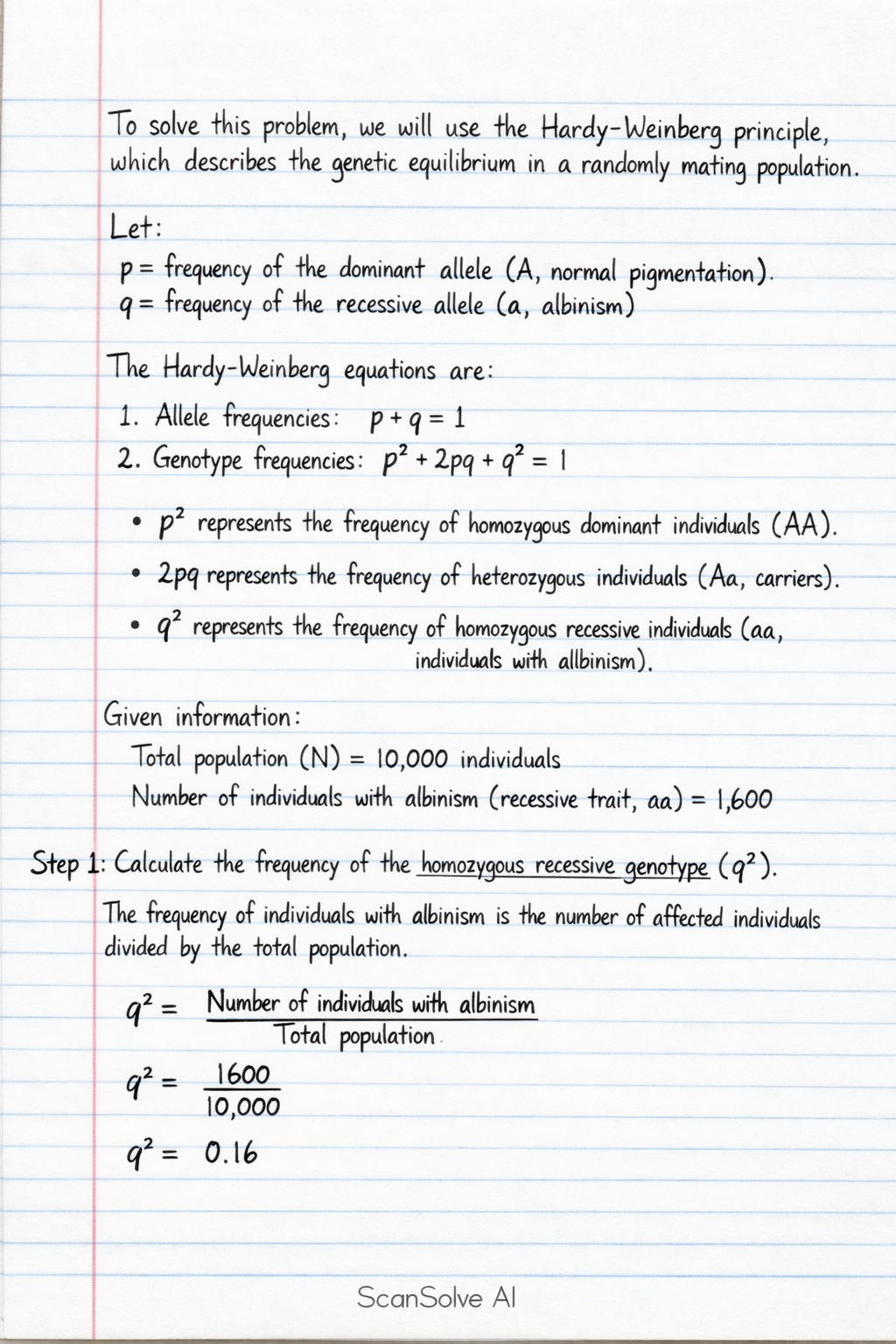
5 stepsTo solve this problem, we will use the Hardy-Weinberg principle, which describes the genetic equilibrium in a randomly mating population.
Let:
= frequency of the dominant allele (A, normal pigmentation)
= frequency of the recessive allele (a, albinism)
The Hardy-Weinberg equations are:
- Allele frequencies:
- Genotype frequencies:
- represents the frequency of homozygous dominant individuals (AA).
- represents the frequency of heterozygous individuals (Aa, carriers).
- represents the frequency of homozygous recessive individuals (aa, individuals with albinism).
Given information:
Total population (N) = 10,000 individuals
Number of individuals with albinism (recessive trait, aa) = 1,600
Calculate the frequency of the homozygous recessive genotype ().
The frequency of individuals with albinism is the number of affected individuals divided by the total population.
Calculate the frequency of the recessive allele ().
Take the square root of .
Calculate the frequency of the dominant allele ().
Using the allele frequency equation :
Calculate the frequency of carriers ($2pq$).
Carriers are heterozygous individuals (Aa).
Calculate the number of carriers in the population.
Multiply the frequency of carriers by the total population.
The number of individuals in this population who are "CARRIERS" of the albino allele is 4,800.
Comparing this to the given options:
A) 8,400
B) 4,800
C) 3,600
D) 480The correct option is B.
The final answer is .
Try one yourself
A new problem that tests the same skill.
Still stuck on this one?
Ask a follow-up, and the answer starts from this question.
More Biology Questions
Handwritten Step-by-Step Solution
Get this as a handwritten image on WhatsApp — like a tutor wrote it for you.
Try on WhatsApp