
We read your photo as:
P2 AL biology set B
ScanSolve AI Answer
This answer stops before the end.
It was cut off when it was first written. Ask ScanSolve this question again for the full working.
Step-by-step solution
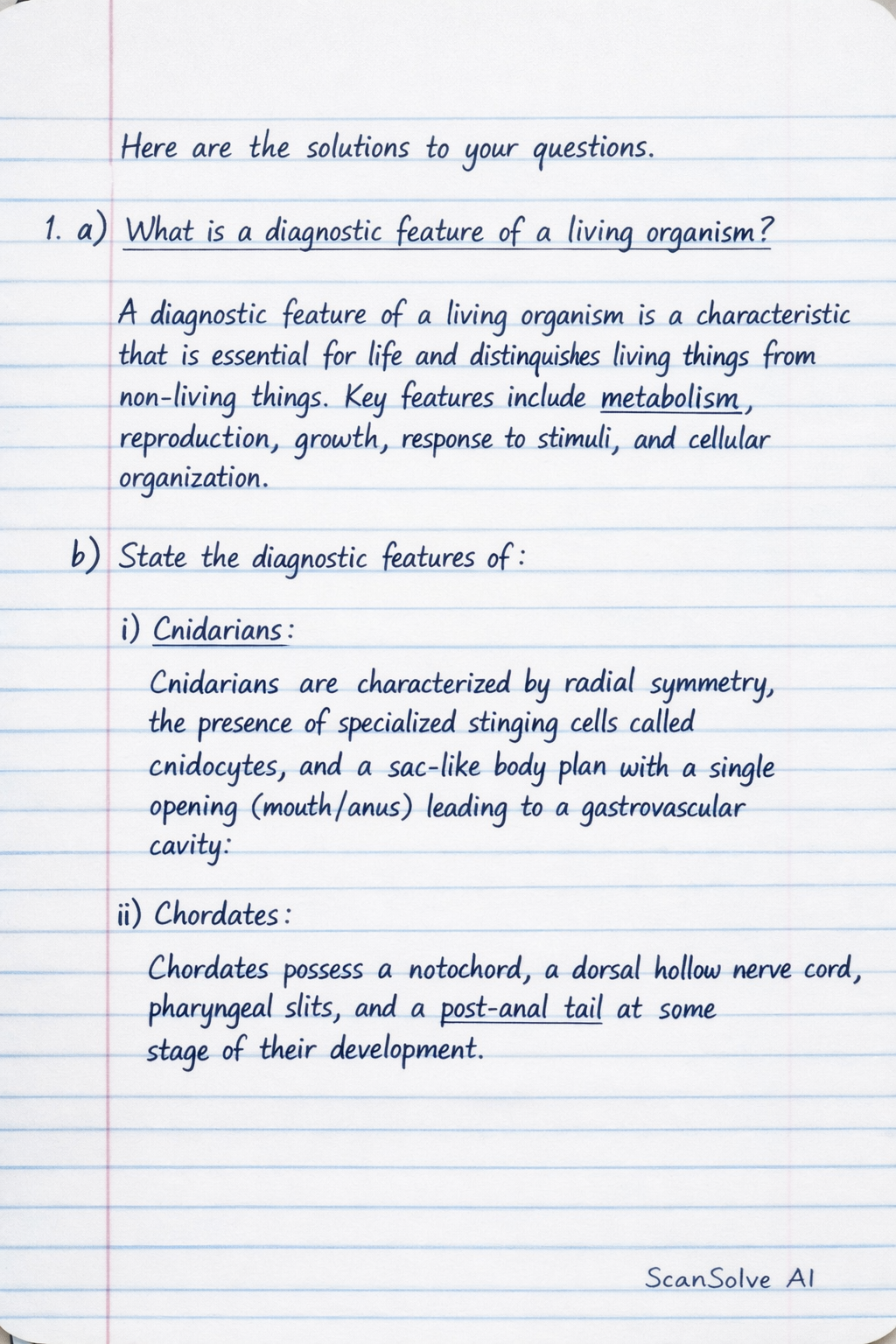
4 stepsHere are the solutions to your questions.
1. a) What is a diagnostic feature of a living organism?
A diagnostic feature of a living organism is a characteristic that is essential for life and distinguishes living things from non-living things. Key features include metabolism, reproduction, growth, response to stimuli, and cellular organization.
b) State the diagnostic features of:
- i) Cnidarians: Cnidarians are characterized by radial symmetry, the presence of specialized stinging cells called cnidocytes, and a sac-like body plan with a single opening (mouth/anus) leading to a gastrovascular cavity.
- ii) Chordates: Chordates possess a notochord, a dorsal hollow nerve cord, pharyngeal slits, and a post-anal tail at some stage of their development.
c) State reasons why living organisms are classified.
Living organisms are classified to organize and understand the vast diversity of life, to identify evolutionary relationships between different species, to facilitate communication among scientists, and to predict characteristics of newly discovered organisms.
d) Write short notes on nomenclature.
Nomenclature is the system of naming organisms. The most widely used system is binomial nomenclature, where each species is given a unique two-part scientific name. This name consists of the genus (capitalized) and the species (lowercase), both typically written in italics (e.g., Homo sapiens). This system provides a universal and unambiguous way to refer to organisms.
2. a) What is meant by:
- i) Homeostasis: Homeostasis is the ability of an organism to maintain a stable internal environment despite changes in external conditions. This involves regulating factors like temperature, pH, and blood glucose levels.
- ii) Osmoregulation: Osmoregulation is the active regulation of the osmotic pressure of an organism's fluids to maintain the homeostasis of the organism's water content. This involves controlling the balance of water and solutes.
b) Describe how the following organisms carry out osmoregulation:
- i) In insect: Insects primarily osmoregulate using Malpighian tubules which absorb solutes and water from the hemolymph. These substances then pass into the hindgut where most of the water and useful solutes are reabsorbed, and nitrogenous waste (uric acid) is excreted as a dry pellet.
- ii) Marine water fish: Marine fish live in a hypertonic environment, meaning water tends to leave their bodies. They drink large amounts of seawater to compensate for water loss, and actively excrete excess salts through specialized chloride cells in their gills. Their kidneys produce a small volume of concentrated urine.
c) Describe how the body regulate the calcium and phosphate level.
Calcium and phosphate levels are regulated primarily by parathyroid hormone (PTH), calcitonin, and vitamin D. When blood calcium levels are low, the parathyroid glands release PTH, which increases calcium reabsorption in the kidneys, stimulates calcium release from bones, and activates vitamin D. Activated vitamin D increases calcium absorption from the gut. When blood calcium levels are high, the thyroid gland releases calcitonin, which inhibits calcium release from bones and increases calcium excretion by the kidneys. Phosphate levels are largely regulated in parallel with calcium, with PTH promoting phosphate excretion by the kidneys.
3. a) Distinguish between autotrophic and heterotrophic nutrition.
- Autotrophic nutrition is a mode of nutrition where organisms produce their own food from inorganic sources, typically using light energy (photosynthesis) or chemical energy (chemosynthesis). Examples include plants and algae.
- Heterotrophic nutrition is a mode of nutrition where organisms obtain their food by consuming other organisms or organic matter. Examples include animals, fungi, and most bacteria.
b) What role does the liver and pancreas play in:
- i) Food digestion:
- Liver: Produces bile, which is stored in the gallbladder and released into the small intestine to emulsify fats, breaking them into smaller droplets for easier digestion by lipases.
- Pancreas: Produces a variety of digestive enzymes (e.g., amylase for carbohydrates, lipase for fats, proteases for proteins) and bicarbonate ions. The bicarbonate neutralizes the acidic chyme from the stomach, providing an optimal pH for pancreatic enzymes in the small intestine.
- ii) Metabolism of absorbed products:
- Liver: The liver is a central metabolic organ. It processes absorbed nutrients from the small intestine (via the hepatic portal vein), converting glucose to glycogen for storage, synthesizing plasma proteins, and detoxifying harmful substances. It also plays a role in fat metabolism.
- Pancreas: The pancreas produces hormones, primarily insulin and glucagon, which regulate blood glucose levels. Insulin promotes the uptake and storage of glucose by cells, while glucagon stimulates the release of glucose from stored glycogen in the liver.
c) State the fate of the end products of liquid digestion.
Assuming "liquid digestion" refers to the digestion of fats, the end products are fatty acids and glycerol. These are absorbed into the epithelial cells of the small intestine, where they are re-esterified into triglycerides and packaged into chylomicrons. Chylomicrons are then absorbed into the lacteals (lymphatic capillaries) within the villi, eventually entering the bloodstream via the lymphatic system.
4. a) Outline the differences between the following pairs of terms as used in genetics:
- i) Gene and allele: A gene is a segment of DNA that codes for a specific trait or protein. An allele is an alternative form or variant of a gene, located at a specific locus on a chromosome. For example, a gene for hair color might have alleles for black hair or white hair.
- ii) Monohybrid inheritance and dihybrid inheritance: Monohybrid inheritance involves the study of the inheritance of a single genetic trait. Dihybrid inheritance involves the study of the inheritance of two different genetic traits simultaneously.
- iii) Homozygote and heterozygote: A homozygote is an individual that has two identical alleles for a particular gene (e.g., BB or bb). A heterozygote is an individual that has two different alleles for a particular gene (e.g., Bb).
b) In guinea pigs, black hair is dependent on a dominant allele B, and recessive allele b. Normal hair length is determined by a dominant allele N, and short hair length by a recessive allele n.
- i) What are the results of F1 generation of a cross between a homozygous black guinea pig with normal hair length and a white guinea pig with short hair length? If the F1 individuals were allowed to interbreed among themselves, what could be their Possible offspring phenotypes.
Determine the genotypes of the parental generation (P).
Homozygous black, normal hair length: $\text{BB NN}$ White, short hair length: $\text{bb nn}$Determine the gametes produced by the parental generation.
$\text{BB NN}$ produces $\text{BN}$ gametes. $\text{bb nn}$ produces $\text{bn}$ gametes.Determine the genotype and phenotype of the F1 generation.
Cross: $\text{BB NN} \times \text{bb nn}$ F1 Genotype: $\text{Bb Nn}$ F1 Phenotype: All individuals will be **black with normal hair length**.Determine the possible offspring phenotypes if F1 individuals interbreed ().
This is a dihybrid cross. The possible gametes from $\text{Bb Nn}$ are $\text{BN}$, $\text{Bn}$, $\text{bN}$, $\text{bn}$. The phenotypic ratio for a dihybrid cross between two heterozygotes is typically 9:3:3:1. The possible offspring phenotypes are: * **Black, Normal hair length** (9/16) * **Black, Short hair length** (3/16) * **White, Normal hair length** (3/16) * **White, Short hair length** (1/16)- ii) Explain a test cross that you could possibly carry out with F2 individuals to determine their various phenotypes.
A test cross involves crossing an individual with an unknown genotype (but dominant phenotype, e.g., a black, normal-haired F2 guinea pig) with a homozygous recessive individual (bb nn). The phenotypes of the offspring from this cross will reveal the genotype of the unknown F2 parent.
For example, if an F2 guinea pig is black and normal-haired, its genotype could be , , , or .
- If the F2 individual is , all offspring will be black and normal-haired ().
- If the F2 individual is , offspring will be 1/2 black normal () and 1/2 white normal ().
- If the F2 individual is , offspring will be 1/2 black normal () and 1/2 black short ().
- If the F2 individual is , offspring will show all four phenotypes in a 1:1:1:1 ratio (black normal, black short, white normal, white short).
5. a) Explain how the following factors affect the rate of enzyme catalyzed reactions:
- **i)
- ii) Explain a test cross that you could possibly carry out with F2 individuals to determine their various phenotypes.
A test cross involves crossing an individual with an unknown genotype (but dominant phenotype, e.g., a black, normal-haired F2 guinea pig) with a homozygous recessive individual (bb nn). The phenotypes of the offspring from this cross will reveal the genotype of the unknown F2 parent.
For example, if an F2 guinea pig is black and normal-haired, its genotype could be , , , or .
Still stuck on this one?
Ask a follow-up, and the answer starts from this question.
More Biology Questions
Handwritten Step-by-Step Solution
Get this as a handwritten image on WhatsApp — like a tutor wrote it for you.
Try on WhatsApp