
We read your photo as:
Explain parthenocarpy and describe two features that prevent self-fertilization in flowering plants. Identify the type of joint shown in the diagram and label parts Z and U. Describe two functions of
ScanSolve AI Answer
Step-by-step solution
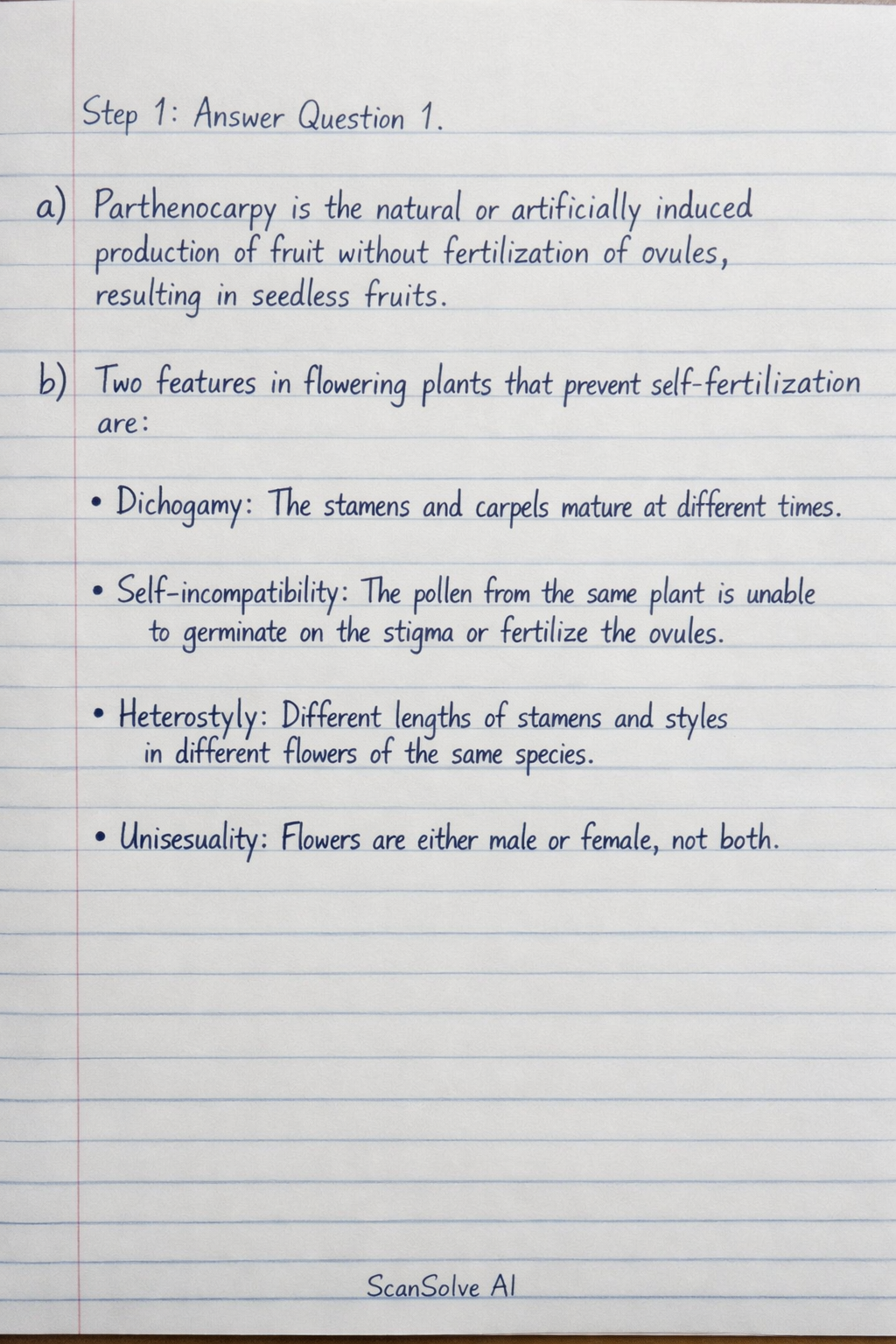
3 stepsAnswer Question 1.
*a) Parthenocarpy is the natural or artificially induced production of fruit without fertilization of ovules, resulting in seedless fruits.
*b) Two features in flowering plants that prevent self-fertilization are:
- Dichogamy: The stamens and carpels mature at different times.
- Self-incompatibility: The pollen from the same plant is unable to germinate on the stigma or fertilize the ovules.
- Heterostyly: Different lengths of stamens and styles in different flowers of the same species.
- Unisexuality: Flowers are either male or female, not both.
Answer Question 5.
*a) The type of joint shown in the diagram is a synovial joint (specifically, a hinge joint or condyloid joint, given it's in the mandibular body, it's the temporomandibular joint which is a complex synovial joint).
*b)
- Z: Mandible (lower jaw bone)
- U: Cartilage (articular cartilage)
*c) Two functions of the fluid found in W (synovial fluid) are:
- Lubrication: Reduces friction between the articular cartilages during movement.
- Nourishment: Supplies nutrients to the articular cartilage.
- Shock absorption: Distributes pressure across the joint surfaces.
*d) The type of muscle found attached to bone Z (mandible) is skeletal muscle.
*e) Two differences between skeletal muscle and the muscle found in the gut (smooth muscle) are:
- Skeletal muscle is striated (has visible bands), while smooth muscle is non-striated.
- Skeletal muscle contraction is voluntary, while smooth muscle contraction is involuntary.
- Skeletal muscle cells are multinucleated, while smooth muscle cells are uninucleated.
Answer Question 6.
*a) To plot the graphs:
- Draw a horizontal axis (x-axis) for "Time of day" from 6 am to 12 am.
- Draw a vertical axis (y-axis) for "Volume of carbon (IV) oxide (cm³/min)".
- Plot the "CO2 consumption" data points: (6am, 0), (8am, 18), (10am, 50), (12pm, 91), (2pm, 69), (4pm, 43), (6pm, 0), (8pm, 0), (10pm, 0), (12am, 0). Connect these points to form the CO2 consumption curve.
- Plot the "CO2 release" data points: (6am, 48), (8am, 48), (10am, 31), (12pm, 6), (2pm, 3), (4pm, 10), (6pm, 22), (8pm, 38), (10pm, 47), (12am, 48). Connect these points to form the CO2 release curve.
- Label both curves clearly (e.g., "CO2 Consumption" and "CO2 Release").
*b)
*i) The rate of carbon (IV) oxide consumption was highest at 12 pm (midday).
*ii) This is because light intensity is usually highest at midday, which maximizes the rate of photosynthesis.*c)
*i) The rate of carbon (IV) oxide release was highest at 6 am and 12 am (or generally during the night/early morning).
*ii) This is because during these times, there is no light for photosynthesis, so only respiration occurs, leading to a net release of CO2. The rate of respiration is relatively constant but appears highest when not masked by photosynthesis.*d) There was no carbon (IV) oxide consumption between 6 pm and 6 am because there was no light during this period. Carbon (IV) oxide consumption in plants is primarily due to photosynthesis, which requires light.
*e) The process being investigated in this experiment is photosynthesis (and respiration, but consumption specifically refers to photosynthesis).
*f) Two ways in which photosynthesis is important to plants are:
- It produces glucose (food) for the plant's growth and energy needs.
- It produces oxygen as a byproduct, which is used by the plant for respiration and released into the atmosphere.
Still stuck on this one?
Ask a follow-up, and the answer starts from this question.
More Biology Questions
Handwritten Step-by-Step Solution
Get this as a handwritten image on WhatsApp — like a tutor wrote it for you.
Try on WhatsApp