
We read your photo as:
Describe the pathway (including the structures) that deoxygenated blood travels throughout the body (i.e. pulmonary circulation). Describe the pathway (including the structures) that oxygen rich blood
ScanSolve AI Answer
Step-by-step solution
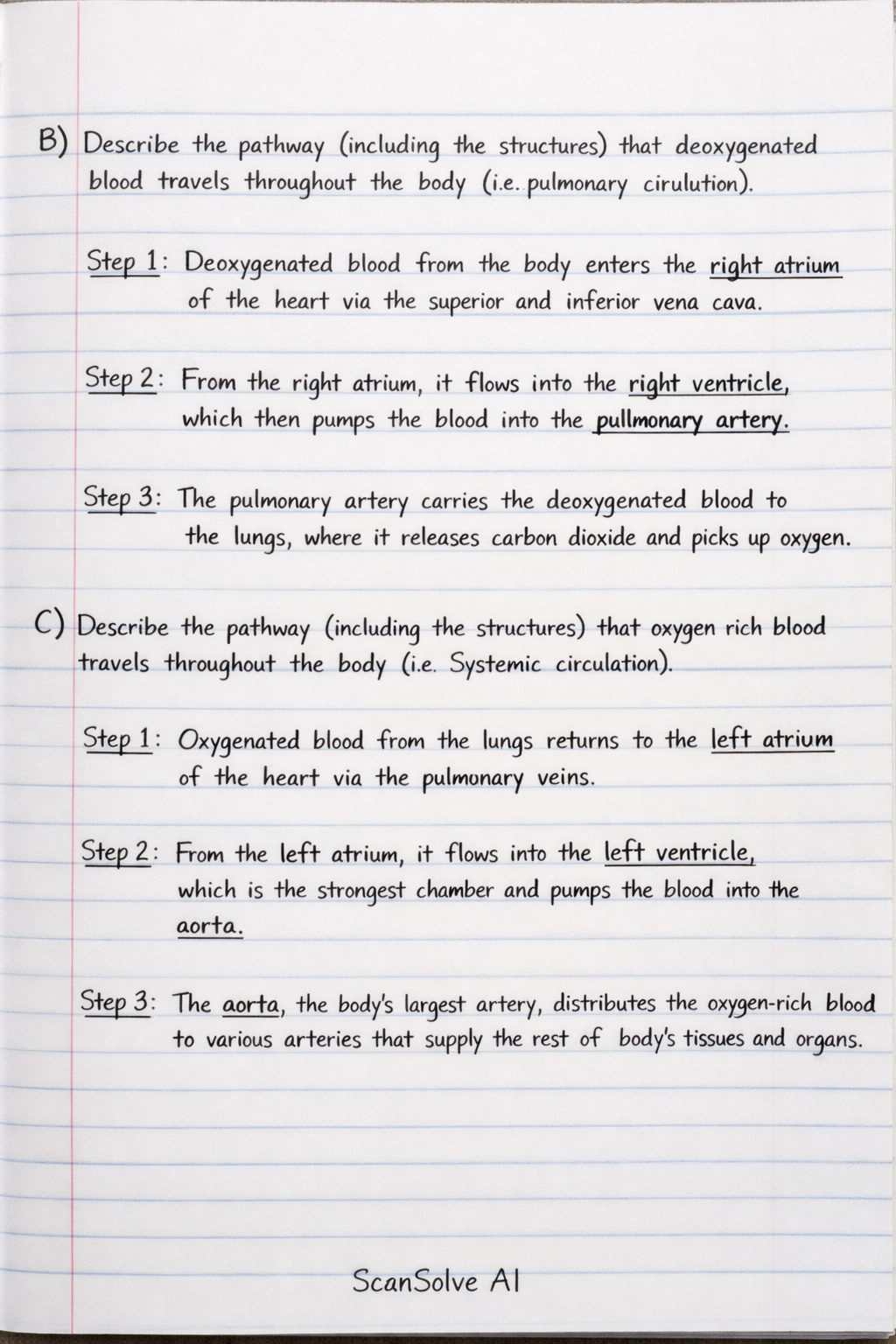
6 stepsB) Describe the pathway (including the structures) that deoxygenated blood travels throughout the body (i.e. pulmonary circulation).
Deoxygenated blood from the body enters the right atrium of the heart via the superior and inferior vena cava.
From the right atrium, it flows into the right ventricle, which then pumps the blood into the pulmonary artery.
The pulmonary artery carries the deoxygenated blood to the lungs, where it releases carbon dioxide and picks up oxygen.
C) Describe the pathway (including the structures) that oxygen rich blood travels throughout the body (i.e. Systemic circulation).
Oxygenated blood from the lungs returns to the left atrium of the heart via the pulmonary veins.
From the left atrium, it flows into the left ventricle, which is the strongest chamber and pumps the blood into the aorta.
The aorta, the body's largest artery, distributes the oxygen-rich blood to various arteries that supply the rest of the body's tissues and organs.
D) Mr James has been admitted to an acute medical ward in a hospital. You are the allocated Occupational therapist to carry out an assessment of his ability to prepare a hot drink in the kitchen which is about 10min walk from the ward Mr James is currently in.
The following information is recorded on his Observations Chart:
Respiratory rate: 15
Blood pressure: Lying: 90/70mmHg
Standing: 80/50mmHg
Heart rate: 130
SPO2 : 99%i) Briefly describe your interpretation of these observations in reference to the normal ranges.
Interpretation:
- Respiratory rate (15 breaths/min): Normal (normal range is 12-20 breaths/min).
- Blood pressure (Lying: 90/70mmHg): Hypotensive (low blood pressure, normal is typically around 120/80mmHg).
- Blood pressure (Standing: 80/50mmHg): Significantly hypotensive with a notable drop upon standing, indicating orthostatic hypotension.
- Heart rate (130 bpm): Tachycardic (elevated heart rate, normal range is 60-100 bpm). This may be a compensatory response to the low blood pressure.
- SpO2 (99%): Normal (normal range is 95-100%).
ii) Do you carry out an assessment of his ability to prepare a hot drink in this circumstance? Explain your clinical reasoning why or why not?
Explanation: No, an assessment of his ability to prepare a hot drink in the kitchen should not be carried out at this time. Mr. James's vital signs indicate significant instability, particularly the orthostatic hypotension and tachycardia. The substantial drop in blood pressure upon standing, combined with a high heart rate, puts him at a high risk of dizziness, fainting (syncope), or falls, especially during a 10-minute walk to the kitchen and while performing tasks that require standing and movement. Prioritizing his safety, it is crucial to address his cardiovascular instability before engaging in activities that could exacerbate his condition.
Still stuck on this one?
Ask a follow-up, and the answer starts from this question.
More Biology Questions
Handwritten Step-by-Step Solution
Get this as a handwritten image on WhatsApp — like a tutor wrote it for you.
Try on WhatsApp