
We read your photo as:
Describe the patient preparation step by step venipuncture procedure for a lipid profile in a 65-year-old obese male with cardiovascular risk factors.
ScanSolve AI Answer
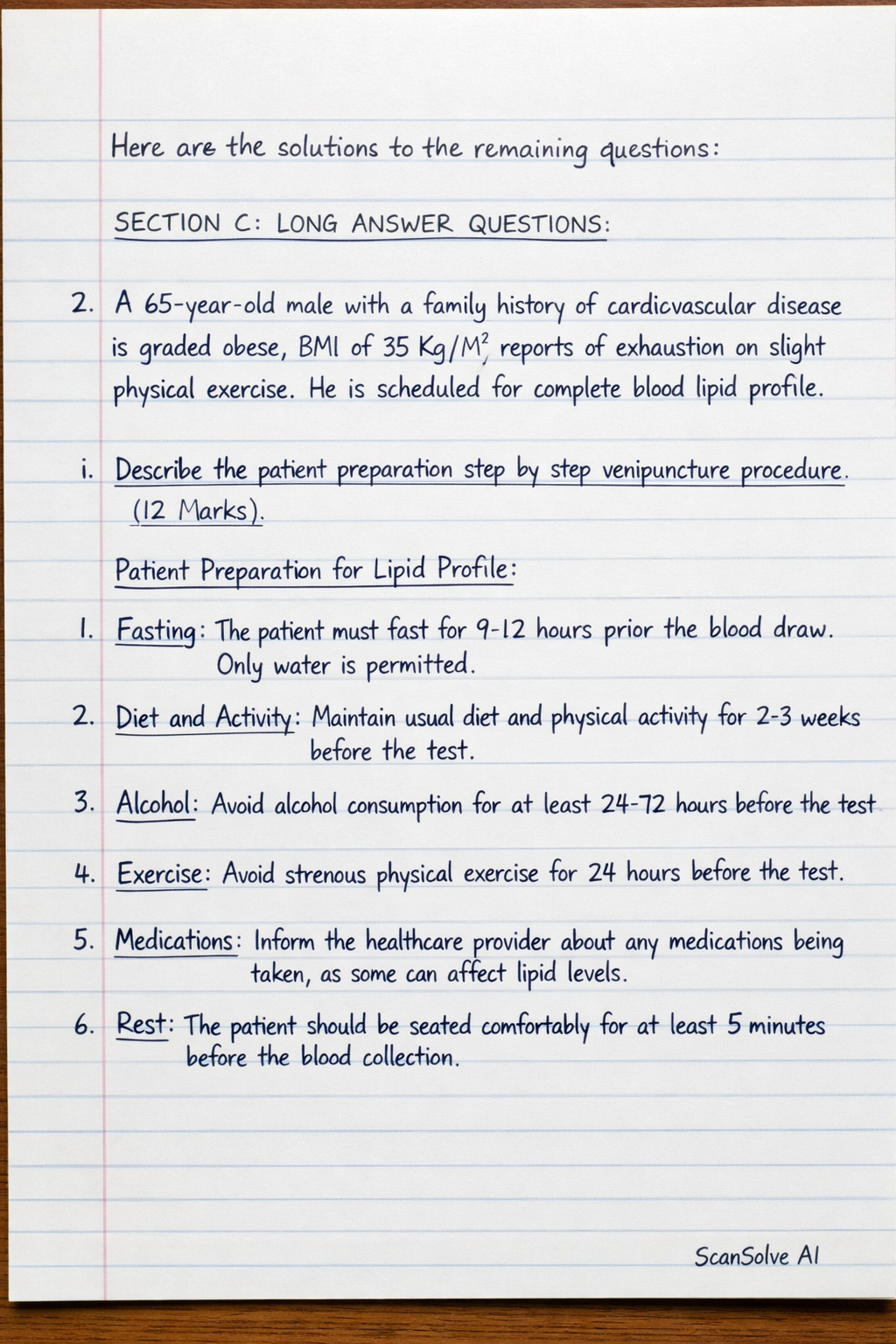
Here are the solutions to the remaining questions:
SECTION C: LONG ANSWER QUESTIONS
2. A 65-year-old male with a family history of cardiovascular disease is graded obese, BMI of 35Kg/M², reports of exhaustions on slight physical exercise. He is scheduled for complete blood lipid profile.
i. Describe the patient preparation step by step venipuncture procedure (12 Marks)
Patient Preparation for Lipid Profile:
- Fasting: The patient must fast for 9-12 hours prior to the blood draw. Only water is permitted.
- Diet and Activity: Maintain usual diet and physical activity for 2-3 weeks before the test.
- Alcohol: Avoid alcohol consumption for at least 24-72 hours before the test.
- Exercise: Avoid strenuous physical exercise for 24 hours before the test.
- Medications: Inform the healthcare provider about any medications being taken, as some can affect lipid levels.
- Rest: The patient should be seated comfortably for at least 5 minutes before the blood collection.
Step-by-step Venipuncture Procedure:
- Review Request: Verify the test request, patient identity, and required tubes.
- Gather Equipment: Assemble all necessary equipment: gloves, tourniquet, antiseptic wipes (e.g., alcohol), appropriate blood collection tubes (e.g., SST or EDTA for lipid profile), needles (e.g., 21-gauge), syringe or vacutainer holder, gauze, adhesive bandage, and sharps container.
- Patient Identification: Confirm the patient's identity by asking for their full name and date of birth, and compare with the request form.
- Explain Procedure: Briefly explain the procedure to the patient, including potential discomfort, and answer any questions.
- Position Patient: Position the patient comfortably, usually in a chair with the arm extended and supported.
- Select Site: Inspect both arms and select a suitable venipuncture site, typically the median cubital, cephalic, or basilic vein in the antecubital fossa.
- Apply Tourniquet: Apply the tourniquet 3-4 inches (7-10 cm) above the chosen venipuncture site. It should be tight enough to impede venous flow but not arterial flow, and should not be left on for more than 1 minute.
- Palpate Vein: Palpate the chosen vein to confirm its location, direction, and depth.
- Clean Site: Cleanse the venipuncture site thoroughly with an antiseptic wipe using a circular motion from the center outwards. Allow the area to air dry completely without fanning or blowing. Do not touch the site after cleaning.
- Perform Venipuncture:
- Anchor the vein firmly with the thumb of your non-dominant hand, pulling the skin taut below the puncture site.
- Hold the needle (bevel up) at a 15-30 degree angle to the skin.
- Puncture the skin and vein in one smooth, deliberate motion.
- Once the needle is in the vein, a "flash" of blood may appear in the hub (if using a butterfly needle) or blood will begin to flow into the tube.
- Advance the tube into the vacutainer holder or slowly pull the plunger of the syringe to collect blood.
- Fill tubes in the correct order of draw to prevent cross-contamination of additives.
- Release Tourniquet: Release the tourniquet as soon as blood flow is established or before the last tube is filled.
- Withdraw Needle: Place a clean gauze pad over the puncture site, then smoothly and quickly withdraw the needle.
- Apply Pressure: Immediately apply firm pressure to the puncture site with the gauze.
- Dispose of Needle: Activate the needle's safety mechanism and immediately dispose of the entire needle assembly into a sharps container.
- Label Tubes: Label all collected tubes at the patient's bedside with the patient's full name, date of birth, date, time of collection, and phlebotomist's initials.
- Check Site: Ensure bleeding has stopped, then apply an adhesive bandage or tape to the site.
- Patient Care: Thank the patient and advise them to keep the bandage on for at least 15 minutes.
- Documentation: Document the procedure as per facility policy.
ii. State four (4) tests to consider with their respective normal ranges (4 Marks)
For a complete blood lipid profile, the following tests are considered:
-
Total Cholesterol:
- Normal Range: Less than 200 mg/dL (or less than 5.2 mmol/L)
-
High-Density Lipoprotein (HDL) Cholesterol:
- Normal Range: 40 mg/dL (or 1.0 mmol/L) for men; 50 mg/dL (or 1.3 mmol/L) for women. Higher values are generally better.
-
Low-Density Lipoprotein (LDL) Cholesterol:
- Normal Range: Less than 100 mg/dL (or less than 2.6 mmol/L)
-
Triglycerides:
- Normal Range: Less than 150 mg/dL (or less than 1.7 mmol/L)
iii. Explain the relationship between lipids and cardiovascular disease (4 Marks)
An imbalance in blood lipid levels, known as dyslipidemia, is a major risk factor for cardiovascular disease (CVD). High levels of Low-Density Lipoprotein (LDL) cholesterol (often called "bad" cholesterol) contribute to the formation of atherosclerotic plaques in the arteries. These plaques narrow the arteries, a process called atherosclerosis, which can lead to reduced blood flow, heart attacks, and strokes. Conversely, High-Density Lipoprotein (HDL) cholesterol (often called "good" cholesterol) helps remove excess cholesterol from the arteries, protecting against CVD. High levels of triglycerides are also associated with an increased risk of CVD, especially when combined with high LDL and low HDL.
Still stuck on this one?
Ask a follow-up, and the answer starts from this question.
More Biology Questions
Handwritten Step-by-Step Solution
Get this as a handwritten image on WhatsApp — like a tutor wrote it for you.
Try on WhatsApp