
We read your photo as:
What is Petrified fossil? Discuss horse evolution in brief. Also, identify parts a, b, c, d in the given figure and state their functions.
Biology
ScanSolve AI Answer
Here are the solutions for Group B:
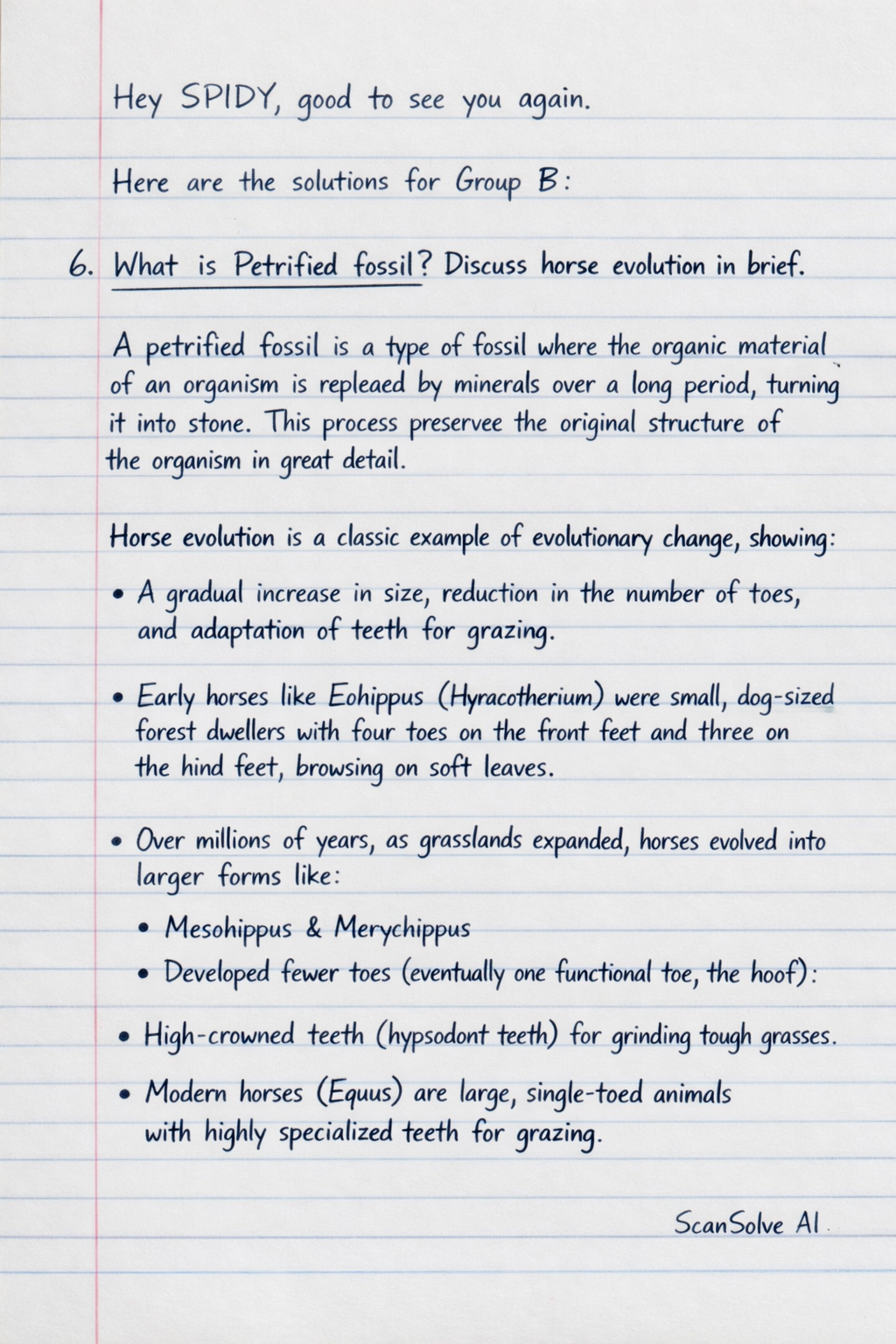
6. What is Petrified fossil? Discuss horse evolution in brief.
- A petrified fossil is a type of fossil where the organic material of an organism is replaced by minerals over a long period, turning it into stone. This process preserves the original structure of the organism in great detail.
- Horse evolution is a classic example of evolutionary change, showing a gradual increase in size, reduction in the number of toes, and adaptation of teeth for grazing. Early horses like Eohippus (Hyracotherium) were small, dog-sized forest dwellers with four toes on the front feet and three on the hind feet, browsing on soft leaves. Over millions of years, as grasslands expanded, horses evolved into larger forms like Mesohippus and Merychippus, developing fewer toes (eventually one functional toe, the hoof) and high-crowned teeth (hypsodont teeth) suitable for grinding tough grasses. Modern horses (Equus) are large, single-toed animals with highly specialized teeth for grazing.
7. Study the given figure and answer the question:
- i. What are a, b, c and d given in the figure?
- a: Stigma
- b: Anther
- c: Filament
- d: Ovary
- ii. Give their functions.
- a: Stigma: The receptive tip of the carpel, which receives pollen.
- b: Anther: Contains pollen sacs where pollen grains (male gametes) are produced.
- c: Filament: The stalk that supports the anther, positioning it to disperse pollen.
- d: Ovary: Contains ovules, which develop into seeds after fertilization. The ovary itself develops into the fruit.
8. Give the view of Pasteur in origin of life. Explain Pasteur's experiment of Biogenesis theory in brief.
- Louis Pasteur's view on the origin of life strongly supported the theory of biogenesis, which states that life arises only from pre-existing life. He refuted the theory of spontaneous generation, which proposed that living organisms could arise from non-living matter.
- Pasteur's experiment involved using swan-neck flasks. He boiled nutrient broth in these flasks to sterilize them, killing any existing microorganisms. The unique swan neck allowed air to enter but trapped dust and microbes in the curves of the neck, preventing them from reaching the broth. The broth remained clear and sterile. If the swan neck was broken, allowing dust and microbes to directly contact the broth, microbial growth occurred. This demonstrated that microorganisms in the air, not spontaneous generation, were responsible for life appearing in the broth, thus proving biogenesis.
9. Explain the erythrocytic schizogony in the malarial parasite with labeled diagram.
- Erythrocytic schizogony is an asexual reproductive stage of the malarial parasite (Plasmodium) that occurs in the red blood cells (erythrocytes) of the human host.
- Mechanism:
- Merozoites, released from the liver cells, invade red blood cells.
- Inside the red blood cell, the merozoite develops into a ring stage trophozoite.
- The trophozoite grows and feeds on hemoglobin, becoming an amoeboid trophozoite.
- It then develops into a schizont, undergoing multiple nuclear divisions (schizogony) to produce numerous daughter nuclei.
- Each nucleus, along with a portion of the cytoplasm, forms new merozoites.
- The infected red blood cell ruptures, releasing these new merozoites into the bloodstream, which then infect other red blood cells, continuing the cycle. This rupture also releases toxins, causing the characteristic fever and chills of malaria.
- Diagram: (Since I cannot draw, I will describe the key stages you would label in a diagram)
- A red blood cell containing a small, ring-shaped parasite (Ring stage).
- A red blood cell with a larger, irregular parasite (Amoeboid trophozoite).
- A red blood cell with a large parasite containing multiple nuclei (Schizont).
- A red blood cell rupturing, releasing many small, oval-shaped parasites (Merozoites).
10. Mention the ways of respiration that takes place in adult frog. Discuss the mechanism of pulmonary respiration.
- Adult frogs respire in three main ways:
- Cutaneous respiration (through the skin)
- Buccopharyngeal respiration (through the lining of the mouth and pharynx)
- Pulmonary respiration (through the lungs)
- Pulmonary respiration in frogs involves the use of lungs, though they are relatively simple sacs compared to mammalian lungs. The mechanism is a positive-pressure breathing system:
- Inhalation: The frog lowers the floor of its mouth, creating a negative pressure that draws air in through the nostrils (nares) into the buccal cavity. The glottis (opening to the lungs) remains closed.
- Forced Air into Lungs: The nostrils then close, and the floor of the mouth is raised. This increases pressure in the buccal cavity, forcing the air through the open glottis into the lungs.
- Gas Exchange: Oxygen diffuses from the air in the lungs into the blood, and carbon dioxide diffuses from the blood into the air in the lungs.
- Exhalation: The muscles of the body wall contract, and the elastic recoil of the lungs forces the stale air out of the lungs and through the glottis into the buccal cavity, and then out through the nostrils.
Was this helpful?
Still stuck on this one?
Ask a follow-up, and the answer starts from this question.
Got a different question?Ask your own question
More Biology Questions
QIdentify the fossil, describe its key features, state its pygidium size relative to its cephalon…QDefine Petrification. Explain why scientists cannot use Carbon 14 to determine the age of a dinosaur…QDefine organic evolution, chemical evolution, fossils, and explain methods of plant fossil…QDefine organic evolution, chemical evolution, fossils, and explain methods in which plant fossils…QDescribe and identify fossil A and B. State with reason the mode of life of specimen A and B.
Handwritten Step-by-Step Solution
Get this as a handwritten image on WhatsApp — like a tutor wrote it for you.
Try on WhatsApp