
We read your photo as:
Which phylum is characterized by a porous body and a canal system for water circulation. This description is characteristic of sponges. Sponges belong to the phylum Porifera.
ScanSolve AI Answer
Answer
Step-by-step solution
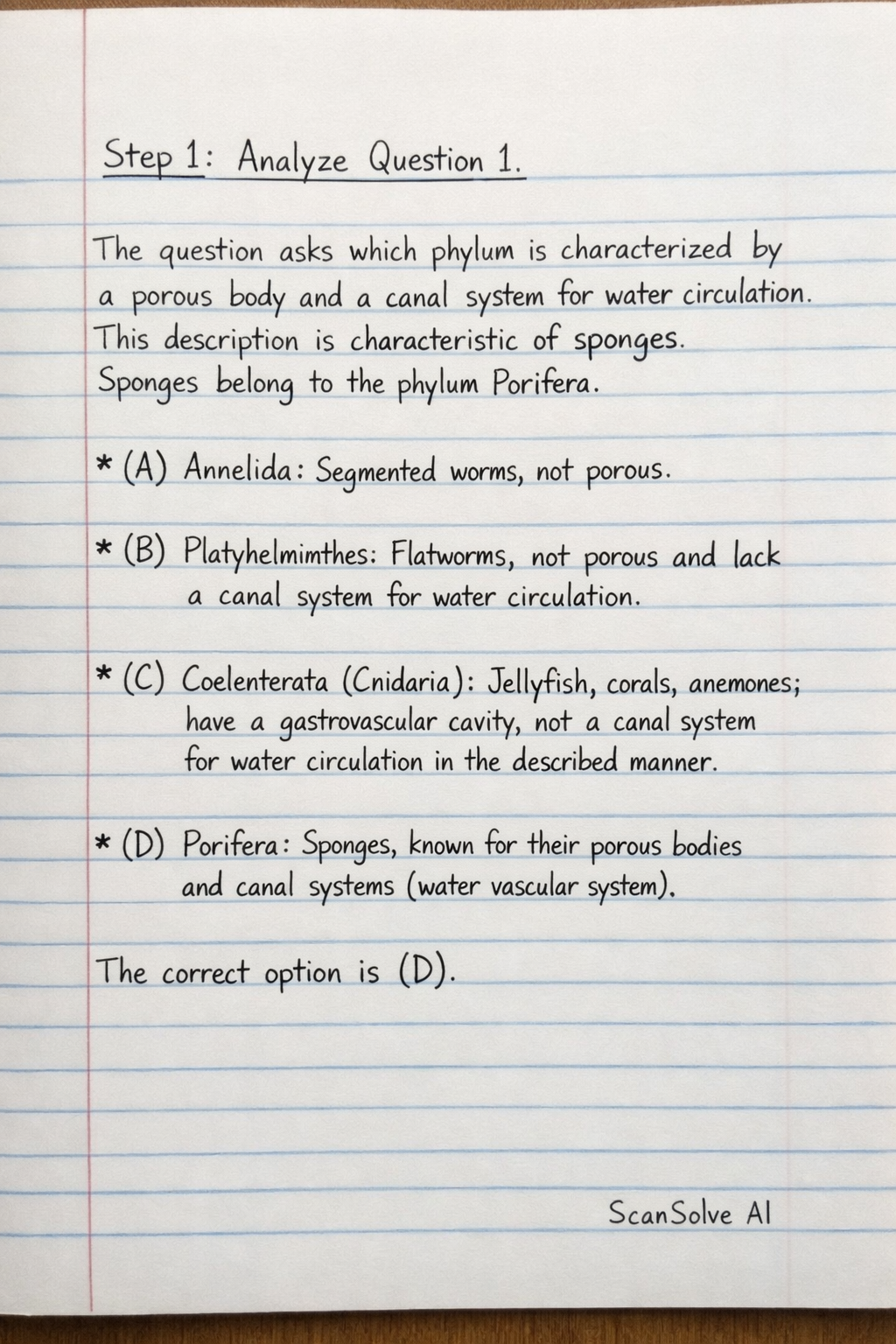
3 stepsAnalyze Question 1.
The question asks which phylum is characterized by a porous body and a canal system for water circulation. This description is characteristic of sponges. Sponges belong to the phylum Porifera.
- (A) Annelida: Segmented worms, not porous.
- (B) Platyhelminthes: Flatworms, not porous and lack a canal system for water circulation.
- (C) Coelenterata (Cnidaria): Jellyfish, corals, anemones; have a gastrovascular cavity, not a canal system for water circulation in the described manner.
- (D) Porifera: Sponges, known for their porous bodies and canal systems (water vascular system).
The correct option is (D).
Analyze Question 2.
The question describes two conditions:
- Periodic fever with hepatosplenomegaly and erythrocytic intracellular parasites. This points to Malaria, caused by Plasmodium species, transmitted by mosquitoes, and infecting red blood cells.
- Chronic lymphatic obstruction causing elephantiasis. This points to Filariasis, caused by Wuchereria bancrofti (or other filarial worms), transmitted by mosquitoes, and blocking lymphatic vessels.
Let's evaluate the options:
- (A) Leishmania (sandfly, infects macrophages, not typically erythrocytes for periodic fever) and Ancylostoma (hookworm, causes anemia, not elephantiasis). Incorrect.
- (B) Trypanosoma (tsetse fly, causes sleeping sickness, not typically periodic fever with erythrocytic parasites in this context) and Taenia (tapeworm, does not cause elephantiasis). Incorrect.
- (C) Entamoeba (contaminated food, causes amoebiasis, not erythrocytic parasites) and Ascaris (roundworm, causes intestinal/lung issues, not elephantiasis). Incorrect.
- (D) Plasmodium (mosquito, infects erythrocytes, causes periodic fever) and Wuchereria (mosquito, induces lymphatic obstruction leading to elephantiasis). This option correctly matches both conditions.
The correct option is (D).
Analyze Question 3.
The question asks about the purpose of measures of dispersion. Measures of dispersion quantify the spread or variability of data points.
- (A) Find total values: Not the primary purpose of dispersion measures.
- (B) Measure central tendency: This is the purpose of measures like mean, median, mode.
- (C) Measure variability or scatter of data: This is the definition and purpose of measures of dispersion (e.g., range, variance, standard deviation).
- (D) Calculate average: This is a measure of central tendency (mean).
The correct option is (C).
a) The correct answer is
b) The correct answer is
c) The correct answer is
Try one yourself
A new problem that tests the same skill.
Still stuck on this one?
Ask a follow-up, and the answer starts from this question.
More Biology Questions
Handwritten Step-by-Step Solution
Get this as a handwritten image on WhatsApp — like a tutor wrote it for you.
Try on WhatsApp