
We read your photo as:
Describe plant and animal nomenclature and differentiate between Chytridiomycota, Zygomycota, Ascomycota, Basidiomycota, and Deuteromycota.
ScanSolve AI Answer
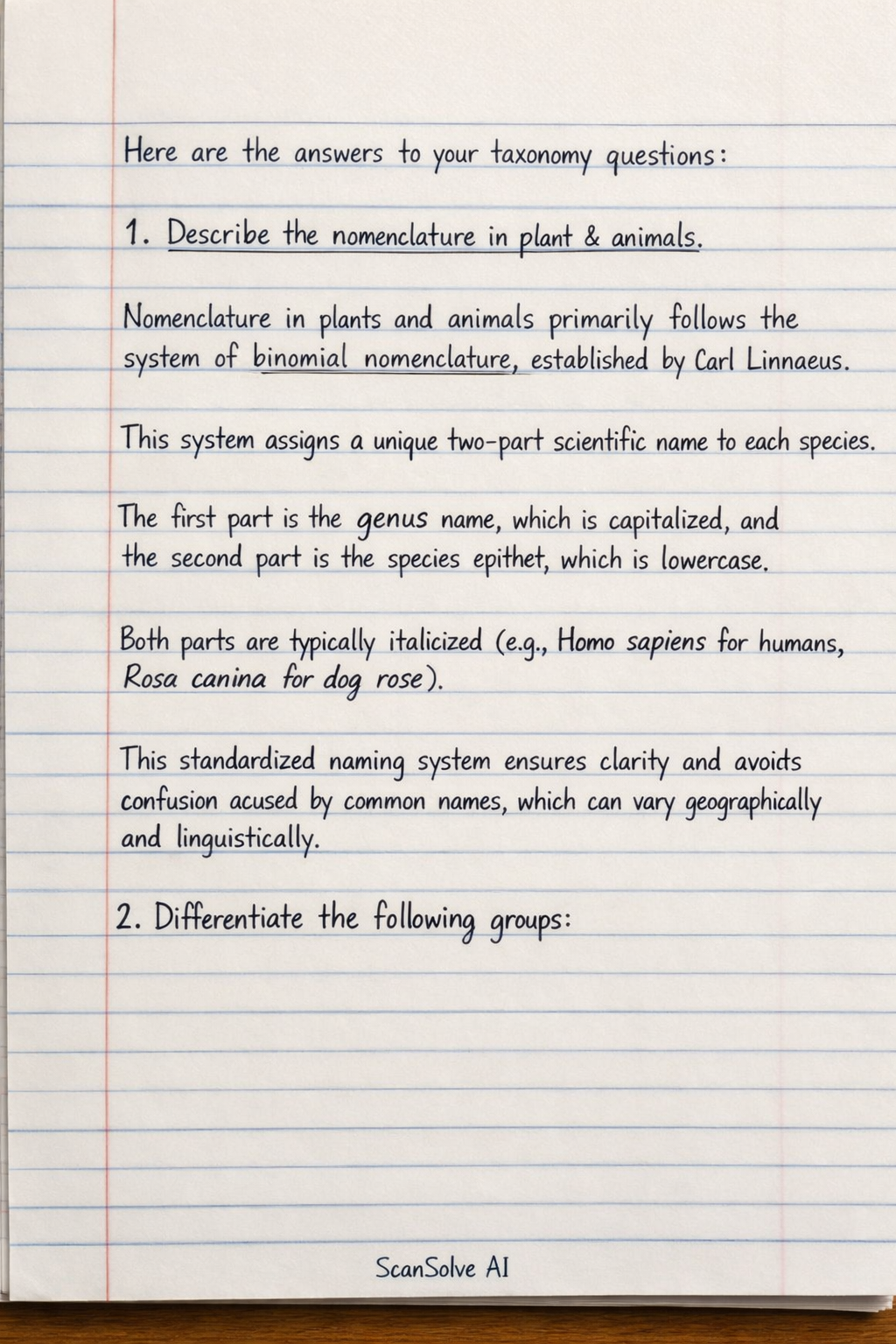
Here are the answers to your taxonomy questions:
1. Describe the nomenclature in plant & animals.
Nomenclature in plants and animals primarily follows the system of binomial nomenclature, established by Carl Linnaeus. This system assigns a unique two-part scientific name to each species. The first part is the genus name, which is capitalized, and the second part is the species epithet, which is lowercase. Both parts are typically italicized (e.g., Homo sapiens for humans, Rosa canina for dog rose). This standardized naming system ensures clarity and avoids confusion caused by common names, which can vary geographically and linguistically.
2. Differentiate the following groups:
| Feature | Chytridiomycota | Zygomycota | Ascomycota | Basidiomycota | Deuteromycota |
|---|---|---|---|---|---|
| Common Name | Chytrids | Conjugation fungi | Sac fungi | Club fungi | Imperfect fungi |
| Key Reproductive Structure | Flagellated zoospores (motile spores) | Zygospores (sexual), sporangiospores (asexual) | Ascospores (sexual, in an ascus), conidia (asexual) | Basidiospores (sexual, on a basidium), conidia (asexual) | Only asexual reproduction (conidia) observed |
| Hyphae | Coenocytic (aseptate) | Coenocytic (aseptate) | Septate | Septate | Septate |
| Habitat | Aquatic, moist soil | Terrestrial | Terrestrial, aquatic | Terrestrial | Diverse |
| Examples | Allomyces, Batrachochytrium | Bread molds (Rhizopus), Pilobolus | Yeasts, morels, truffles, Penicillium | Mushrooms, puffballs, rusts, smuts | Aspergillus, Candida (some species) |
3. Describe the structure of two examples of common fungi.
-
Mushroom (e.g., Agaricus species): A typical mushroom, which is the fruiting body of a Basidiomycota fungus, consists of a cap (pileus) at the top, supported by a stalk (stipe). Underneath the cap are gills (lamellae) radiating outwards, which contain the basidia where spores are produced. Some mushrooms also have an annulus (ring) on the stalk, a remnant of a veil that covered the gills when young, and a volva (cup-like structure) at the base, which is a remnant of the universal veil. The main body of the fungus, the mycelium, is a network of thread-like hyphae that grows underground or within its substrate.
-
Bread Mold (e.g., Rhizopus stolonifer): Bread mold, a Zygomycota fungus, has a relatively simple structure. It consists of a network of hyphae that grow over and into the substrate (like bread). These hyphae are coenocytic, meaning they lack septa (cross-walls) and contain multiple nuclei. Specialized hyphae called rhizoids anchor the mold to the substrate and absorb nutrients. Other hyphae called stolons grow horizontally across the surface. From the stolons, sporangiophores grow upwards, each topped with a sporangium, a sac-like structure containing asexual spores.
4. Differentiate the following groups:
| Feature | Phycophyta (Algae) | Bryophyta (Mosses, Liverworts) | Pteridophyta (Ferns, Horsetails) | Spermatophyta (Seed Plants) | Mycophyta (Fungi) |
|---|---|---|---|---|---|
| Dominant Generation | Gametophyte or Sporophyte (variable) | Gametophyte | Sporophyte | Sporophyte | N/A (no distinct alternation of generations like plants) |
| Vascular Tissue | Absent | Absent (non-vascular) | Present (vascular) | Present (highly developed vascular) | Absent |
| Reproduction | Spores (sexual/asexual), fragmentation | Spores (sexual), fragmentation | Spores (sexual) | Seeds (sexual) | Spores (sexual/asexual), budding, fragmentation |
| Roots/Stems/Leaves | Absent (thallus body) | Absent (rhizoids, simple stems/leaves) | Present (true roots, stems, leaves) | Present (true roots, stems, leaves) | Absent (hyphae) |
| Water for Fertilization | Required | Required | Required | Not required (pollen) | N/A |
| Nutrition | Autotrophic (photosynthesis) | Autotrophic (photosynthesis) | Autotrophic (photosynthesis) | Autotrophic (photosynthesis) | Heterotrophic (absorption) |
5. Describe the structure of two named examples of common algae found in your environment.
-
Spirogyra (Green Algae): Spirogyra is a filamentous green alga commonly found in freshwater. Its structure consists of unbranched chains of cylindrical cells. Each cell contains one or more distinctive spiral chloroplasts, which are ribbon-like and arranged helically around the periphery of the cell. Within the chloroplasts are pyrenoids, structures involved in starch synthesis and storage. The cells are enclosed by a cell wall and contain a central vacuole and a nucleus. Spirogyra often forms slimy, bright green mats in ponds and ditches.
-
Ulva (Sea Lettuce - Green Algae): Ulva is a marine green alga, often called "sea lettuce" due to its appearance. It has a flattened, leaf-like thallus (body) that is typically two cells thick. This thallus is bright green and can be quite large, resembling a lettuce leaf. It attaches to rocks or other substrates by a small, disc-shaped holdfast. Ulva lacks true roots, stems, or leaves, and its entire thallus is photosynthetic.
6. Draw the structure of one example of the following groups:
As an AI, I cannot draw diagrams. However, I can describe the key structural features of a representative example from each group:
-
Phycophyta (e.g., Chlamydomonas - Green Alga): A single-celled, motile alga. It is typically oval or pear-shaped, with a cell wall, a large cup-shaped chloroplast, a nucleus, and a prominent pyrenoid. It possesses two anterior flagella for locomotion and an eyespot (stigma) for light perception.
-
Bryophyta (e.g., Moss - Polytrichum): The dominant gametophyte generation consists of a small, leafy shoot with a central axis and spirally arranged "leaves" (phyllids) that lack vascular tissue. It is anchored by rhizoids (root-like structures, not true roots). The sporophyte, which is dependent on the gametophyte, consists of a foot embedded in the gametophyte, a seta (stalk), and a capsule (sporangium) at the tip, where spores are produced.
-
Mycophyta (e.g., Yeast - Saccharomyces cerevisiae): A single-celled fungus, typically oval-shaped. It has a cell wall, cell membrane, cytoplasm, nucleus, and various organelles. It reproduces primarily by budding, where a small outgrowth (bud) forms on the parent cell, grows, and eventually detaches.
-
Pteridophyta (e.g., Fern - Dryopteris): The dominant sporophyte generation consists of true roots, a rhizome (underground stem), and large, often compound leaves called fronds. Young fronds are typically coiled (fiddleheads). On the underside of mature fronds, sori (clusters of sporangia) are found, where spores are produced.
-
Spermatophyta (e.g., Flowering Plant - Sunflower): The dominant sporophyte generation is a complex plant with true roots, stems, and leaves. It produces flowers for sexual reproduction, which contain male (stamens with pollen) and female (pistil with ovules) reproductive organs. After fertilization, the ovules develop into seeds, which are enclosed within a fruit.
7. Differentiate Plants into Monocotyledon & Dicotyledon.
| Feature | Monocotyledons (Monocots) | Dicotyledons (Dicots) |
|---|---|---|
| Cotyledons (Seed Leaves) | One | Two |
| Leaf Venation | Parallel venation | Netted (reticulate) venation |
| Flower Parts | Multiples of three (e.g., 3, 6 petals) | Multiples of four or five (e.g., 4, 5, 8, 10 petals) |
| Vascular Bundles in Stem | Scattered | Arranged in a ring |
| Root System | Fibrous root system | Taproot system |
| Secondary Growth | Generally absent (no true wood) | Often present (can form wood) |
| Pollen Grains | Monosulcate (single furrow or pore) | Trisulcate (three furrows or pores) |
| Examples | Grasses, corn, wheat, rice, lilies, orchids | Beans, roses, oaks, sunflowers, tomatoes |
8. Draw one example each of the Phylum of Invertebrates i.e. Protozoa, Coelenterata, Platyhelminthes, Nematodes, Annelida, Arthropoda, Chordata.
As an AI, I cannot draw diagrams. However, I can describe a representative example for each phylum:
-
Protozoa (e.g., Amoeba): A single-celled organism that lacks a fixed shape. It moves and feeds using temporary cytoplasmic extensions called pseudopods. It has a nucleus, contractile vacuole, and food vacuoles.
-
Coelenterata (Cnidaria) (e.g., Jellyfish): A radially symmetrical animal with a bell-shaped body (medusa form). It has a mouth on the underside, surrounded by tentacles armed with stinging cells (cnidocytes). It possesses a simple nerve net and a gastrovascular cavity.
-
Platyhelminthes (e.g., Flatworm - Planaria): A bilaterally symmetrical, flattened, unsegmented worm. It has a distinct head region with eyespots and chemoreceptors. It possesses a simple digestive system with a single opening (pharynx) and a ladder-like nervous system.
-
Nematodes (e.g., Roundworm - Ascaris): A bilaterally symmetrical, unsegmented, cylindrical worm with tapered ends. It has a complete digestive system (mouth and anus) and a tough outer cuticle. It moves with a characteristic thrashing motion.
-
Annelida (e.g., Earthworm - Lumbricus): A segmented worm with a cylindrical body. Each segment contains similar internal and external structures. It has a well-developed coelom, a closed circulatory system, and bristles (setae) on each segment for locomotion.
-
Arthropoda (e.g., Insect - Grasshopper): An animal with a segmented body, an exoskeleton made of chitin, and jointed appendages. The body is typically divided into a head, thorax, and abdomen. It has compound eyes and antennae.
-
Chordata (e.g., Tunicate - Sea Squirt): While many chordates are vertebrates, some are invertebrates. A tunicate larva has a notochord, a dorsal hollow nerve cord, pharyngeal slits, and a post-anal tail. The adult form is sessile and filter-feeding, often losing some of these chordate characteristics.
9. List 10 differences between Vertebrates & Invertebrates.
| Feature | Vertebrates | Invertebrates |
|---|---|---|
| Backbone/Spine | Present (made of vertebrae) | Absent |
| Internal Skeleton | Present (endoskeleton of bone/cartilage) | Absent (some have exoskeletons or hydrostatic skeletons) |
| Nervous System | Dorsal |
Still stuck on this one?
Ask a follow-up, and the answer starts from this question.
More Biology Questions
Handwritten Step-by-Step Solution
Get this as a handwritten image on WhatsApp — like a tutor wrote it for you.
Try on WhatsApp