
We read your photo as:
Plant Cell and Animal Cell, Difference, Structure of Chloroplast, Mitochondria, Nucleus, Ribosome, etc.
Biology
ScanSolve AI Answer
Here's an overview of the biology topics from your notes:
-
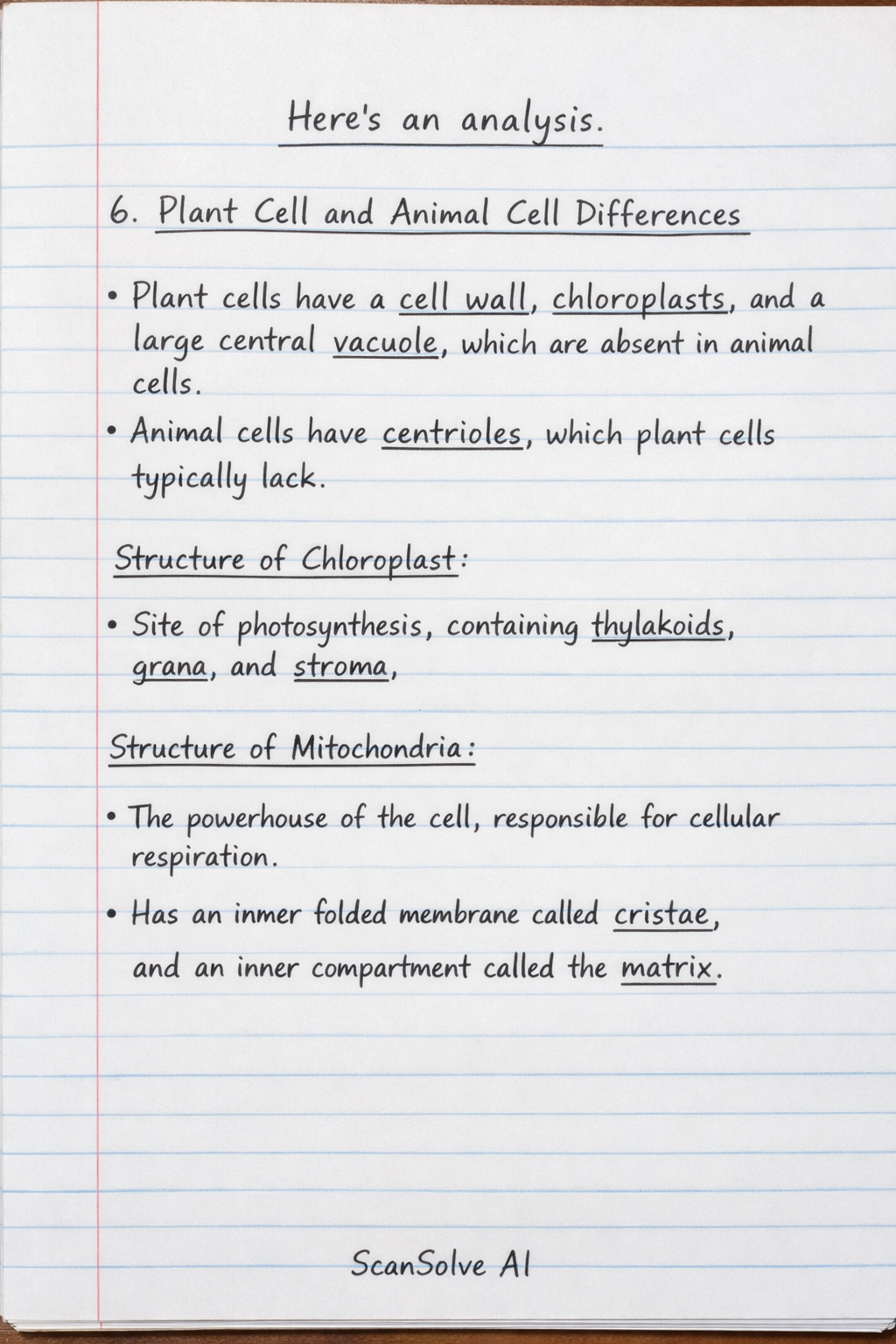
6. Plant Cell and Animal Cell Differences
- Plant cells have a cell wall, chloroplasts, and a large central vacuole, which are absent in animal cells. Animal cells have centrioles, which plant cells typically lack.
- Structure of Chloroplast: Site of photosynthesis, containing thylakoids, grana, and stroma.
- Structure of Mitochondria: The powerhouse of the cell, responsible for cellular respiration, with an inner folded membrane called cristae and an inner compartment called the matrix.
-
7. Structure of the Nucleus
- The nucleus contains the cell's genetic material. Key components include the chromatin network (DNA and proteins), the nucleolus (involved in ribosome synthesis), nucleolar pores (for transport), endoplasmic reticulum (ER) often associated with the nuclear envelope, and nucleoplasm (the fluid inside the nucleus).
- The nuclear membrane (or envelope) encloses the nucleus, and ribosomes are often found on its outer surface.
-
8. Transport of Substances into and out of Cell
- Diffusion: The net movement of molecules from a region of higher concentration to a region of lower concentration down a concentration gradient.
- Osmosis: The diffusion of water molecules across a selectively permeable membrane from a region of higher water potential to a region of lower water potential.
-
9. Mitosis - Cell Division
- Mitosis is a type of cell division that results in two daughter cells each having the same number and kind of chromosomes as the parent nucleus.
- Stages: It involves Interphase (I), followed by Prophase (P), Metaphase (M), Anaphase (A), and Telophase (T).
- Structure of Chromosome: Chromosomes are condensed structures of DNA and proteins, visible during cell division. Each chromosome has a centromere and two chromatids when duplicated.
- Significance of Mitosis: Essential for growth, repair of damaged tissues, and asexual reproduction.
-
10. Summary of Plant and Animal Tissue
- Plant Tissue:
- Simple Ground Tissue: Includes Parenchyma (storage, photosynthesis), Collenchyma (flexible support), and Sclerenchyma (strong, rigid support).
- Epidermal Tissue: Forms the outer protective layer of roots, stems, and leaves.
- Conducting Tissue: Xylem (transports water and minerals) and Phloem (transports sugars).
- Animal Tissue:
- Epithelium Tissue: Covers body surfaces and lines cavities, classified by shape (e.g., cuboidal, ciliated, columnar).
- Connective Tissue: Supports, connects, or separates different types of tissues and organs (e.g., bone, blood, cartilage).
- Muscle Tissue: Responsible for movement (e.g., skeletal, smooth, cardiac).
- Nerve Tissue: Transmits electrical signals throughout the body.
- Plant Tissue:
-
11. Dicot Plants
- Uptake and absorption of water: Water is absorbed by roots from the soil, primarily through root hairs.
- Transpiration pull and root pressure: Water moves up the plant due to transpiration pull (evaporation from leaves creating tension) and, to a lesser extent, root pressure (pressure generated in roots pushing water up).
- Environmental factors: Factors like temperature, humidity, wind, and light intensity affect transpiration rates.
Was this helpful?
Still stuck on this one?
Ask a follow-up, and the answer starts from this question.
Got a different question?Ask your own question
More Biology Questions
QPlant Cell Structure, Tissues, and Their Functions Plant Cell Organelles List and explain the…QWhat are the key structural differences between plant and animal cells?QTabulate three differences between a plant cell and a animal cellQThe question asks which structure is found in animal cells.QThe diagram below shows the structural layout of a specialized animal cell. (a) Identify the…
Handwritten Step-by-Step Solution
Get this as a handwritten image on WhatsApp — like a tutor wrote it for you.
Try on WhatsApp