
We read your photo as:
Plot a graph of Red blood cells (Haemolysed) (%) against Salt concentration (g/100cm) (%) using the data provided. Label axes appropriately and draw a smooth curve of best fit.
Biology
ScanSolve AI Answer
Step-by-step solution
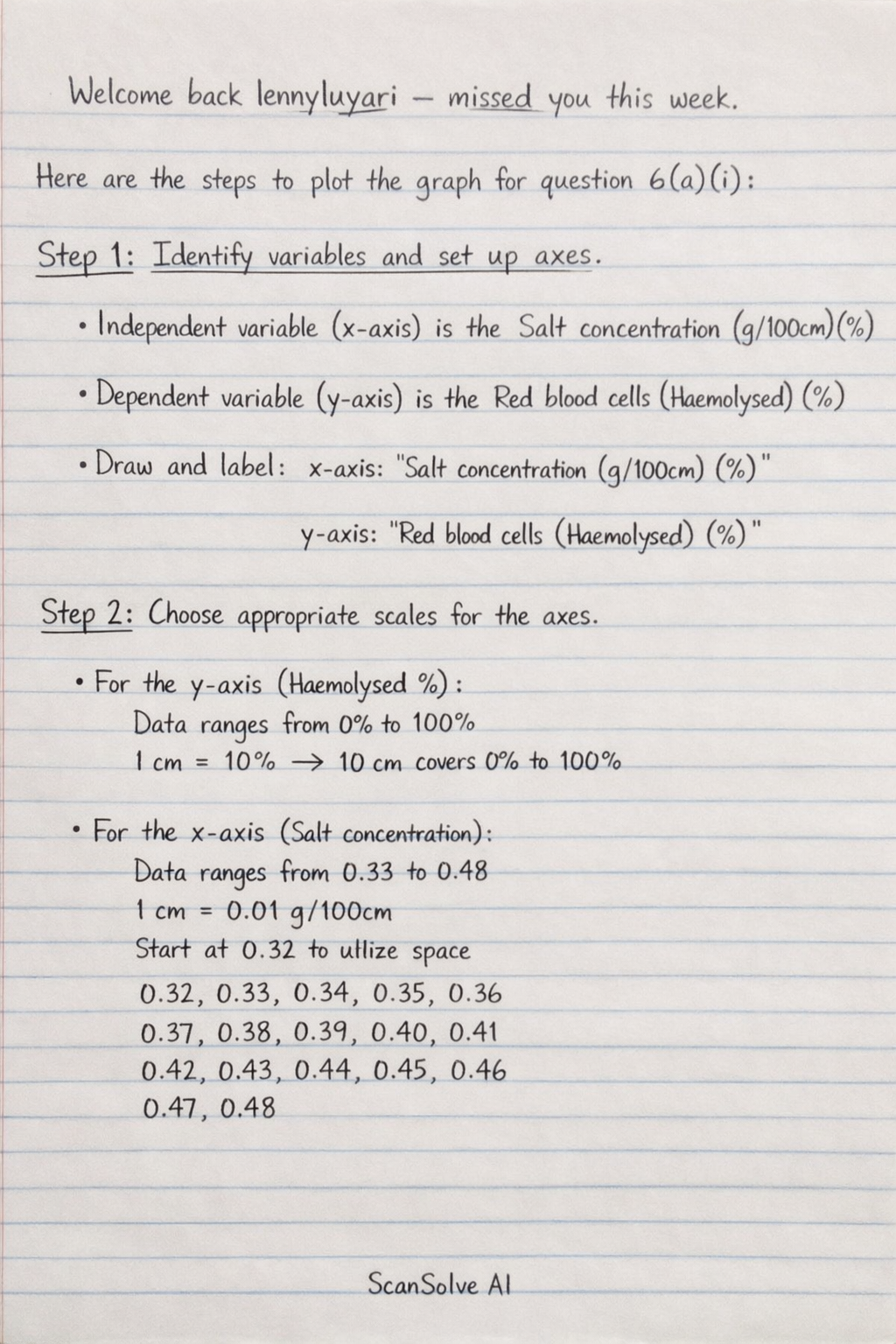
4 stepsHere are the steps to plot the graph for question 6 (a)(i):
Identify variables and set up axes.
- The independent variable (x-axis) is the Salt concentration (g/100cm) (%).
- The dependent variable (y-axis) is the Red blood cells (Haemolysed) (%).
- Draw and label the x-axis as "Salt concentration (g/100cm) (%)" and the y-axis as "Red blood cells (Haemolysed) (%)".
Choose appropriate scales for the axes.
- For the y-axis (Haemolysed %): The data ranges from 0% to 100%. A suitable scale would be 1 cm (or 1 large square) representing 10%. This means 10 large squares will cover the full range.
- For the x-axis (Salt concentration): The data ranges from 0.33 to 0.48. A suitable scale would be 1 cm (or 1 large square) representing 0.01 g/100cm. Start the x-axis at a value like 0.30 or 0.32 to utilize the graph paper effectively.
Plot the data points.
- Plot each pair of (Salt concentration, Haemolysed %) values from the table onto your graph:
- $(0.33, 100)$
- $(0.36, 91)$
- $(0.38, 82)$
- $(0.39, 69)$
- $(0.42, 30)$
- $(0.44, 15)$
- $(0.48, 0)$
- Plot each pair of (Salt concentration, Haemolysed %) values from the table onto your graph:
Draw the curve.
- Draw a smooth curve of best fit through the plotted points. Do not connect the points with straight lines; aim for a continuous, flowing curve that best represents the trend of the data.
Was this helpful?
Still stuck on this one?
Ask a follow-up, and the answer starts from this question.
Got a different question?Ask your own question
More Biology Questions
QIf blood sample F was treated with a salt concentration of 2.6%, the red blood cells would crenate…QDraw a line graph on the grid provided, to show the effect of the salt solution on germination…QPlot a graph of temperature change against the volume of solution B added, and draw lines of best…QDraw and label the axes. The x-axis should represent Temperature (^ C) and the y-axis should…QDraw a graph of the rate of reaction against temperature using the provided data.
Handwritten Step-by-Step Solution
Get this as a handwritten image on WhatsApp — like a tutor wrote it for you.
Try on WhatsApp