
We read your photo as:
Describe the procedure, observation, and explanation for testing proteins in non-germinating maize seeds using the Biuret test.
Biology
ScanSolve AI Answer
Here is the procedure, observation/result, and explanation for the protein test using the filtrate from non-germinating maize seeds:
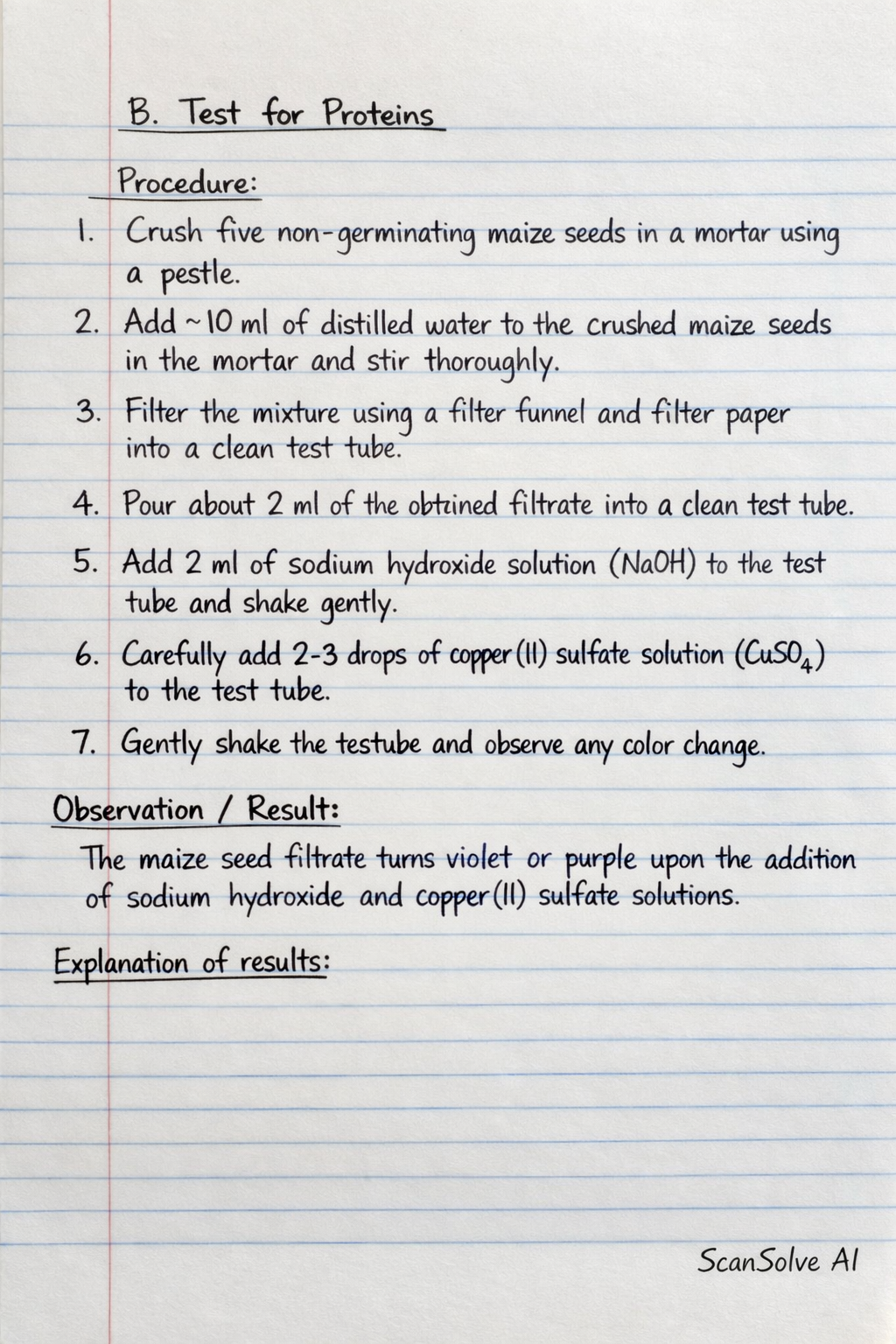
B. Test for Proteins
Procedure:
- Crush five non-germinating maize seeds in a mortar using a pestle.
- Add approximately 10 ml of distilled water to the crushed maize seeds in the mortar and stir thoroughly.
- Filter the mixture using a filter funnel and filter paper into a clean test tube or beaker to obtain the maize seed filtrate.
- Pour about 2 ml of the obtained filtrate into a clean test tube.
- Add 2 ml of sodium hydroxide solution (NaOH) to the test tube and shake gently.
- Carefully add 2-3 drops of copper(II) sulfate solution (CuSO) to the test tube.
- Gently shake the test tube and observe any color change.
Observation / Result:
- The maize seed filtrate turns violet or purple upon the addition of sodium hydroxide and copper(II) sulfate solutions.
Explanation of results:
- The Biuret test is used to detect the presence of proteins.
- Proteins are composed of amino acids linked by peptide bonds.
- In the presence of an alkaline solution (sodium hydroxide), copper(II) ions from copper(II) sulfate react with the peptide bonds in proteins to form a violet-colored complex.
- Non-germinating maize seeds contain proteins, particularly in the embryo and to a lesser extent in the endosperm, which serve as food reserves.
- The violet color change observed indicates a positive test for proteins, confirming their presence in the non-germinating maize seed filtrate.
Was this helpful?
Still stuck on this one?
Ask a follow-up, and the answer starts from this question.
Got a different question?Ask your own question
More Biology Questions
QDescribe the procedure, observation/result, and explanation for the reducing sugars test using…QDescribe the procedure, observation, and explanation for testing non-germinating maize seeds for…QDescribe the procedure, expected observations, and explanation for testing the presence of starch in…QDescribe the results and explain the observations of an iodine test on a non-germinating maize…QExplain the results of an iodine test on a non-germinating maize grain, detailing the color changes…
Browse by topic:Biochemistry
Handwritten Step-by-Step Solution
Get this as a handwritten image on WhatsApp — like a tutor wrote it for you.
Try on WhatsApp