
We read your photo as:
Explain the process of ion uptake by plant roots, including the role of respiration and oxygen concentration. Discuss factors affecting this process and ways to inhibit it.
ScanSolve AI Answer
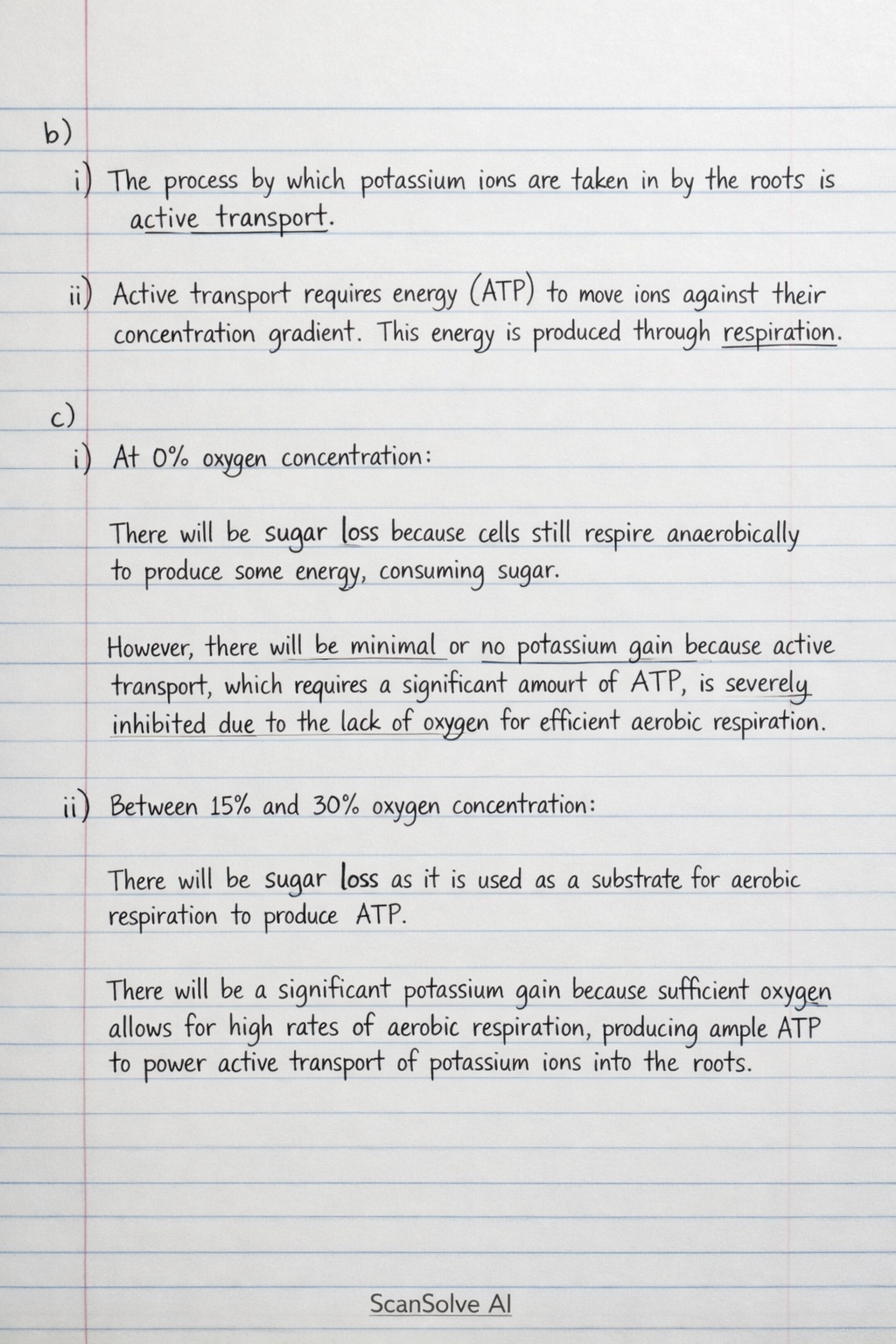
b)
i) The process by which potassium ions are taken in by the roots is active transport.
ii) Active transport requires energy (ATP) to move ions against their concentration gradient. This energy is produced through respiration.
c)
i) At 0% oxygen concentration: There will be sugar loss because cells still respire anaerobically to produce some energy, consuming sugar. However, there will be minimal or no potassium gain because active transport, which requires a significant amount of ATP, is severely inhibited due to the lack of oxygen for efficient aerobic respiration.
ii) Between 15% and 30% oxygen concentration: There will be sugar loss as it is used as a substrate for aerobic respiration to produce ATP. There will be a significant potassium gain because sufficient oxygen allows for high rates of aerobic respiration, producing ample ATP to power active transport of potassium ions into the roots.
d) Apart from oxygen concentration, two other possible factors that affect the process (active transport of ions) are:
- Temperature (affects enzyme activity in respiration and transport)
- Availability of glucose/sugar (as a substrate for respiration to produce ATP)
e) Two ways to stop the above process (active transport of ions) are:
- Removing oxygen from the environment to stop aerobic respiration and ATP production.
- Adding metabolic inhibitors (e.g., cyanide) that block ATP production.
a) Pollution is the introduction of harmful substances or contaminants into the natural environment, causing adverse changes.
b) Water pollution:
i) Causes:
- Industrial discharge of untreated waste into water bodies.
- Sewage and domestic waste from urban areas.
- Agricultural runoff containing pesticides, herbicides, and fertilizers.
- Oil spills from ships and offshore drilling.
ii) Effects of pollutants on plants and animals:
- Eutrophication: Excess nutrients (from fertilizers/sewage) lead to algal blooms, which deplete oxygen when they decompose, harming aquatic life.
- Toxicity: Heavy metals and chemicals directly poison aquatic organisms, leading to death or impaired reproduction.
- Bioaccumulation and biomagnification: Toxins accumulate in organisms and become more concentrated up the food chain, affecting top predators.
- Habitat destruction: Sedimentation and chemical changes can destroy breeding grounds and food sources.
iii) Methods of controlling pollution:
- Wastewater treatment: Treating sewage and industrial effluent before discharge.
- Sustainable agriculture: Reducing the use of chemical fertilizers and pesticides.
- Proper waste management: Implementing effective recycling and disposal systems to prevent litter from reaching water bodies.
- Legislation and enforcement: Implementing strict laws and regulations to control industrial discharges and prevent illegal dumping.
a) Mitosis is a type of cell division that results in two daughter cells each having the same number and kind of chromosomes as the parent nucleus, typical of ordinary tissue growth.
b) The process of mitosis involves several distinct phases:
- Prophase: Chromatin condenses into visible chromosomes, each consisting of two sister chromatids. The nuclear envelope begins to break down, and the spindle fibers start to form from the centrosomes.
- Metaphase: The chromosomes align along the metaphase plate (equatorial plane) of the cell. Each sister chromatid is attached to a spindle fiber from opposite poles.
- Anaphase: The sister chromatids separate and are pulled apart by the shortening spindle fibers towards opposite poles of the cell. Each chromatid is now considered an individual chromosome.
- Telophase: The chromosomes arrive at the poles and begin to decondense. New nuclear envelopes form around the two sets of chromosomes, and the spindle fibers disappear.
- Cytokinesis: The cytoplasm divides, typically by the formation of a cleavage furrow in animal cells or a cell plate in plant cells, resulting in two genetically identical daughter cells.
Functions of mitosis:
- Growth: Mitosis increases the number of cells in an organism, leading to growth and development.
- Repair and replacement: It replaces damaged or dead cells, ensuring tissue repair and maintenance.
- Asexual reproduction: In some organisms (e.g., single-celled organisms, plants), mitosis is the primary method of asexual reproduction.
Still stuck on this one?
Ask a follow-up, and the answer starts from this question.
More Biology Questions
Handwritten Step-by-Step Solution
Get this as a handwritten image on WhatsApp — like a tutor wrote it for you.
Try on WhatsApp