
We read your photo as:
Describe prokaryotic and eukaryotic cells with diagrams and differentiate them in tabular form.
ScanSolve AI Answer
Step-by-step solution
11 stepsOkay, let's continue with the remaining questions.
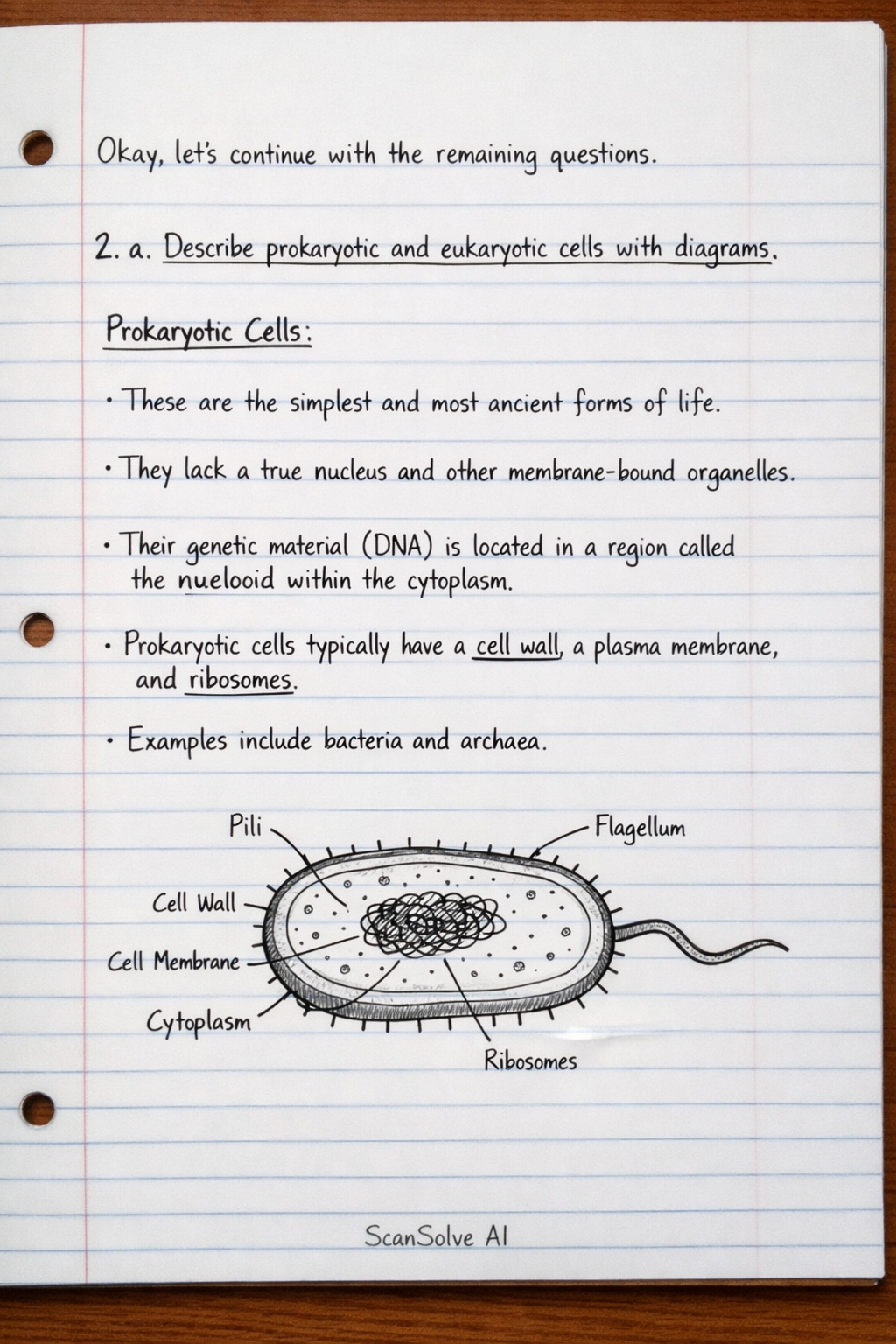
2. a. Describe prokaryotic and eukaryotic cells with diagrams.
- Prokaryotic Cells: These are the simplest and most ancient forms of life. They lack a true nucleus and other membrane-bound organelles. Their genetic material (DNA) is located in a region called the nucleoid within the cytoplasm. Prokaryotic cells typically have a cell wall, a plasma membrane, and ribosomes. Examples include bacteria and archaea. (A typical diagram would show a cell wall, cell membrane, cytoplasm, ribosomes, and a nucleoid region containing DNA, possibly with a flagellum or pili).
- Eukaryotic Cells: These are more complex cells characterized by the presence of a true nucleus, which encloses their genetic material, and various membrane-bound organelles (e.g., mitochondria, endoplasmic reticulum, Golgi apparatus, lysosomes, vacuoles, chloroplasts in plants). These organelles perform specialized functions within the cell. Examples include plant cells, animal cells, fungi, and protists. (A typical diagram would show a nucleus, mitochondria, endoplasmic reticulum, Golgi apparatus, cytoplasm, and a cell membrane, with a cell wall and chloroplasts if it's a plant cell).
2. b. In a tabular form, differentiate between prokaryotes and eukaryotes.
| Feature | Prokaryotic Cell | Eukaryotic Cell |
|---|---|---|
| Nucleus | Absent; DNA in nucleoid region | Present; DNA enclosed within a nuclear membrane |
| Membrane-bound organelles | Absent | Present (e.g., mitochondria, ER, Golgi) |
| DNA | Circular, usually single chromosome | Linear, multiple chromosomes |
| Size | Generally smaller () | Generally larger () |
| Cell Wall | Present (peptidoglycan in bacteria) | Present in plants (cellulose) and fungi (chitin); absent in animals |
| Ribosomes | Smaller () | Larger () |
| Reproduction | Asexual (binary fission) | Asexual (mitosis) and sexual (meiosis) |
| Examples | Bacteria, Archaea | Plants, Animals, Fungi, Protists |
3. Write short note on the following
- a. Calcium oxalate crystals: These are metabolic byproducts found in many plant cells, often in the vacuoles. They occur in various shapes, including raphides (needle-shaped), druses (spherical aggregates), prisms (single crystals), and styloids (elongated prisms). They play roles in plant defense against herbivores and calcium regulation.
- b. Calcium carbonate crystals: These crystals are typically found as cystoliths, which are outgrowths of the cell wall into the lumen of epidermal cells, particularly in plants like those in the Urticaceae (nettle) and Moraceae (fig) families. They are usually grape-like or club-shaped and are thought to be involved in light scattering and defense.
- c. Silica: Silica (silicon dioxide, ) is deposited in various forms within plant tissues, especially in the epidermal cells and cell walls of grasses (Poaceae) and horsetails (Equisetaceae). It provides structural rigidity, enhances resistance to pests and diseases, and contributes to the abrasive nature of some plant surfaces.
4. Describe the various types of trichomes found in plants with example(s) of each
Trichomes are epidermal outgrowths of plants, varying widely in structure and function.
- Unicellular Trichomes: Single-celled hairs, often elongated.
- Example: Cotton fibers (from Gossypium species).
- Multicellular Trichomes: Composed of multiple cells, which can be uniseriate (single row of cells) or multiseriate (multiple rows).
- Example: Stinging hairs of nettle (Urtica dioica).
- Glandular Trichomes: Possess a secretory head, often on a stalk, that produces and releases various substances (e.g., essential oils, resins, mucilage).
- Example: Mentha species (peppermint, spearmint) which produce menthol.
- Non-glandular Trichomes: Do not secrete substances; primarily serve protective functions, reducing water loss or deterring herbivores.
- Example: Stellate (star-shaped) hairs on Verbascum species (mullein).
- Branched Trichomes: Hairs that divide into multiple arms or branches.
- Example: Found in Artemisia species.
- Scales (Peltate Trichomes): Flattened, shield-like structures that lie parallel to the epidermal surface.
- Example: Found on the leaves of Olea europaea (olive).
5. Explain with an example how to calibrate an eyepiece micrometer
Calibrating an eyepiece micrometer (EM) is essential to determine the actual length represented by each of its divisions at different magnifications.
Place a stage micrometer (SM) on the microscope stage and focus on its scale.
The stage micrometer has a precisely known scale (e.g., 1 mm divided into 100 divisions, so each division is or ).
Insert the eyepiece micrometer into the microscope eyepiece.
Align the zero mark of the eyepiece micrometer with the zero mark of the stage micrometer.
Find a point where another mark on the eyepiece micrometer exactly coincides with a mark on the stage micrometer.
Count the number of eyepiece micrometer divisions (EMD) and the corresponding number of stage micrometer divisions (SMD) that coincide.
Calculate the value of one eyepiece micrometer division using the formula
- Example: If 50 divisions of the eyepiece micrometer coincide with 10 divisions of the stage micrometer, and each stage micrometer division is ():
Repeat this calibration for each objective lens (magnification) used, as the value of an EMD changes with magnification.
6. Explain how to prepare a drug sample for microscopical examination
The preparation method depends on whether the drug is organized (e.g., leaf, root) or unorganized (e.g., gum, resin) and its physical state (whole, cut, or powdered).
For organized drugs (e.g., leaves, barks, roots)*
Cut very thin transverse or longitudinal sections using a sharp razor blade or microtome. The sections should be thin enough for light to pass through.
For powdered drugs*
Place a small amount of the powder (a few milligrams) on a clean microscope slide.
Add a suitable mounting medium.
Common media include: * Water: For general observation. * Glycerin: To prevent drying and improve clarity. * Chloral hydrate solution: To clear plant tissues by dissolving starch and chlorophyll, making internal structures more visible. Gentle heating may be required. * Phloroglucinol and concentrated HCl: To stain lignified tissues red. * Sudan III or IV: To stain oily or fatty substances red/orange.
Gently lower a coverslip over the sample, avoiding air bubbles.
If using a clearing agent like chloral
Still stuck on this one?
Ask a follow-up, and the answer starts from this question.
More Biology Questions
Handwritten Step-by-Step Solution
Get this as a handwritten image on WhatsApp — like a tutor wrote it for you.
Try on WhatsApp