
We read your photo as:
Provide answers for question 1 about excretion, grafting, and laboratory safety.
ScanSolve AI Answer
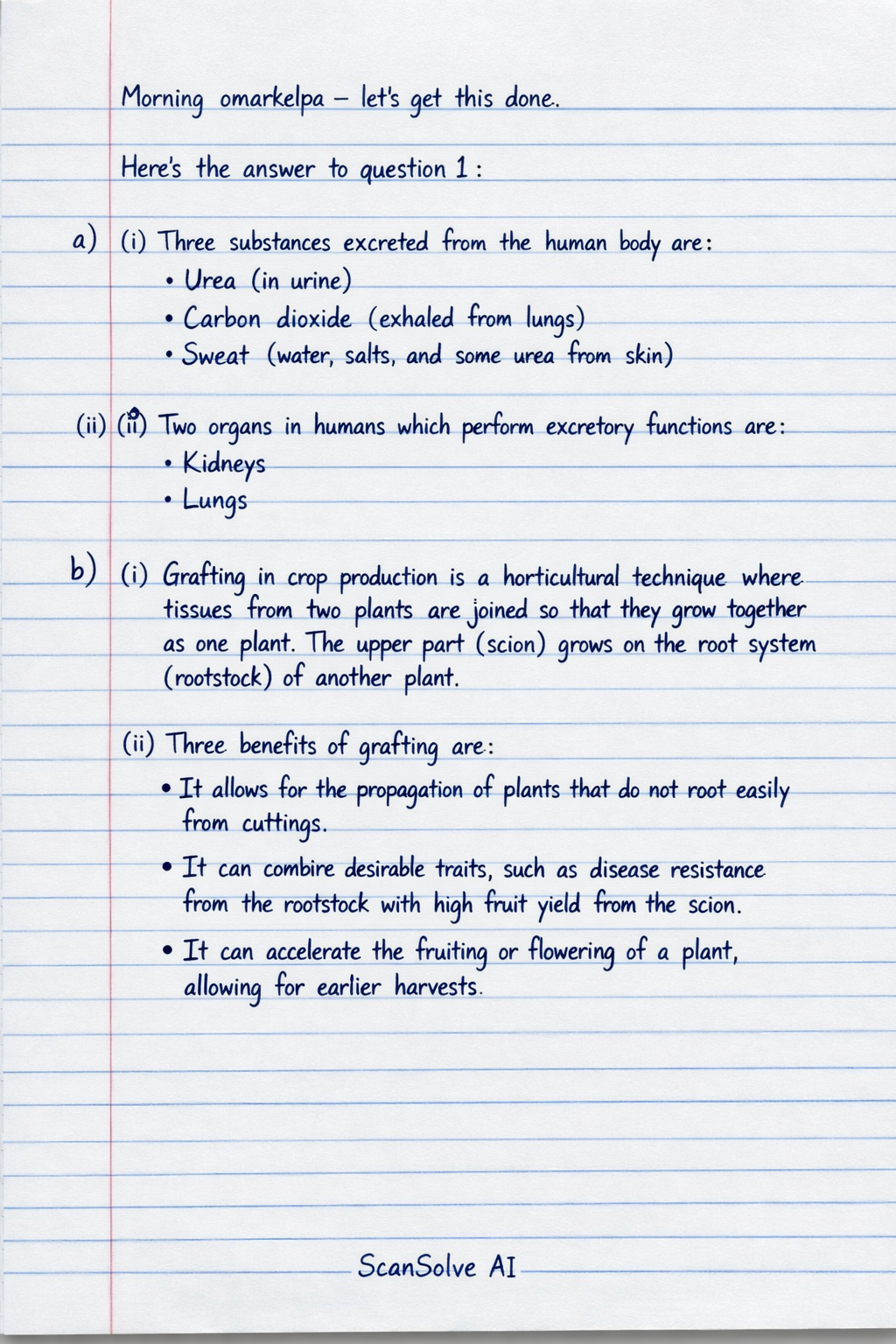
Here's the answer to question 1:
a)
(i) Three substances excreted from the human body are:
- Urea (in urine)
- Carbon dioxide (exhaled from lungs)
- Sweat (water, salts, and some urea from skin)
(ii) Two organs in humans which perform excretory functions are:
- Kidneys
- Lungs
b)
(i) Grafting in crop production is a horticultural technique where tissues from two plants are joined so that they grow together as one plant. The upper part (scion) grows on the root system (rootstock) of another plant.
(ii) Three benefits of grafting are:
- It allows for the propagation of plants that do not root easily from cuttings.
- It can combine desirable traits, such as disease resistance from the rootstock with high fruit yield from the scion.
- It can accelerate the fruiting or flowering of a plant, allowing for earlier harvests.
c)
(i) Two ways in which scientific methods are important are:
- They provide a systematic and logical approach to solving problems and understanding natural phenomena, ensuring reliability of results.
- They allow for the testing of hypotheses through experimentation and observation, leading to the development of new knowledge and technologies.
(ii) One reason for each of the following laboratory rules:
- (α) Do not wear rubber slippers to the laboratory: To protect feet from chemical spills, broken glass, or heavy falling objects, and to provide electrical insulation.
- (β) Close all taps before leaving the laboratory: To prevent flooding and to conserve water.
- (γ) Spilled liquids must be cleaned immediately: To prevent slips and falls, and to avoid contamination or damage to equipment/surfaces.
d)
(i) Earthing (or grounding) in household wiring is a safety measure that connects the metal casing of electrical appliances to the earth via a low-resistance wire. This provides a safe path for fault current to flow directly to the ground in case of an electrical fault, preventing electric shock.
(ii) Two sources of electric power generation are:
- Thermal power plants (e.g., burning coal, natural gas, or oil)
- Hydroelectric power plants (using the force of moving water)
Still stuck on this one?
Ask a follow-up, and the answer starts from this question.
More Biology Questions
Handwritten Step-by-Step Solution
Get this as a handwritten image on WhatsApp — like a tutor wrote it for you.
Try on WhatsApp