
We read your photo as:
Please provide information on Carbon Monoxide Poisoning and Snake Bites, including definitions, signs/symptoms, and management/antidotes.
ScanSolve AI Answer
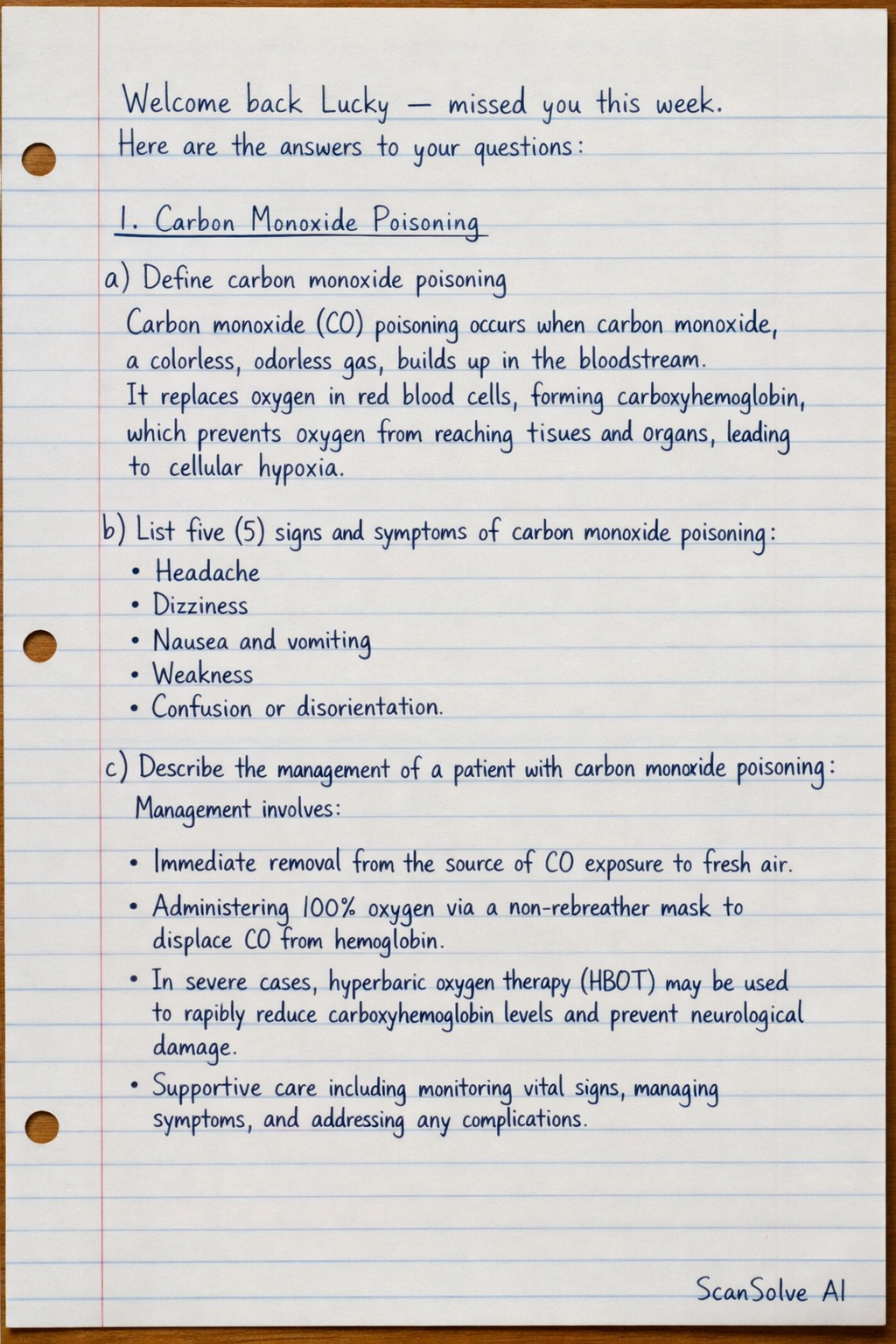
Here are the answers to your questions:
1. Carbon Monoxide Poisoning
a) Define carbon monoxide poisoning
Carbon monoxide (CO) poisoning occurs when carbon monoxide, a colorless, odorless gas, builds up in the bloodstream. It replaces oxygen in red blood cells, forming carboxyhemoglobin, which prevents oxygen from reaching tissues and organs, leading to cellular hypoxia.
b) List five (5) signs and symptoms of carbon monoxide poisoning
- Headache
- Dizziness
- Nausea and vomiting
- Weakness
- Confusion or disorientation
c) Describe the management of a patient with carbon monoxide poisoning
Management involves:
- Immediate removal from the source of CO exposure to fresh air.
- Administering 100% oxygen via a non-rebreather mask to displace CO from hemoglobin.
- In severe cases, hyperbaric oxygen therapy (HBOT) may be used to rapidly reduce carboxyhemoglobin levels and prevent neurological damage.
- Supportive care including monitoring vital signs, managing symptoms, and addressing any complications.
2. Snake Bite
a) What is the antidote for snake bite
The antidote for snake bite is antivenom (also known as antivenin).
b) List five (5) signs and symptoms of snake bite
- Local pain and swelling at the bite site
- Bleeding from the bite site or other orifices (e.g., gums, nose)
- Nausea and vomiting
- Weakness or dizziness
- Difficulty breathing or paralysis (in severe cases)
c) Describe the management of a patient with snake bite
Management involves:
- Immobilizing the affected limb below the level of the heart to slow venom spread.
- Rapid transport to a medical facility.
- Administering appropriate antivenom based on the snake species (if known) and severity of symptoms.
- Monitoring vital signs and observing for signs of systemic envenomation (e.g., coagulopathy, neurological deficits).
- Supportive care including pain management, fluid resuscitation, and tetanus prophylaxis.
3. A 40 year old man is brought from a farm after pesticide exposure. He is sweating excessively, drooling saliva, has difficulty breathing and muscle twitching.
a) What is the antidote for OPP
The primary antidote for organophosphate poisoning (OPP) is atropine. Pralidoxime (2-PAM) is also used as an oxime reactivator.
b) List signs and symptoms of patient with OPP (Organophosphate poisoning)
Signs and symptoms of OPP can be remembered by the mnemonic SLUDGE (Salivation, Lacrimation, Urination, Defecation, Gastrointestinal upset, Emesis) and DUMBELS (Diarrhea, Urination, Miosis, Bronchospasm/Bradycardia, Emesis, Lacrimation, Salivation). Specific signs include:
- Excessive salivation and drooling
- Sweating (diaphoresis)
- Difficulty breathing (bronchospasm, increased bronchial secretions)
- Muscle twitching, weakness, or paralysis
- Miosis (constricted pupils)
c) Describe the management of patient with OPP
Management involves:
- Decontamination: Removing contaminated clothing and washing skin with soap and water to prevent further absorption.
- Airway management: Ensuring a patent airway, providing oxygen, and potentially intubation if respiratory distress is severe.
- Administering atropine: Titrating doses intravenously until bronchorrhea and bradycardia resolve.
- Administering pralidoxime (2-PAM): To reactivate acetylcholinesterase, especially if given early.
- Supportive care: Monitoring vital signs, managing seizures, and providing fluid support.
4. A 65 year old man is found outdoors at night unconscious with cold skin and slow pulse. His temperature is 28°C.
a) Describe the classification of the type of hypothermia
Based on a core body temperature of 28°C, this patient is experiencing moderate hypothermia.
Classification of hypothermia:
- Mild: to ( to )
- Moderate: to ( to )
- Severe: Below (Below )
b) List the sign and symptoms of the classified hypothermia
For moderate hypothermia ( to ):
- Impaired consciousness or unconsciousness
- Slowed heart rate (bradycardia) and respiration
- Cold skin
- Shivering may cease
- Dilated pupils
- Muscle rigidity
c) Describe the management of the patient
Management of moderate hypothermia involves:
- Gentle handling: To avoid precipitating arrhythmias.
- Removing wet clothing and insulating the patient with dry blankets.
- Passive external rewarming: Using blankets, warm environment.
- Active external rewarming: Applying heat packs to the torso, armpits, and groin.
- Active internal (core) rewarming: Administering warmed intravenous fluids, warmed humidified oxygen, or gastric/bladder lavage with warm fluids.
- Continuous cardiac monitoring for arrhythmias.
- Supportive care for vital signs and any complications.
Still stuck on this one?
Ask a follow-up, and the answer starts from this question.
More Biology Questions
Handwritten Step-by-Step Solution
Get this as a handwritten image on WhatsApp — like a tutor wrote it for you.
Try on WhatsApp