
We read your photo as:
Question one to question six solve all that's plant propagation questions
ScanSolve AI Answer
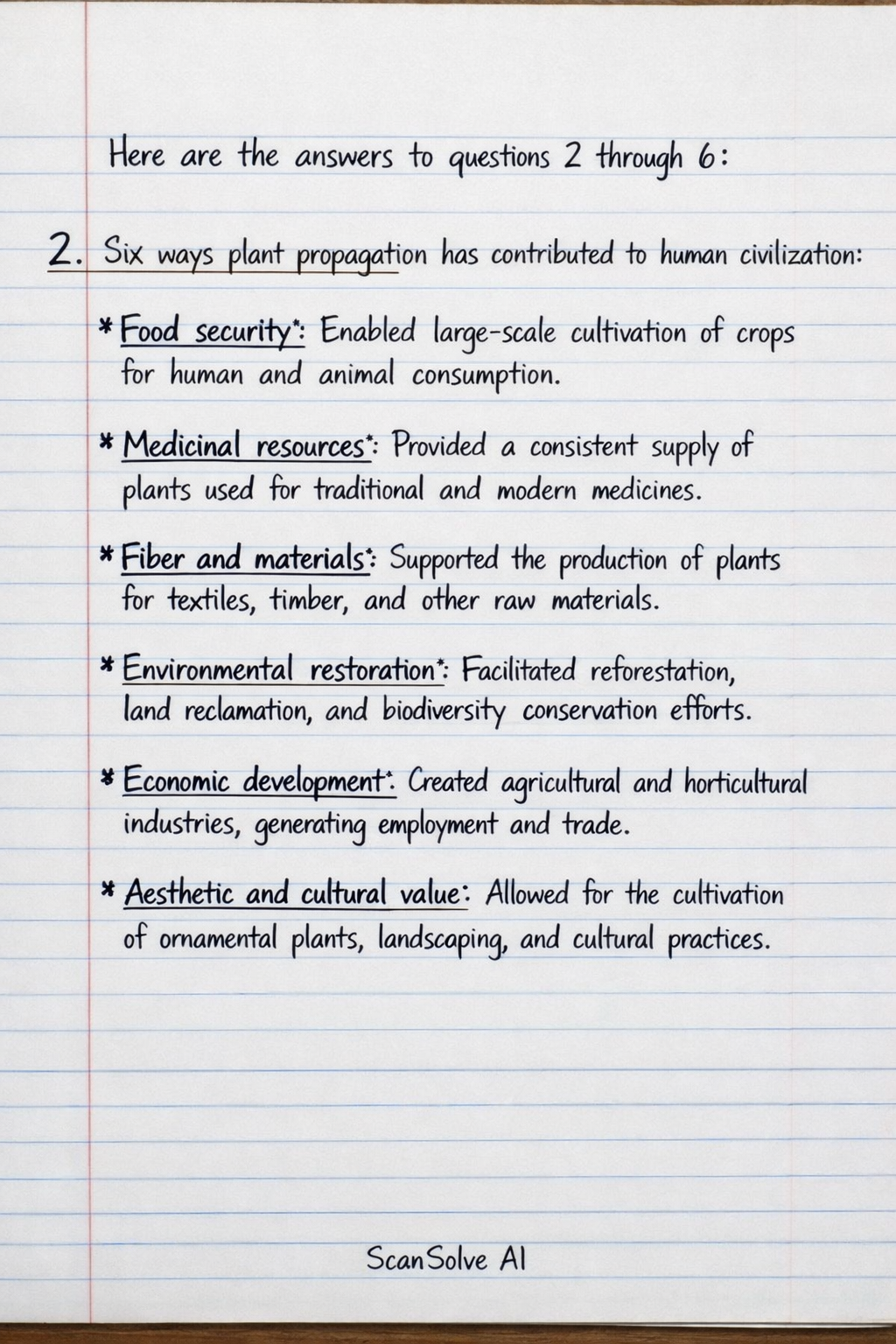
Here are the answers to questions 2 through 6:
- Six ways plant propagation has contributed to human civilization:
- Food security: Enabled large-scale cultivation of crops for human and animal consumption.
- Medicinal resources: Provided a consistent supply of plants used for traditional and modern medicines.
- Fiber and materials: Supported the production of plants for textiles, timber, and other raw materials.
- Environmental restoration: Facilitated reforestation, land reclamation, and biodiversity conservation efforts.
- Economic development: Created agricultural and horticultural industries, generating employment and trade.
- Aesthetic and cultural value: Allowed for the cultivation of ornamental plants, landscaping, and cultural practices.
- The physical and genetic components of seed purity are:
- Physical purity: Refers to the percentage by weight of pure seed of the specified crop variety, free from inert matter (chaff, dirt), weed seeds, and seeds of other crop species.
- Genetic purity: Refers to the degree to which the seeds are true-to-type, meaning they possess the desired genetic characteristics and traits of the specified cultivar or variety.
-
Ten examples of containers used in growing young plants in a nursery:
-
Plastic pots
-
Peat pots
-
Jiffy pots/pellets
-
Seed trays/flats
-
Root trainers
-
Grow bags
-
Clay pots
-
Fabric pots
-
Paper pots
-
Biodegradable pots
-
Eight examples of media used in propagating and growing nursery plants:
-
Peat moss
-
Coir (coconut fiber)
-
Perlite
-
Vermiculite
-
Sand
-
Compost
-
Bark (e.g., pine bark)
-
Rockwool
-
Harrington's rule of thumb states that for every 1% decrease in seed moisture content (between 5% and 14%) or every decrease in storage temperature (between and ), the life of the seed is doubled.
Its significance in seed storage and plant propagation is:
- It provides a practical guideline for optimizing storage conditions to maximize seed longevity.
- By controlling moisture and temperature, it helps maintain seed viability for extended periods, ensuring successful germination and propagation when needed.
- This rule is fundamental for seed banks and commercial growers to preserve genetic resources and manage seed inventories effectively.
Still stuck on this one?
Ask a follow-up, and the answer starts from this question.
More Biology Questions
Handwritten Step-by-Step Solution
Get this as a handwritten image on WhatsApp — like a tutor wrote it for you.
Try on WhatsApp