
We read your photo as:
Question Three: (a) i. Outline any four (4) amino acids ii. Describe the formation of a peptide bond. (b) i. What is the relationship between amino acids and proteins? ii. Write on Protein structure. (c) In tabular form, outline the biological functions of proteins
ScanSolve AI Answer
Here are the answers to all the questions from the image, formatted as requested:
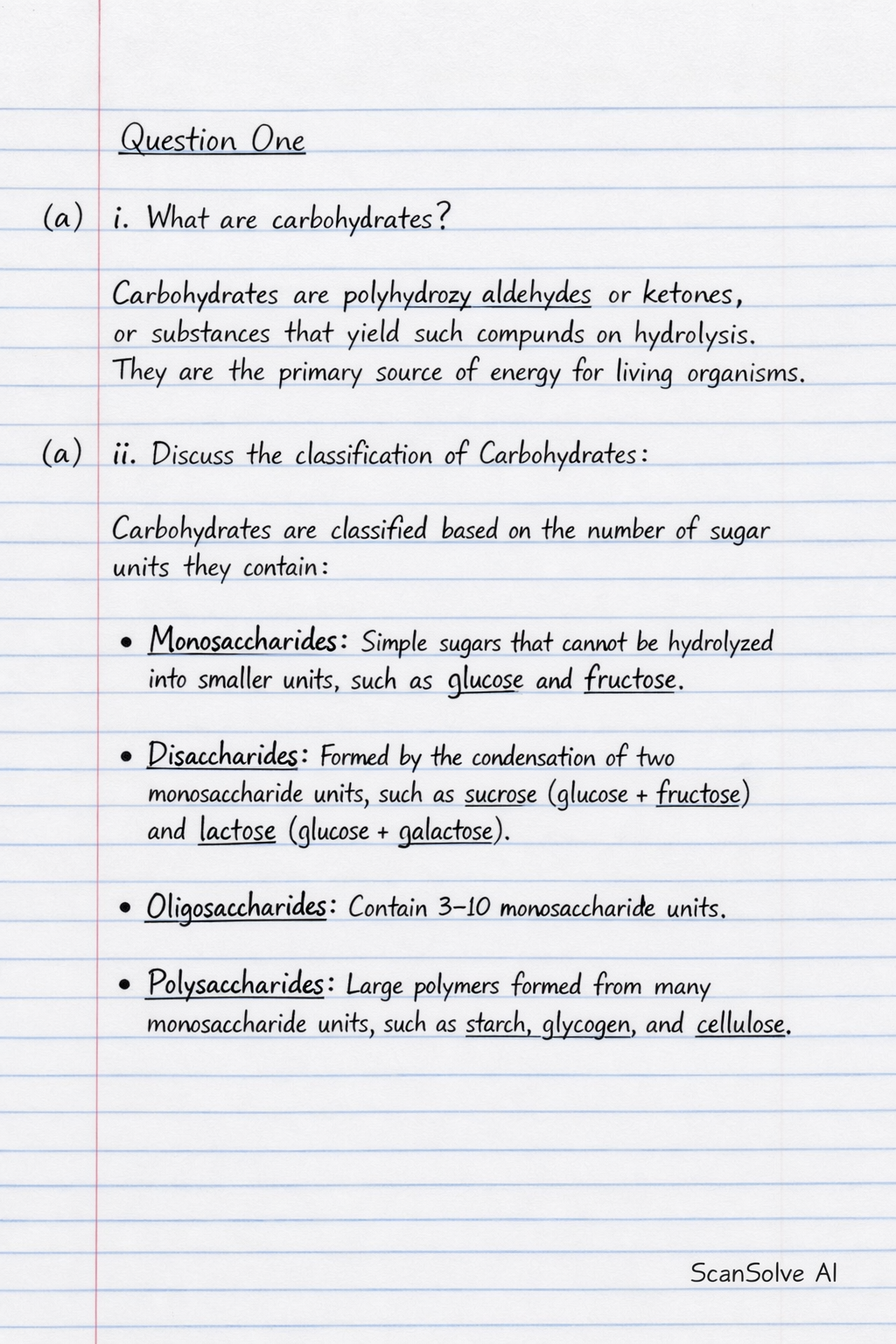
Question One
a) i. What are carbohydrates?
Carbohydrates are polyhydroxy aldehydes or ketones, or substances that yield such compounds on hydrolysis. They are the primary source of energy for living organisms.
a) ii. Discuss the classification of Carbohydrates.
Carbohydrates are classified based on the number of sugar units they contain:
- Monosaccharides: Simple sugars that cannot be hydrolyzed into smaller units, such as glucose and fructose.
- Disaccharides: Formed by the condensation of two monosaccharide units, such as sucrose (glucose + fructose) and lactose (glucose + galactose).
- Oligosaccharides: Contain 3-10 monosaccharide units.
- Polysaccharides: Large polymers formed from many monosaccharide units, such as starch, glycogen, and cellulose.
b) Write short note on:
i. Maltose: A disaccharide composed of two -D-glucose units linked by an -(14) glycosidic bond. It is commonly known as malt sugar and is an intermediate product in the digestion of starch.
ii. Lactose: A disaccharide found in milk, composed of -D-galactose and - or -D-glucose linked by a -(14) glycosidic bond. It is often called milk sugar.
iii. Glycogen: A highly branched polysaccharide of glucose units, serving as the primary storage form of glucose in animals and fungi. It is often referred to as "animal starch."
iv. Cellobiose: A disaccharide composed of two -D-glucose units linked by a -(14) glycosidic bond. It is a disaccharide unit of cellulose and is not digestible by humans.
c) i. What are Amines?
Amines are organic compounds derived from ammonia () where one or more hydrogen atoms are replaced by alkyl or aryl groups. They are characterized by the presence of a nitrogen atom with a lone pair of electrons, making them basic.
c) ii. Discuss the classification of amines with examples.
Amines are classified based on the number of alkyl or aryl groups attached to the nitrogen atom:
- Primary amines (): One alkyl/aryl group attached to nitrogen (e.g., , methylamine).
- Secondary amines (): Two alkyl/aryl groups attached to nitrogen (e.g., , dimethylamine).
- Tertiary amines (): Three alkyl/aryl groups attached to nitrogen (e.g., , trimethylamine).
- Quaternary ammonium salts: Nitrogen atom is bonded to four alkyl/aryl groups and carries a positive charge, forming an ionic salt (e.g., , tetramethylammonium chloride).
Question Two
a) Define the following terms:
i. Lipids: A diverse group of naturally occurring organic compounds that are insoluble in water but soluble in nonpolar organic solvents. They include fats, oils, waxes, and steroids.
ii. Triglycerides: Esters derived from glycerol and three fatty acids. They are the main components of body fat in humans and other vertebrates, as well as vegetable fat.
iii. Rancidity: The chemical decomposition of fats and oils, leading to unpleasant odors and flavors. It is primarily caused by hydrolysis and oxidation of the fatty acids.
b) i. Write on the properties of Triglycerides.
Triglycerides are generally hydrophobic and insoluble in water but soluble in organic solvents. Their physical state (solid fat or liquid oil) at room temperature depends on the degree of saturation of their fatty acid chains. Chemically, they undergo hydrolysis (breaking down into glycerol and fatty acids) and saponification (hydrolysis with a strong base to form soap). They can also undergo hydrogenation (addition of hydrogen to unsaturated bonds) and oxidation (leading to rancidity).
b) ii. Discuss the biological functions of Triglycerides.
Triglycerides serve several vital biological functions:
- Energy storage: They are the most efficient form of energy storage, providing more than twice the energy per gram compared to carbohydrates or proteins.
- Insulation: The fat layer beneath the skin provides thermal insulation, helping to maintain body temperature.
- Protection: Adipose tissue cushions vital organs against physical shock.
- Absorption of fat-soluble vitamins: Dietary triglycerides are essential for the absorption and transport of fat-soluble vitamins (A, D, E, K).
c) i. Explain the term Saponification.
Saponification is the hydrolysis of an ester (typically a triglyceride) with a strong base (like or ) to produce an alcohol (glycerol) and a salt of a carboxylic acid (soap). This reaction is irreversible and is the primary method for manufacturing soap.
c) ii. Discuss the commercial applications of fats and oil.
Fats and oils have numerous commercial applications:
- Food industry: Used as cooking oils, shortenings, margarines, and ingredients in baked goods for flavor, texture, and energy.
- Soap and detergent production: Saponification of fats and oils yields soap, a primary cleaning agent.
- Cosmetics and pharmaceuticals: Used in lotions, creams, ointments, and other personal care products as emollients, moisturizers, and carriers for active ingredients.
- Biofuels: Transesterification of vegetable oils and animal fats produces biodiesel, a renewable alternative to petroleum diesel.
Question Three
a) i. Outline any four (4) amino acids.
Four common amino acids are:
- Glycine (Gly)
- Alanine (Ala)
- Valine (Val)
- Leucine (Leu)
a) ii. Describe the formation of a peptide bond.
A peptide bond is formed by a condensation reaction (dehydration synthesis) between the carboxyl group () of one amino acid and the amino group () of another amino acid. During this reaction, a molecule of water is removed, and a covalent bond forms between the carbon atom of the carboxyl group and the nitrogen atom of the amino group, resulting in an amide linkage ().
b) i. What is the relationship between amino acids and proteins?
Amino acids are the fundamental monomeric building blocks of proteins. Proteins are polymers formed by long chains of amino acids linked together by peptide bonds. The specific sequence of amino acids determines the protein's unique structure and function.
b) ii. Write on Protein structure.
Protein structure is described at four hierarchical levels:
- Primary structure: The unique linear sequence of amino acids in the polypeptide chain.
- Secondary structure: Localized folding patterns of the polypeptide chain, primarily stabilized by hydrogen bonds. Common forms include the alpha-helix and beta-pleated sheet.
- Tertiary structure: The overall three-dimensional shape of a single polypeptide chain, resulting from interactions between the side chains (R-groups) of amino acids.
- Quaternary structure: The arrangement of multiple polypeptide subunits (if present) to form a functional protein complex.
c) In tabular form, outline the biological functions of proteins.
| Function | Description | Example |
|---|---|---|
| Enzymatic catalysis | Proteins act as biological catalysts, speeding up biochemical reactions without being consumed. | Amylase (digests starch), DNA polymerase (synthesizes DNA). |
| Structural support | Provide strength, rigidity, and organization to cells and tissues. | Collagen (connective tissue), Keratin (hair, nails). |
| Transport | Carry substances across cell membranes or throughout the body. | Hemoglobin (oxygen transport in blood), Ion channels (membrane transport). |
| Immune defense | Recognize and neutralize foreign invaders like bacteria and viruses. | Antibodies (immunoglobulins). |
| Movement | Essential components of muscle contraction and cellular motility. | Actin and Myosin (muscle contraction). |
| Signaling/Hormones | Transmit signals between cells or regulate physiological processes. | Insulin (regulates blood sugar), Growth hormone. |
| Storage | Store essential substances for later use. | Ferritin (stores iron), Casein (stores amino acids in milk). |
Still stuck on this one?
Ask a follow-up, and the answer starts from this question.
More Biology Questions
Handwritten Step-by-Step Solution
Get this as a handwritten image on WhatsApp — like a tutor wrote it for you.
Try on WhatsApp