
We read your photo as:
Questions about newborn jaundice: ABO incompatibility, physiological jaundice, and breastfeeding jaundice.
ScanSolve AI Answer
Answer
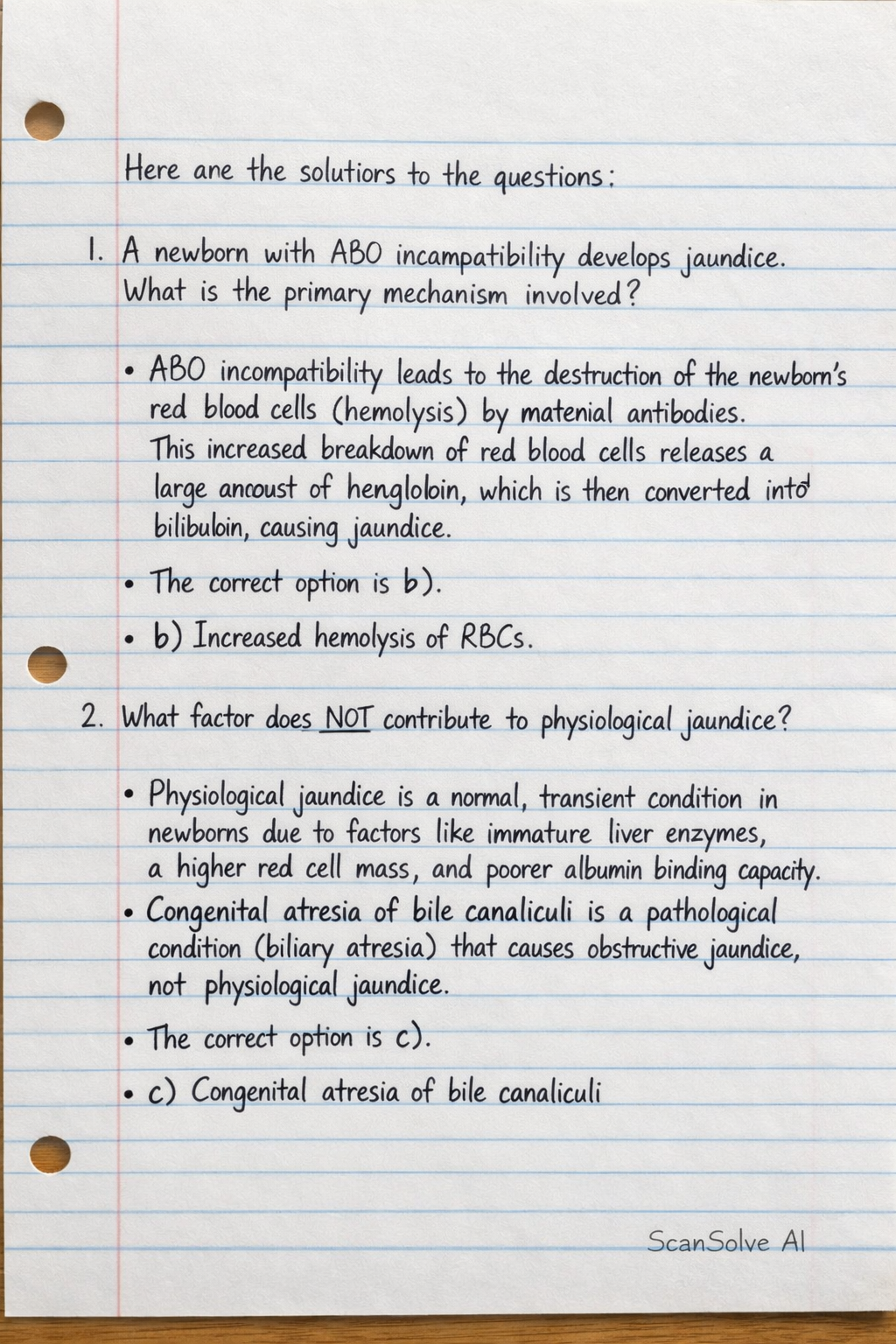
Here are the solutions to the questions:
-
A newborn with ABO incompatibility develops jaundice. What is the primary mechanism involved?
- ABO incompatibility leads to the destruction of the newborn's red blood cells (hemolysis) by maternal antibodies. This increased breakdown of red blood cells releases a large amount of hemoglobin, which is then converted into bilirubin, causing jaundice.
- The correct option is b).
- b) Increased hemolysis of RBCs
-
What factor does NOT contribute to physiological jaundice?
- Physiological jaundice is a normal, transient condition in newborns due to factors like immature liver enzymes, a higher red cell mass, and poorer albumin binding capacity. Congenital atresia of bile canaliculi is a pathological condition (biliary atresia) that causes obstructive jaundice, not physiological jaundice.
- The correct option is c).
- c) Congenital atresia of bile canaliculi
-
What is the most appropriate management for breastfeeding jaundice?
- Breastfeeding jaundice (also known as breast-non-feeding jaundice) occurs due to insufficient milk intake. The most appropriate management is to ensure the baby receives adequate milk by increasing the frequency and effectiveness of breastfeeding.
- The correct option is c).
- c) Increase the frequency of breastfeeding
-
A newborn has jaundice, dark urine, and white stools. What diagnostic feature confirms obstructive jaundice?
- Dark urine and white (acholic) stools are classic signs of obstructive jaundice, indicating that bilirubin is not reaching the intestines. In obstructive jaundice, the liver can conjugate bilirubin, but its excretion is blocked, leading to a buildup of conjugated bilirubin in the blood.
- The correct option is b).
- b) High conjugated bilirubin
-
Which type of jaundice occurs due to the mother's milk inhibiting bilirubin metabolism?
- Breastmilk jaundice is a specific type of jaundice that typically appears after the first week of life and can persist for several weeks. It is thought to be caused by substances in breast milk that interfere with bilirubin conjugation or increase its reabsorption.
- The correct option is d).
- d) Breastmilk jaundice
-
Which condition increases the risk of severe jaundice in newborns?
- G6PD deficiency (Glucose-6-phosphate dehydrogenase deficiency) is a genetic condition that causes red blood cells to break down (hemolyze) easily, leading to a rapid and significant increase in bilirubin levels, which can result in severe jaundice.
- The correct option is c).
- c) G6PD deficiency
-
What is the significance of early feeding in the management of neonatal jaundice?
- Early and frequent feeding, especially breastfeeding, promotes gut motility and helps establish normal gut flora. This increases the excretion of bilirubin in the stool and reduces the enterohepatic recirculation of bilirubin, thereby lowering bilirubin levels.
- The correct option is b).
- b) Promotes gut motility and colonization
-
Which symptom distinguishes pathological jaundice from physiological jaundice?
- Physiological jaundice typically appears after 24 hours of life. Jaundice that appears within the first 24 hours of life is considered pathological and often indicates a more serious underlying cause, such as hemolytic disease.
- The correct option is b).
- b) Jaundice appearing within 24 hours
Try one yourself
A new problem that tests the same skill.
Still stuck on this one?
Ask a follow-up, and the answer starts from this question.
More Biology Questions
Handwritten Step-by-Step Solution
Get this as a handwritten image on WhatsApp — like a tutor wrote it for you.
Try on WhatsApp