
Solve questions on ghram law of diffusion
ScanSolve AI Answer
Answer
Step-by-step solution
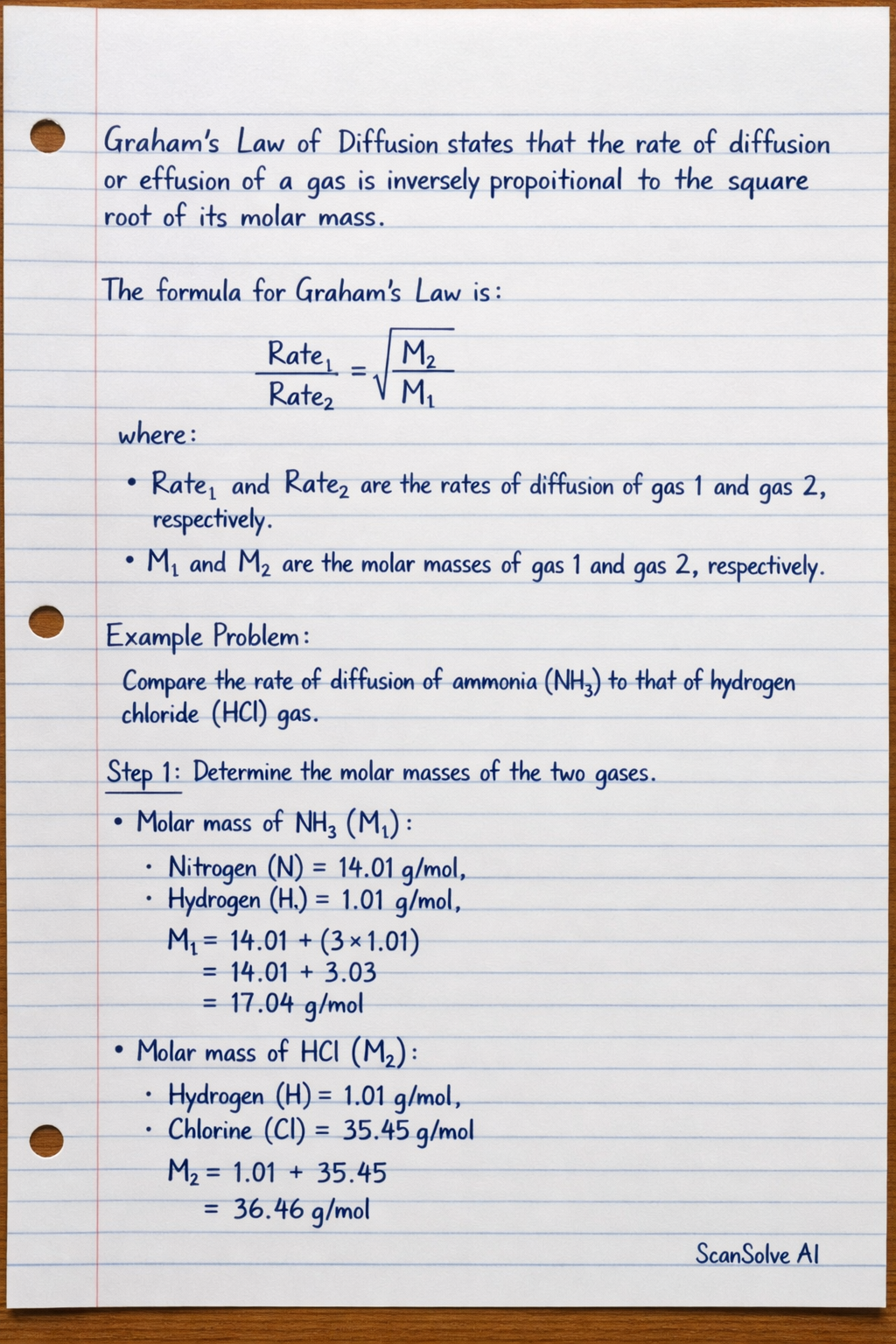
3 stepsGraham's Law of Diffusion states that the rate of diffusion or effusion of a gas is inversely proportional to the square root of its molar mass.
The formula for Graham's Law is:
where:
- and are the rates of diffusion of gas 1 and gas 2, respectively.
- and are the molar masses of gas 1 and gas 2, respectively.
Example Problem:
Compare the rate of diffusion of ammonia () to that of hydrogen chloride () gas.
Determine the molar masses of the two gases.
-
Molar mass of (): Nitrogen (N) = Hydrogen (H) =
-
Molar mass of (): Hydrogen (H) = Chlorine (Cl) =
-
Apply Graham's Law formula.
Let be the rate of and be the rate of .
Substitute the molar masses into the formula and calculate the ratio.
This means that ammonia gas diffuses approximately 1.46 times faster than hydrogen chloride gas.
The ratio of the rate of diffusion of ammonia to hydrogen chloride is approximately .
Try one yourself
A new problem that tests the same skill.
Still stuck on this one?
Ask a follow-up, and the answer starts from this question.
More Biology Questions
Handwritten Step-by-Step Solution
Get this as a handwritten image on WhatsApp — like a tutor wrote it for you.
Try on WhatsApp