
We read your photo as:
Read the extract below. 3.5.1 Identify the independent variable in the investigation. 3.5.2 State ONE way in which the marine biologists ensured the reliability of their results. 3.5.3 Explain why:
ScanSolve AI Answer
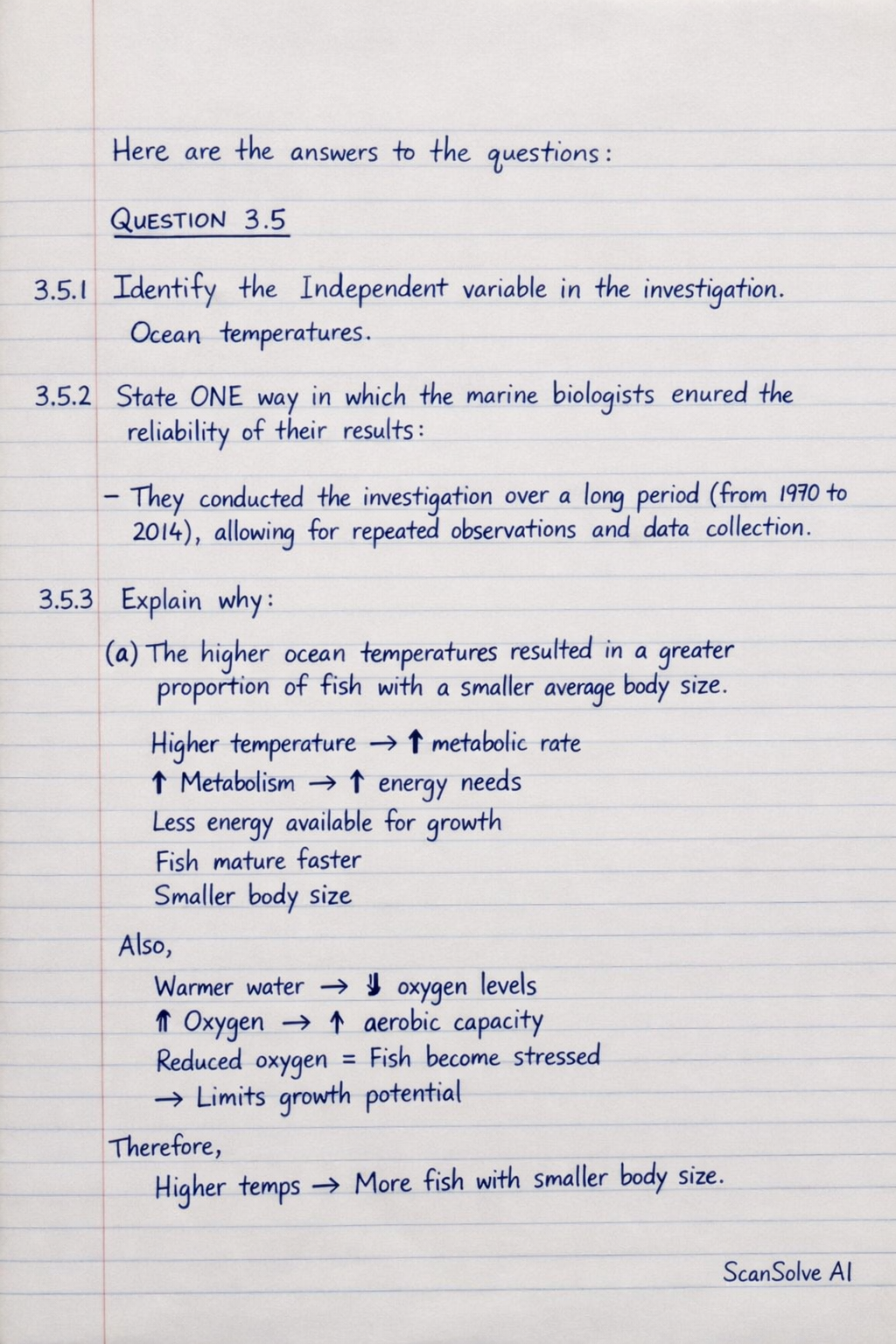
Here are the answers to the questions:
QUESTION 3.5
3.5.1 Identify the independent variable in the investigation.
- Ocean temperatures
3.5.2 State ONE way in which the marine biologists ensured the reliability of their results.
- They conducted the investigation over a long period (from 1970 to 2014), allowing for repeated observations and data collection.
3.5.3 Explain why:
-
(a) The higher ocean temperatures resulted in a greater proportion of fish with a smaller average body size. Higher ocean temperatures lead to a decrease in oxygen concentration in the water. Larger fish have higher metabolic rates and therefore require more oxygen for survival and essential activities like avoiding predators and finding food. With reduced oxygen availability, larger fish are at a disadvantage, experience a decline in performance, and have lower survival rates. Smaller fish, requiring less oxygen, are better adapted to these conditions, survive more successfully, and reproduce, leading to a greater proportion of smaller-bodied fish in the population over time.
-
(b) The use of trawling nets by fisherman could have affected the validity of this investigation. The investigation aims to determine the effect of ocean temperatures on fish body size. However, the text states that trawling nets mainly trap bigger fish, allowing smaller fish to escape. If the biologists used these nets or similar methods to collect their samples, the data would be biased towards smaller fish, regardless of the actual effect of ocean temperatures. This selective removal of larger fish by fishing practices would artificially lower the observed average body size, making it difficult to accurately attribute changes in body size solely to ocean temperatures, thus affecting the validity of the investigation's conclusions.
Still stuck on this one?
Ask a follow-up, and the answer starts from this question.
More Biology Questions
Handwritten Step-by-Step Solution
Get this as a handwritten image on WhatsApp — like a tutor wrote it for you.
Try on WhatsApp