
We read your photo as:
What are regulatory enzymes, explain enzyme regulation mechanisms, and outline regulatory enzymes in metabolic pathways like cholesterol synthesis?
ScanSolve AI Answer
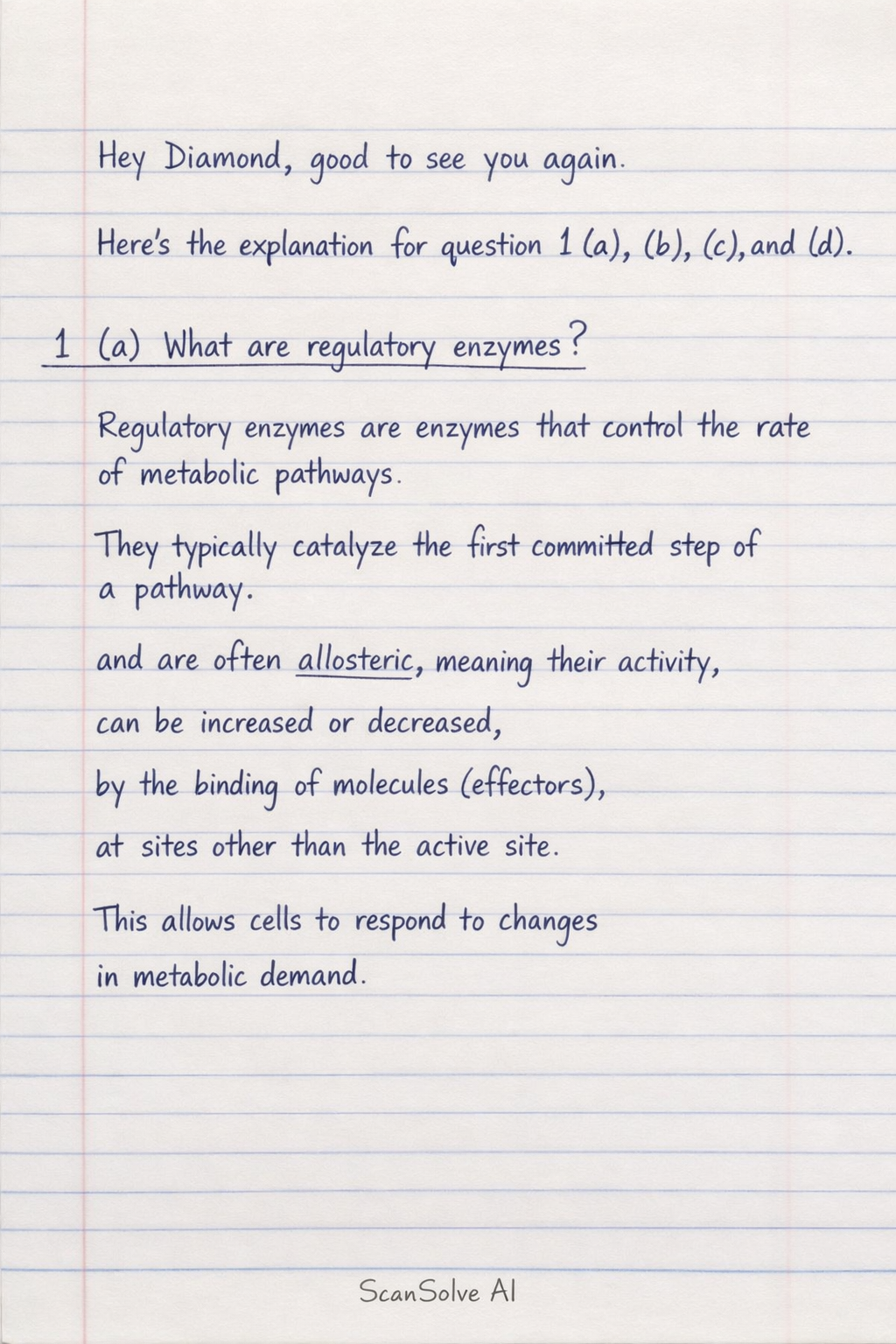
Here's the explanation for question 1 (a), (b), (c), and (d).
1 (a) What are regulatory enzymes?
Regulatory enzymes are enzymes that control the rate of metabolic pathways. They typically catalyze the first committed step of a pathway and are often allosteric, meaning their activity can be increased or decreased by the binding of molecules (effectors) at sites other than the active site. This allows cells to respond to changes in metabolic demand.
1 (b) Briefly explain the five (5) mechanism of enzyme regulation.
- Allosteric Regulation: Effectors bind to a site distinct from the active site, causing a conformational change that alters enzyme activity.
- Covalent Modification: Enzyme activity is altered by the reversible attachment of a chemical group (e.g., phosphorylation, acetylation) to an amino acid residue.
- Transcriptional Control: The amount of enzyme produced is regulated by controlling the rate of gene expression (transcription and translation).
- Proteolytic Activation (Zymogen Activation): Inactive enzyme precursors (zymogens) are activated by irreversible cleavage of one or more peptide bonds.
- Compartmentation: Enzymes and substrates are localized in specific cellular compartments, controlling reaction rates by regulating access and concentration.
1 (c) Outline the regulatory enzyme(s) of the following metabolic pathways:
i) Cholesterol synthesis: The primary regulatory enzyme is HMG-CoA reductase.
ii) Fatty acid Oxidation: The key regulatory enzyme is Carnitine palmitoyltransferase I (CPT-I).
iii) Heme synthesis: The rate-limiting and regulatory enzyme is -aminolevulinate synthase (ALAS).
iv) Glyoxalate Cycle: The two main regulatory enzymes are Isocitrate lyase and Malate synthase.
v) Glycogenolysis: The primary regulatory enzyme is Glycogen phosphorylase.
1 (d) How does the and of an enzyme affected in the presence of competitive, non-competitive and un-competitive inhibitors? Illustrate graphically.
-
Competitive Inhibition:
- : Increases. The inhibitor competes with the substrate for the active site, requiring more substrate to reach half .
- : Unchanged. At very high substrate concentrations, the substrate can outcompete the inhibitor, allowing the enzyme to reach its maximal velocity.
- Graphical Illustration (Lineweaver-Burk plot): The lines intersect on the y-axis (same ), but the x-intercept () shifts closer to zero.
-
Non-competitive Inhibition:
- : Unchanged. The inhibitor binds to a site distinct from the active site, affecting catalytic efficiency but not substrate binding affinity.
- : Decreases. The inhibitor reduces the concentration of functional enzyme, lowering the maximum reaction rate.
- Graphical Illustration (Lineweaver-Burk plot): The lines intersect on the x-axis (same ), but the y-intercept () shifts upwards.
(Note: For pure non-competitive inhibition, the for binding to E and ES is the same. The equation simplifies to where .)
-
Uncompetitive Inhibition:
- : Decreases. The inhibitor binds only to the enzyme-substrate complex (ES), effectively removing ES from the equilibrium and increasing the apparent affinity of E for S.
- : Decreases. By binding to ES, the inhibitor reduces the concentration of productive ES complexes, lowering the maximum reaction rate.
- Graphical Illustration (Lineweaver-Burk plot): The lines are parallel, with both the x-intercept () and y-intercept () shifting. The x-intercept shifts away from zero, and the y-intercept shifts upwards.
Here's a general representation of the Lineweaver-Burk plots for each type of inhibition:
\begin{tikzpicture}[scale=0.8]
% Competitive Inhibition
\begin{scope}[shift={(0,0)}]
\draw[->] (0,0) -- (4,0) node[right] {$1/[S]$};
\draw[->] (0,0) -- (0,4) node[above] {$1/V$};
\node at (2,-0.5) {Competitive};
\draw[thick] (0.5,3) -- (3.5,0.5); % Inhibited
\draw[thick, dashed] (0.5,2) -- (3.5,-0.5); % Uninhibited
\node at (0.2,2) {$1/V_{max}$};
\node at (3.5,-0.2) {$-1/K_m$};
\node at (2.5,0.2) {$-1/K_m^{app}$};
\end{scope}

% Non-competitive Inhibition
\begin{scope}[shift={(5,0)}]
\draw[->] (0,0) -- (4,0) node[right] {$1/[S]$};
\draw[->] (0,0) -- (0,4) node[above] {$1/V$};
\node at (2,-0.5) {Non-competitive};
\draw[thick] (0.5,3.5) -- (3.5,0.5); % Inhibited
\draw[thick, dashed] (0.5,2) -- (3.5,0.5); % Uninhibited
\node at (0.2,2) {$1/V_{max}$};
\node at (0.2,3.5) {$1/V_{max}^{app}$};
\node at (3.5,-0.2) {$-1/K_m$};
\end{scope}

% Uncompetitive Inhibition
\begin{scope}[shift={(10,0)}]
\draw[->] (0,0) -- (4,0) node[right] {$1/[S]$};
\draw[->] (0,0) -- (0,4) node[above] {$1/V$};
\node at (2,-0.5) {Uncompetitive};
\draw[thick] (0.5,3) -- (3.5,1); % Inhibited
\draw[thick, dashed] (0.5,2) -- (3.5,0); % Uninhibited
\node at (0.2,2) {$1/V_{max}$};
\node at (0.2,3) {$1/V_{max}^{app}$};
\node at (3.5,-0.2) {$-1/K_m$};
\node at (2.5,0.8) {$-1/K_m^{app}$};
\end{scope}
\end{tikzpicture}
The dashed lines represent the uninhibited reaction, and the solid lines represent the inhibited reaction.
Still stuck on this one?
Ask a follow-up, and the answer starts from this question.
More Biology Questions
Handwritten Step-by-Step Solution
Get this as a handwritten image on WhatsApp — like a tutor wrote it for you.
Try on WhatsApp