
We read your photo as:
Describe the results and explain the observations of an iodine test on a non-germinating maize grain.
ScanSolve AI Answer
a. Observations:
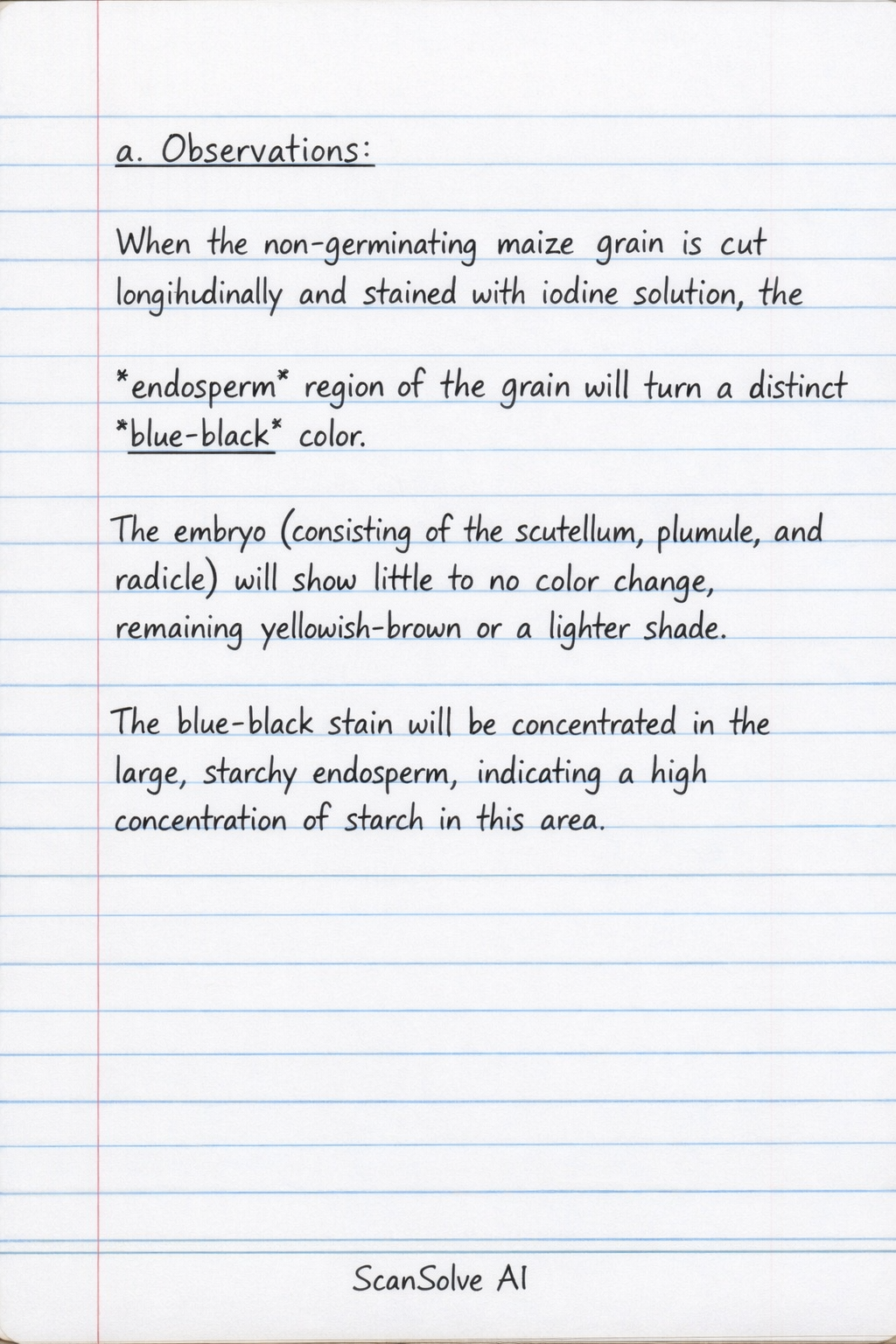
When the non-germinating maize grain is cut longitudinally and stained with iodine solution, the endosperm region of the grain will turn a distinct blue-black color. The embryo (consisting of the scutellum, plumule, and radicle) will show little to no color change, remaining yellowish-brown or a lighter shade. The blue-black stain will be concentrated in the large, starchy endosperm, indicating a high concentration of starch in this area.
b. Explanation:
The iodine solution is used as an indicator for the presence of starch. Starch, a complex carbohydrate, reacts with iodine (specifically the triiodide ion, ) to form a characteristic blue-black colored complex. In a non-germinating maize grain, the endosperm serves as the primary storage tissue for starch, which acts as an energy reserve for the embryo during germination. Therefore, the endosperm stains blue-black due to its high starch content. The embryo, on the other hand, contains less starch and more other biomolecules like proteins and lipids, which do not react with iodine to produce a blue-black color, hence it remains unstained or lightly stained.
Still stuck on this one?
Ask a follow-up, and the answer starts from this question.
More Biology Questions
Handwritten Step-by-Step Solution
Get this as a handwritten image on WhatsApp — like a tutor wrote it for you.
Try on WhatsApp