
We read your photo as:
SECTION A: [40 MARKS] (ANSWER ALL QUESTIONS)
ScanSolve AI Answer
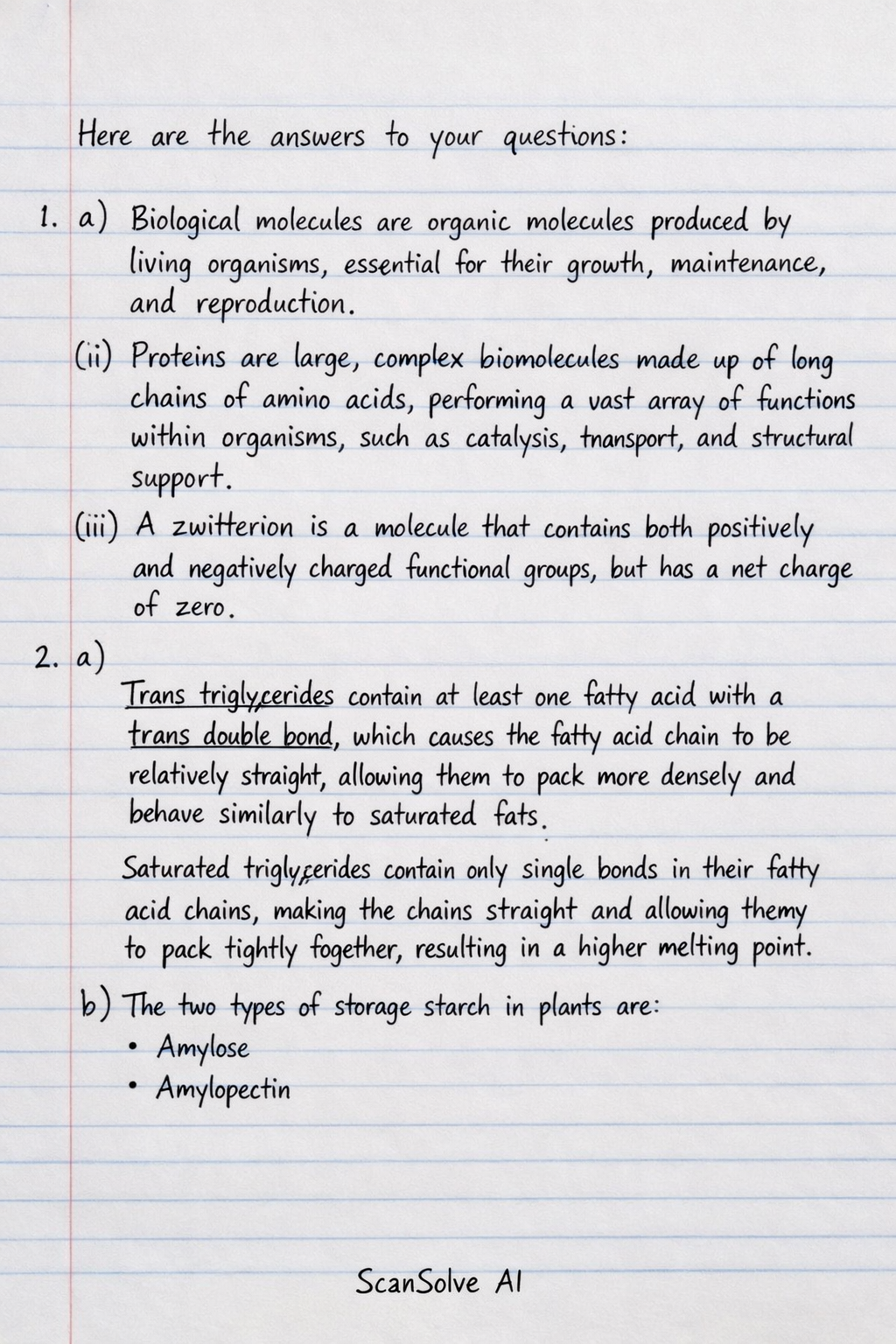
Here are the answers to your questions:
-
a)
- (i) Biological molecules are organic molecules produced by living organisms, essential for their growth, maintenance, and reproduction.
- (ii) Proteins are large, complex biomolecules made up of long chains of amino acids, performing a vast array of functions within organisms, such as catalysis, transport, and structural support.
- (iii) A zwitterion is a molecule that contains both positively and negatively charged functional groups, but has a net charge of zero.
-
a)
- Trans triglycerides contain at least one fatty acid with a trans double bond, which causes the fatty acid chain to be relatively straight, allowing them to pack more densely and behave similarly to saturated fats.
- Saturated triglycerides contain only single bonds in their fatty acid chains, making the chains straight and allowing them to pack tightly together, resulting in a higher melting point.
b) The two types of storage starch in plants are:
- Amylose
- Amylopectin
c) I cannot draw images, but I can describe the linear structures:
- i. Fructose: A 6-carbon ketose sugar. Its linear structure is a polyhydroxy ketone, with a ketone group typically at the C2 position and hydroxyl groups on the other carbons.
- ii. Glucose: A 6-carbon aldose sugar. Its linear structure is a polyhydroxy aldehyde, with an aldehyde group at the C1 position and hydroxyl groups on the other carbons.
-
a) Ampholytes are molecules that can act as both an acid (proton donor) and a base (proton acceptor), depending on the pH of their environment.
b) An acetate buffer () operates by neutralizing added acids or bases:
- When a strong acid () is added:
- When a strong base () is added:
-
Two types of RNA and their functions are:
- Messenger RNA (mRNA): Carries genetic information from DNA in the nucleus to the ribosomes in the cytoplasm, where it serves as a template for protein synthesis.
- Transfer RNA (tRNA): Carries specific amino acids to the ribosome during protein synthesis, matching them to the codons on the mRNA template.
-
a) Aerobic respiration is the metabolic process that occurs in the presence of oxygen to produce energy (ATP) from glucose, releasing carbon dioxide and water as byproducts.
b) Three ways in which biochemical regulation of glycolysis is achieved are:
- Allosteric regulation of key enzymes: Enzymes like phosphofructokinase-1 (PFK-1), hexokinase, and pyruvate kinase are regulated by allosteric effectors (e.g., ATP, AMP, citrate, fructose-2,6-bisphosphate) that signal the cell's energy status.
- Hormonal regulation: Hormones such as insulin and glucagon influence glycolysis by affecting the synthesis or activity of glycolytic enzymes, thereby controlling glucose metabolism in response to blood glucose levels.
- Substrate availability: The rate of glycolysis is directly influenced by the availability of its primary substrate, glucose. Higher glucose concentrations generally lead to increased glycolytic flux.
-
a) The aerobic respiration equation is:
b) Two physiological significances of cyanide-resistant respiration are:
- It allows plants to continue some level of respiration and ATP production even when the main cytochrome oxidase pathway is inhibited, for example, by environmental toxins or stress.
- It can generate heat (thermogenesis) in certain plants, which helps in processes like attracting pollinators by volatilizing scents or melting snow to aid seed dispersal.
-
a) Three types of plastids found in plant cells are:
- Chloroplasts: Sites of photosynthesis, containing chlorophyll.
- Chromoplasts: Contain pigments other than chlorophyll, responsible for the colors of fruits and flowers.
- Leucoplasts: Non-pigmented plastids involved in storage of starch (amyloplasts), lipids (elaioplasts), or proteins (proteinoplasts).
b) Two functions of the nucleus in a plant cell are:
- It stores the cell's genetic material (DNA) in the form of chromosomes, which dictates the cell's characteristics and functions.
- It controls cell growth, metabolism, and reproduction by regulating gene expression and coordinating cellular activities.
Still stuck on this one?
Ask a follow-up, and the answer starts from this question.
More Biology Questions
Handwritten Step-by-Step Solution
Get this as a handwritten image on WhatsApp — like a tutor wrote it for you.
Try on WhatsApp