

This biology question covers important biological concepts and processes. The step-by-step explanation below helps you understand the underlying mechanisms and reasoning.
ScanSolve AI Answer
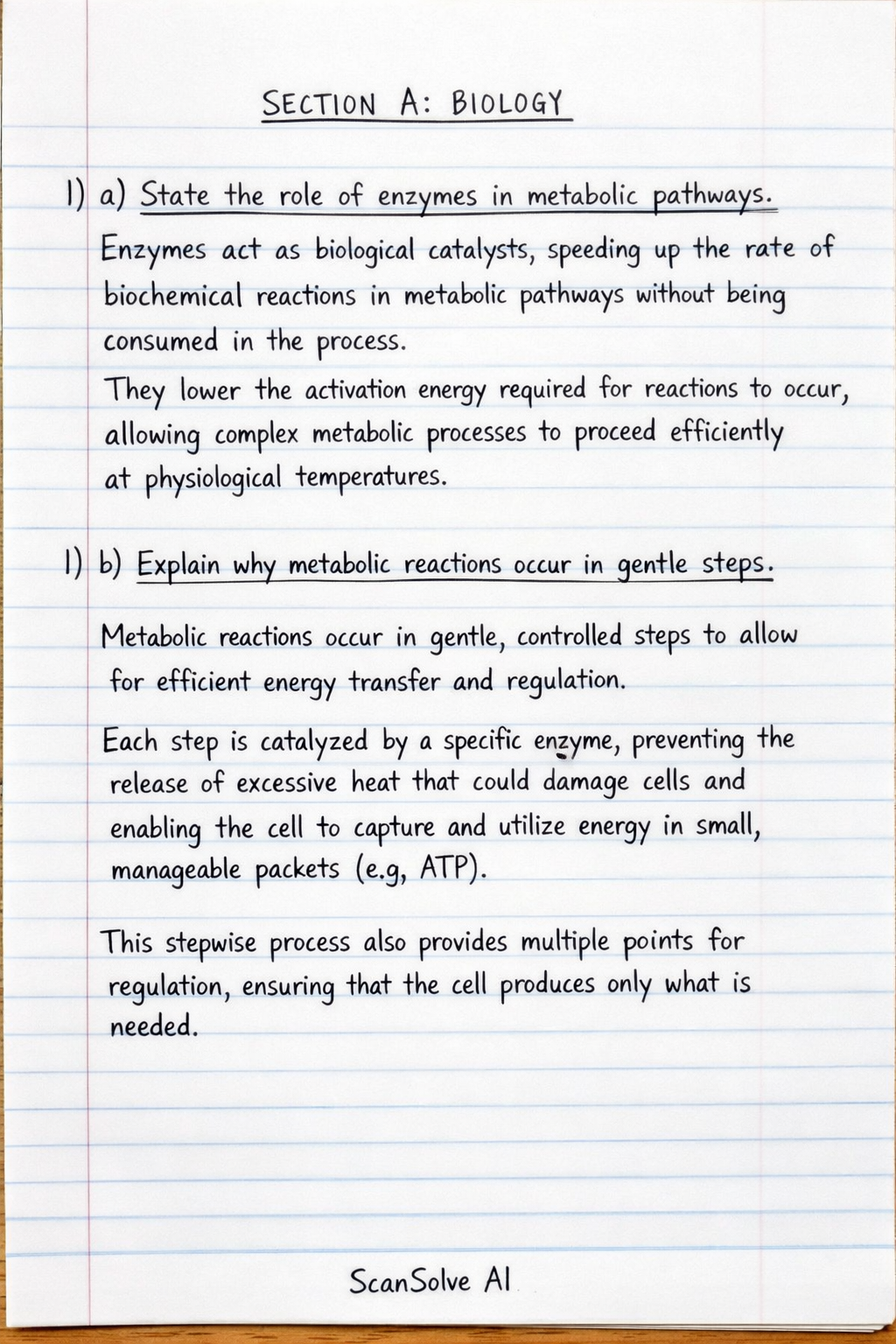
SECTION A: BIOLOGY 1) a) State the role of enzymes in metabolic pathways. Enzymes act as biological catalysts, speeding up the rate of biochemical reactions in metabolic pathways without being consumed in the process. They lower the activation energy required for reactions to occur, allowing complex metabolic processes to proceed efficiently at physiological temperatures. 1) b) Explain why metabolic reactions occur in gentle steps. Metabolic reactions occur in gentle, controlled steps to allow for efficient energy transfer and regulation. Each step is catalyzed by a specific enzyme, preventing the release of excessive heat that could damage cells and enabling the cell to capture and utilize energy in small, manageable packets (e.g., ATP). This stepwise process also provides multiple points for regulation, ensuring that the cell produces only what is needed. 1) c) Describe the stages of the light independent reactions in a typical C_3 plant. The light-independent reactions (Calvin cycle) in C_3 plants occur in three main stages: Carbon Fixation: Ribulose-1,5-bisphosphate (RuBP) combines with carbon dioxide, catalyzed by the enzyme RuBisCO, to form an unstable 6-carbon intermediate that immediately splits into two molecules of 3-phosphoglycerate (3-PGA). Reduction: The 3-PGA molecules are phosphorylated by ATP and then reduced by NADPH to form glyceraldehyde-3-phosphate (G3P). For every six G3P molecules produced, one leaves the cycle to be used for glucose synthesis. Regeneration: The remaining five G3P molecules are rearranged and phosphorylated using ATP to regenerate three molecules of RuBP, allowing the cycle to continue. 1) d) Differentiate between C_3 and C_4 plants. C_3 plants fix carbon dioxide directly into a 3-carbon compound (3-PGA) using RuBisCO in the mesophyll cells. They are less efficient in hot, dry conditions due to photorespiration. C_4 plants initially fix carbon dioxide into a 4-carbon compound (oxaloacetate) using PEP carboxylase in the mesophyll cells. This 4-carbon compound is then transported to bundle-sheath cells where CO_2 is released and enters the Calvin cycle. This spatial separation minimizes photorespiration and makes them more efficient in hot, dry environments. 2) a) Describe the role played by the following biomolecules in the structural and functional well-being of living organisms: i) Carbohydrates: Primarily serve as the main source of energy for living organisms (e.g., glucose). They also play structural roles (e.g., cellulose in plant cell walls, chitin in arthropod exoskeletons) and are involved in cell recognition and signaling. ii) Proteins: Perform a vast array of functions, including acting as enzymes to catalyze reactions, providing structural support (e.g., collagen, keratin), transporting substances (e.g., hemoglobin), enabling movement (e.g., actin, myosin), and functioning as hormones and antibodies. iii) Lipids: Essential for long-term energy storage, forming the primary component of cell membranes (phospholipids), acting as hormones (steroids), and providing insulation and protection for organs. 2) b) Define the following terms as used in molecular biology: i) Transcription: The process by which genetic information from a DNA segment is copied into an RNA molecule (messenger RNA, mRNA). This occurs in the nucleus of eukaryotic cells and the cytoplasm of prokaryotic cells. ii) Translation: The process by which the genetic information carried by mRNA is decoded to synthesize a specific protein. This occurs on ribosomes in the cytoplasm, where transfer RNA (tRNA) molecules bring specific amino acids according to the mRNA codons. 2) c) Describe the process by which DNA molecule makes an exact copy of itself. DNA makes an exact copy of itself through a process called DNA replication. Unwinding: The double helix unwinds and the two strands separate, breaking the hydrogen bonds between complementary base pairs, catalyzed by DNA helicase. Primer Binding: Short RNA primers bind to specific sites on each DNA strand, providing a starting point for DNA synthesis. Elongation: DNA polymerase adds complementary nucleotides to each original strand, following the base-pairing rules (A with T, C with G). The leading strand is synthesized continuously, while the lagging strand is synthesized in short fragments (Okazaki fragments). Ligation: DNA ligase joins the Okazaki fragments on the lagging strand. Proofreading: DNA polymerase also proofreads the newly synthesized strands, correcting any errors. This results in two identical DNA molecules, each consisting of one original and one new strand (semiconservative replication). 2) d) Biochemical analysis of a nucleic acid shows that 17% of the nitrogenous bases is Adenine. Calculate the percentage of the bases which would be Guanine and explain how you arrived at your answer. According to Chargaff's rules, in a double-stranded DNA molecule, the amount of Adenine (A) is equal to the amount of Thymine (T), and the amount of Guanine (G) is equal to the amount of Cytosine (C). Given: Adenine (A) = 17% Therefore, Thymine (T) = 17% Total percentage of A and T = 17% + 17% = 34% The remaining percentage for G and C = 100% - 34% = 66% Since Guanine (G) = Cytosine (C), the percentage of Guanine is half of the remaining percentage. Percentage of Guanine (G) = (66\%)/(2) = 33\% The percentage of Guanine would be 33%. This is derived from Chargaff's rules, which state that in DNA, the percentage of Adenine equals Thymine, and the percentage of Guanine equals Cytosine. If Adenine is 17%, then Thymine is also 17%. The sum of A and T is 34%. The remaining 66% must be equally divided between Guanine and Cytosine, so Guanine is 33%. 3) a) Explain the following ecological concepts: i) Competition: An interaction between organisms or species in which the fitness of one is lowered by the presence of another. This occurs when two or more organisms require the same limited resources (e.g., food, water, space, light). Competition can be intraspecific (between individuals of the same species) or interspecific (between individuals of different species). ii) Succession: The process of change in the species structure of an ecological community over time. It involves the gradual replacement of one community by another until a stable climax community is reached. Primary succession occurs in newly formed or exposed habitats, while secondary succession occurs in areas where a community has been removed but the soil remains. iii) Pyramid of energy: A graphical representation showing the flow of energy through different trophic levels in an ecosystem. It illustrates that the amount of energy decreases significantly at each successive trophic level, with producers forming the base and top carnivores at the apex. This is due to energy loss as heat during metabolic processes. 3) b) Explain the role of decomposers and detritivores in an ecosystem. Decomposers (e.g., bacteria, fungi) and detritivores (e.g., earthworms, millipedes) play a crucial role in nutrient cycling by breaking down dead organic matter (detritus) from plants and animals. They convert complex organic compounds into simpler inorganic substances, such as nitrates, phosphates, and carbon dioxide, which are then returned to the soil, water, and atmosphere. This process makes essential nutrients available for producers, thus sustaining the ecosystem. 3) c) Describe the role of bacteria in the cycling of nitrogen. Bacteria are central to the nitrogen cycle, facilitating several key transformations: Nitrogen Fixation: Some bacteria (e.g., Rhizobium in legumes, Azotobacter* in soil) convert atmospheric nitrogen gas (N_2) into ammonia (NH_3), making it usable by plants. Nitrification: Nitrifying bacteria (e.g., Nitrosomonas, Nitrobacter*) convert ammonia into nitrites (NO_2^-) and then into nitrates (NO_3^-), which are readily absorbed by plants. Denitrification: Denitrifying bacteria (e.g., Pseudomonas*) convert nitrates back into atmospheric nitrogen gas, completing the cycle. Ammonification: Decomposer bacteria break down organic nitrogen compounds in dead organisms and waste products into ammonia. 4) a) Describe the physiological mechanisms responsible for photoperiodism in plants. Photoperiodism in plants is regulated by a pigment called phytochrome, which exists in two interconvertible forms: P_r (red-light absorbing) and P_fr (far-red-light absorbing). P_r is the inactive form and is converted to P_fr upon exposure to red light (660 nm). P_fr is the active form and is converted back to P_r by far-red light (730 nm) or slowly in darkness. The ratio of P_r to P_fr and the duration of darkness determine the plant's response to day length, influencing processes like flowering, seed germination, and dormancy. For example, short-day plants flower when the P_fr concentration drops below a critical level, indicating a long night. 4) b) State factors that cause the release of a hormone from an endocrine gland. The release of hormones from endocrine glands is typically triggered by: Humoral stimuli: Changes in the concentration of ions or nutrients in the blood (e.g., high blood glucose stimulates insulin release). Neural stimuli: Nerve impulses directly stimulate hormone release (e.g., sympathetic nervous system stimulates adrenaline release from adrenal medulla). Hormonal stimuli: Hormones from one endocrine gland stimulate another endocrine gland to release its hormones (e.g., TSH from pituitary stimulates thyroid hormone release). 4) c) With a named example of a hormone, explain the second messenger mechanism of hormone action. Many water-soluble hormones, such as adrenaline, act via a second messenger mechanism. Binding: Adrenaline, the first messenger, binds to specific receptor proteins on the target cell's plasma membrane. Activation: This binding activates a G-protein, which then activates an enzyme, often adenylyl cyclase. Second Messenger Production: Adenylyl cyclase converts ATP into cyclic AMP (cAMP), which acts as the second messenger inside the cell. Cellular Response: cAMP then activates protein kinases, which phosphorylate other proteins, leading to a cascade of reactions that ultimately produce the specific cellular response (e.g., breakdown of glycogen to glucose in liver cells). 4) d) Explain the role of hormones in the growth and development of insects. Hormones play critical roles in regulating insect growth, metamorphosis, and reproduction. Juvenile Hormone (JH): Maintains the larval stage, preventing metamorphosis. High levels of JH ensure that each molt results in a larger larva. Ecdysone (Molting Hormone): Triggers molting and metamorphosis. When JH levels drop, ecdysone promotes the development of pupal and then adult characteristics. The interplay between these hormones, regulated by neurosecretory cells in the brain, controls the timing