
We read your photo as:
What should be included in the "Interpretation of results" section of a biotechnology project report?
Biology
ScanSolve AI Answer
Here's what to include in the "Interpretation of results" section for your biotechnology project:
-
10. Interpretation of results
This section explains what your collected data (from section 9) means in relation to your hypothesis and existing scientific knowledge. It's where you discuss patterns, trends, and the significance of your findings.
-
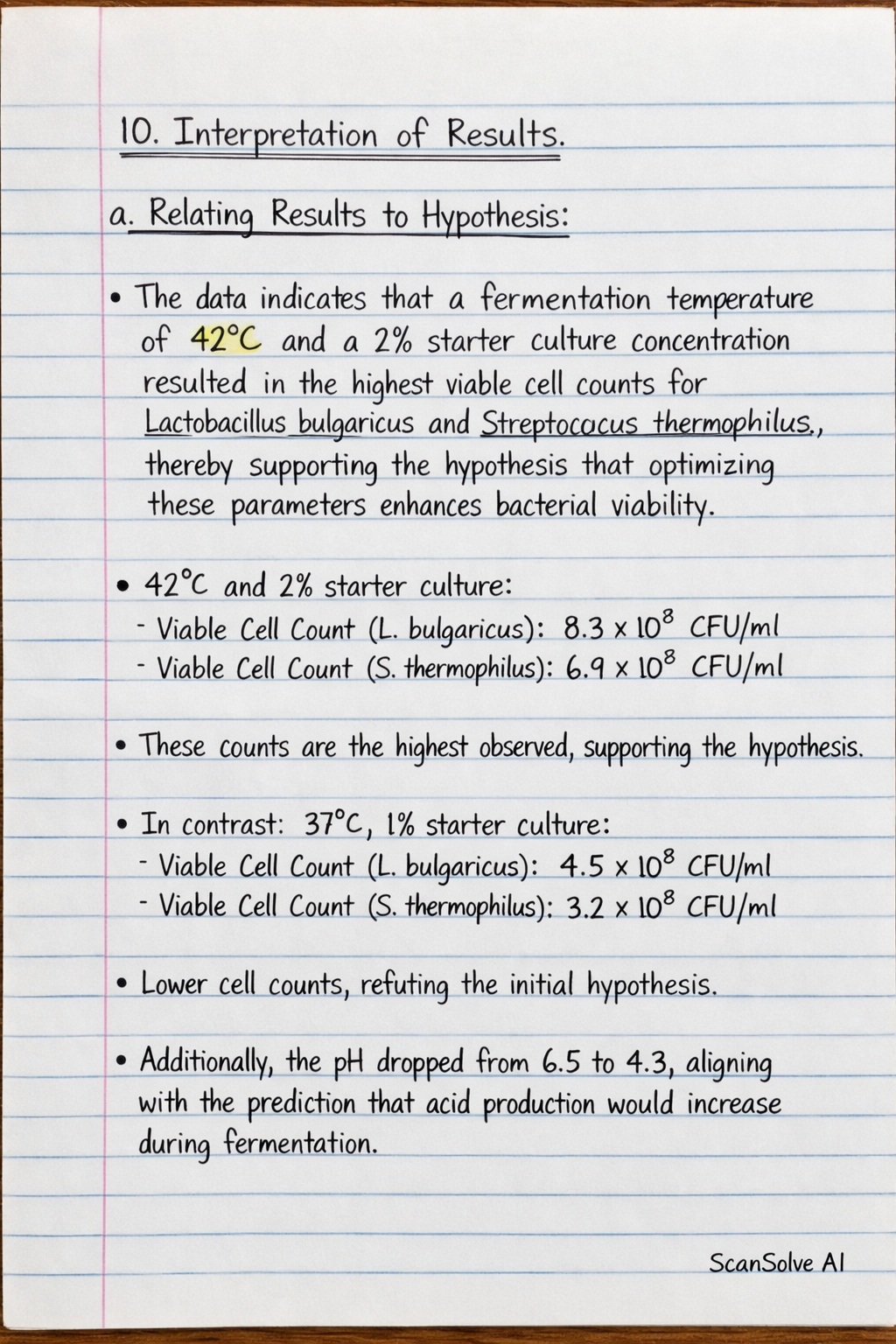
a. Relating Results to Hypothesis:
- Discuss whether the experimental results support or refute your initial hypothesis. For example, "The data indicates that a fermentation temperature of and a starter culture concentration resulted in the highest viable cell counts for Lactobacillus bulgaricus and Streptococcus thermophilus, thereby supporting the hypothesis that optimizing these parameters enhances bacterial viability."
- Explain how specific data points (e.g., pH changes, viscosity measurements) align with or deviate from your predictions.
-
b. Explaining Observed Trends:
- Analyze the trends in your microbiological data. For instance, "Yoghurt samples fermented at higher temperatures () showed a faster pH drop but also a more rapid decline in viable cell counts during storage, suggesting an optimal temperature range for both rapid fermentation and probiotic survival."
- Interpret the physicochemical changes. "The decrease in pH and increase in titratable acidity are direct indicators of lactic acid production by the starter cultures, which is crucial for milk coagulation and yoghurt preservation."
- Discuss the relationship between fermentation conditions and viscosity. "Higher starter culture concentrations or specific fermentation temperatures led to increased viscosity, likely due to enhanced protein network formation."
-
c. Discussing Sensory Attributes:
- Correlate physicochemical data with sensory evaluation results. "Samples with optimal pH and viscosity received higher scores for texture and overall acceptability, indicating a consumer preference for specific textural characteristics."
- Explain any off-flavors or undesirable textures observed and link them to specific experimental conditions or microbial activity.
-
d. Comparing with Literature:
- Compare your findings with results from similar studies in scientific literature. "Our findings regarding the optimal temperature for Lactobacillus bulgaricus activity are consistent with previous research by [Author, Year], which also reported enhanced lactic acid production at similar temperatures."
- Highlight any novel findings or discrepancies with existing literature, and propose potential reasons for these differences.
-
e. Implications and Significance:
- Discuss the practical implications of your results, especially for the local context. "The identification of optimal conditions for yoghurt production using local milk can contribute to improved local dairy processing and product quality."
- Explain the scientific significance of your findings, such as contributing to a better understanding of microbial kinetics in fermentation or the impact of specific parameters on product quality.
-
Was this helpful?
Still stuck on this one?
Ask a follow-up, and the answer starts from this question.
Got a different question?Ask your own question
More Biology Questions
QOutline the typical content of the "Results obtained" section for a biotechnology project on milk to…QWhat are the key components of a "Presentation of findings, analysis and synthesis of information"…QWrite a biology test reportQSummarize the interpretation of results and conclusion for the "Transformation of Cassava to Garri"…QWhat are the typical sections of a computer science project report and their contents?
Handwritten Step-by-Step Solution
Get this as a handwritten image on WhatsApp — like a tutor wrote it for you.
Try on WhatsApp