We read your photo as:

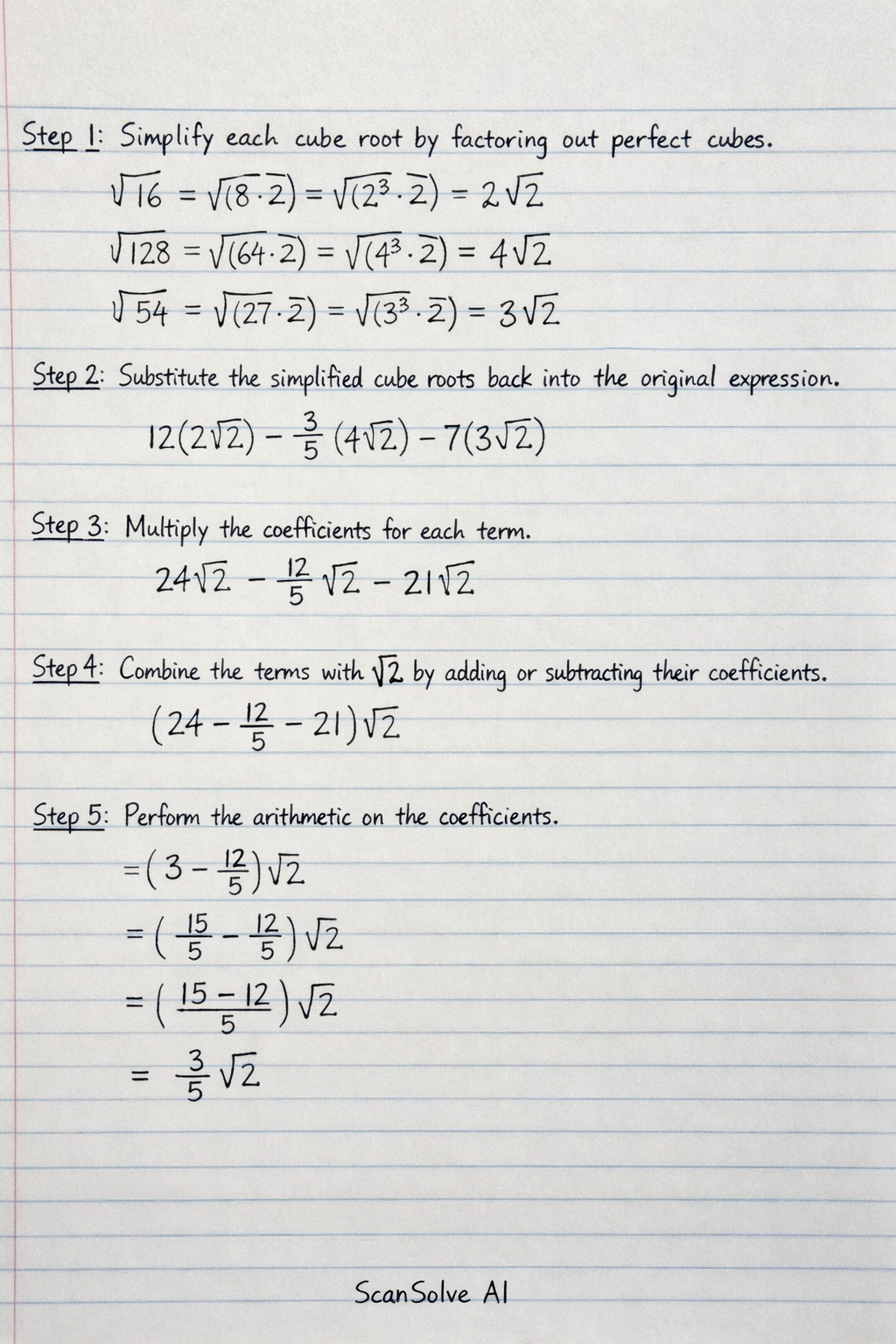
Simplify each cube root by factoring out perfect cubes.

Biology

ScanSolve AI Answer

Answer

3523\frac{3}{5}\sqrt[3]{2}

Step-by-step solution

5 steps
  1. Simplify each cube root by factoring out perfect cubes.

    163=8×23=23×23=223\sqrt[3]{16} = \sqrt[3]{8 \times 2} = \sqrt[3]{2^3 \times 2} = 2\sqrt[3]{2} 1283=64×23=43×23=423\sqrt[3]{128} = \sqrt[3]{64 \times 2} = \sqrt[3]{4^3 \times 2} = 4\sqrt[3]{2} 543=27×23=33×23=323\sqrt[3]{54} = \sqrt[3]{27 \times 2} = \sqrt[3]{3^3 \times 2} = 3\sqrt[3]{2}
  2. Substitute the simplified cube roots back into the original expression.

    12(223)−35(423)−7(323)12(2\sqrt[3]{2}) - \frac{3}{5}(4\sqrt[3]{2}) - 7(3\sqrt[3]{2})
  3. Multiply the coefficients for each term.

    2423−12523−212324\sqrt[3]{2} - \frac{12}{5}\sqrt[3]{2} - 21\sqrt[3]{2}
  4. Combine the terms with 23\sqrt[3]{2} by adding or subtracting their coefficients.

    (24−125−21)23\left(24 - \frac{12}{5} - 21\right)\sqrt[3]{2}
  5. Perform the arithmetic on the coefficients.

    (3−125)23\left(3 - \frac{12}{5}\right)\sqrt[3]{2}

    To subtract the fraction, find a common denominator:

    (3×55−125)23=(155−125)23\left(\frac{3 \times 5}{5} - \frac{12}{5}\right)\sqrt[3]{2} = \left(\frac{15}{5} - \frac{12}{5}\right)\sqrt[3]{2} (15−125)23=3523\left(\frac{15 - 12}{5}\right)\sqrt[3]{2} = \frac{3}{5}\sqrt[3]{2}

    The final answer is 3523\frac{3}{5}\sqrt[3]{2}.

Was this helpful?

Try one yourself

A new problem that tests the same skill.

Still stuck on this one?

Ask a follow-up, and the answer starts from this question.

Got a different question?Ask your own question
Handwritten step-by-step solution preview

Handwritten Step-by-Step Solution

Get this as a handwritten image on WhatsApp — like a tutor wrote it for you.

Try on WhatsApp