
We read your photo as:
Study the diagrams of bird beaks and a growth curve, and answer the questions regarding homologous structures, comparative anatomy, and growth curve identification and interpretation.
ScanSolve AI Answer
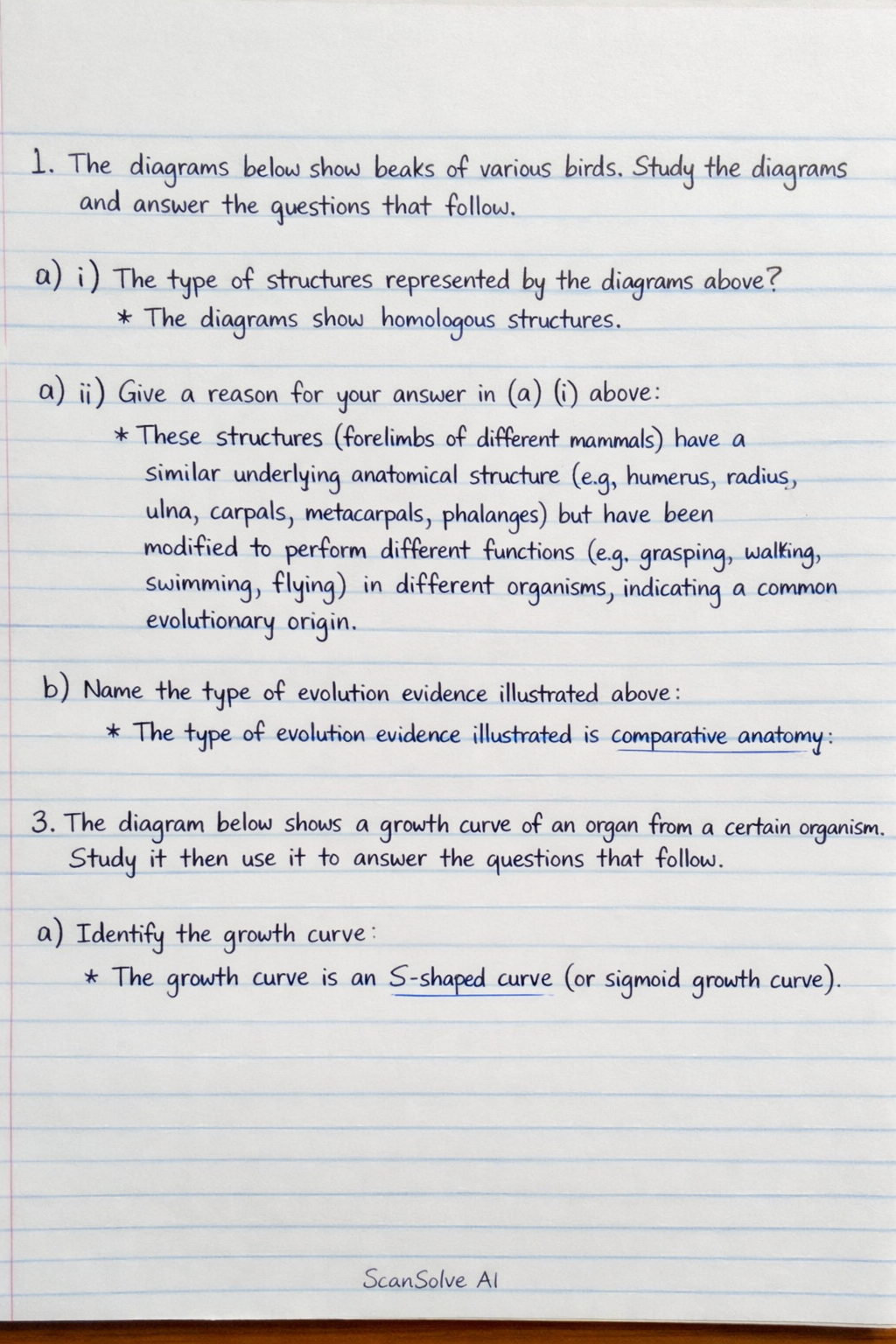
1. The diagrams below show beaks of various birds. Study the diagrams and answer the questions that follow.
a) i) The type of structures represented by the diagrams above?
- The diagrams show homologous structures.
a) ii) Give a reason for your answer in (a) (i) above.
- These structures (forelimbs of different mammals) have a similar underlying anatomical structure (e.g., humerus, radius, ulna, carpals, metacarpals, phalanges) but have been modified to perform different functions (e.g., grasping, walking, swimming, flying) in different organisms, indicating a common evolutionary origin.
b) Name the type of evolution evidence illustrated above.
- The type of evolution evidence illustrated is comparative anatomy.
3. The diagram below shows a growth curve of an organ from a certain organism. Study it then use it to answer the questions that follow.
a) Identify the growth curve.
- The growth curve is an S-shaped curve (or sigmoid growth curve).
b) State the Phylum from which the organism belongs.
- This S-shaped growth curve is characteristic of many organisms, including those from the Phylum Chordata (e.g., mammals, humans) or Arthropoda (e.g., insects, though often with molting steps). Given the general nature, Chordata is a common example.
c) Explain the phenomenon that occurs at points:
- A: Lag phase. This is an initial period of slow growth where the organism is adapting to its environment, synthesizing enzymes, and preparing for rapid growth.
- B: Log phase (or exponential phase). This is a period of rapid growth where the organism is growing at its maximum rate, as resources are abundant and conditions are optimal.
- C: Stationary phase. Growth slows down and eventually stops. The birth rate equals the death rate, or the rate of cell production equals the rate of cell death, due to limiting factors such as nutrient depletion, accumulation of waste products, or lack of space.
d) State two factors affecting growth in plants.
- Light intensity (for photosynthesis)
- Availability of water
- Availability of nutrients (e.g., nitrates, phosphates)
- Temperature
- Hormones (e.g., auxins, gibberellins)
4. A Rhesus positive man marries a Rhesus positive woman and one of their children happens to be Rhesus negative.
a) Work out the possible genotypes of the two parents.
- Let R be the allele for Rhesus positive (dominant) and r be the allele for Rhesus negative (recessive).
- A Rhesus negative child has the genotype rr.
- For a child to be rr, each parent must contribute an 'r' allele.
- Since both parents are Rhesus positive, but they have a Rhesus negative child, both parents must be heterozygous.
- Therefore, the possible genotypes of the two parents are:
- Man: Rr
- Woman: Rr
Still stuck on this one?
Ask a follow-up, and the answer starts from this question.
More Biology Questions
Handwritten Step-by-Step Solution
Get this as a handwritten image on WhatsApp — like a tutor wrote it for you.
Try on WhatsApp