
We read your photo as:
Substitute the given root into the equation to find k.
ScanSolve AI Answer
Step-by-step solution
9 stepsSubstitute the given root into the equation to find .
If is a root of , then substituting must satisfy the equation:
Write the complete quadratic equation.
Substitute back into the original equation:
Find the other root using the sum of roots property.
For a quadratic equation , the sum of the roots is .
In our equation, , we have , , .
Let the two roots be and . We are given .
The sum of the roots is .
Substitute :Alternatively, using the product of roots property:
The product of the roots is .
Substitute :The other root is .
Define the two numbers.
Let the first number be .
The second number is greater than the first by 4, so the second number is .Formulate the quadratic equation based on their product.
The product of the two numbers is 21.
Expand and rearrange the equation into standard quadratic form.
The quadratic equation is .
Solve the quadratic equation by factoring.
We need two numbers that multiply to -21 and add to 4. These numbers are 7 and -3.
Find the possible values for .
Set each factor to zero:
Determine the two numbers for each possible value of .
Case 1: If .
The first number is 3.
The second number is .
Check: .Case 2: If .
The first number is -7.
The second number is .
Check: .The two numbers are either or .
Still stuck on this one?
Ask a follow-up, and the answer starts from this question.
More Biology Questions
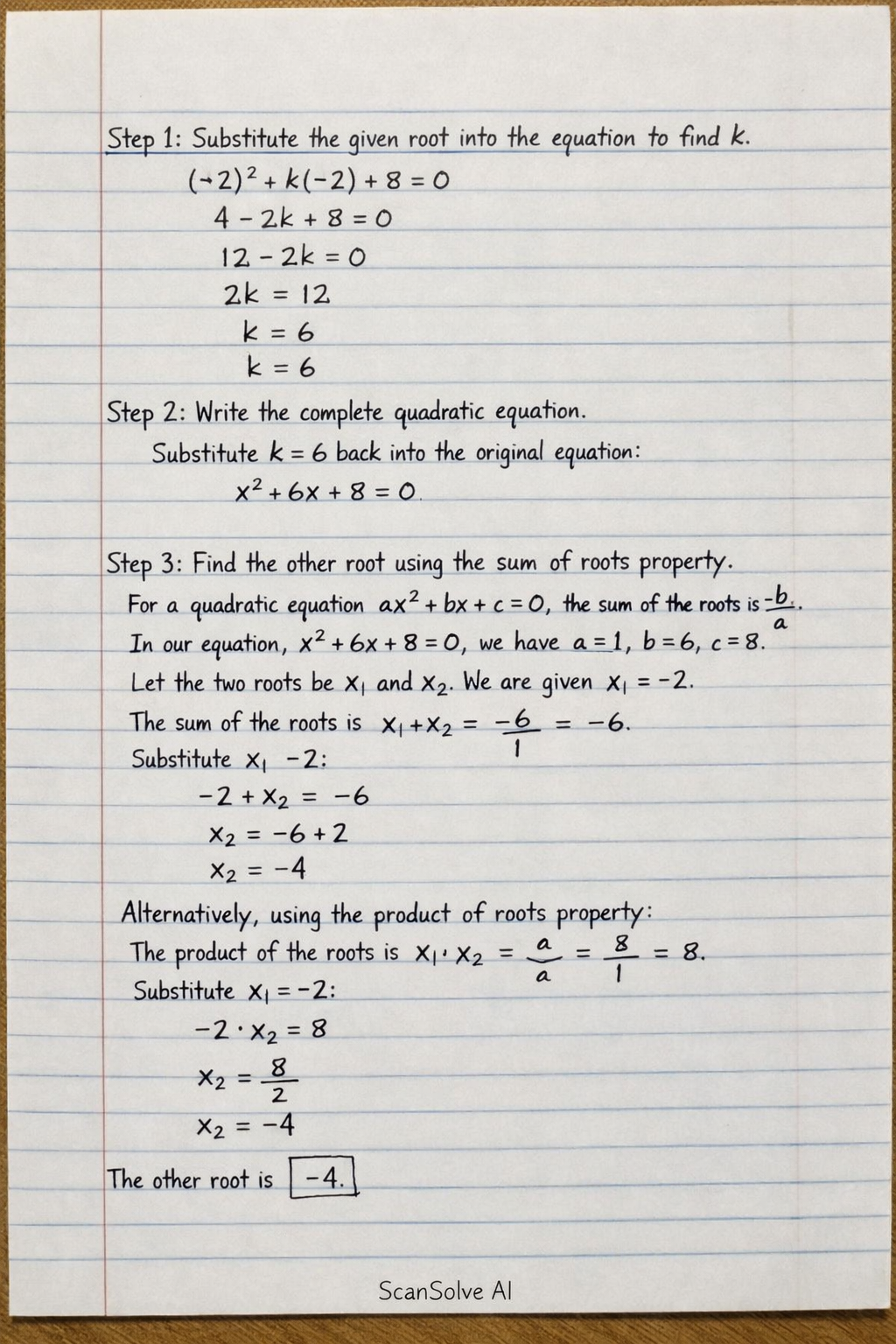
Handwritten Step-by-Step Solution
Get this as a handwritten image on WhatsApp — like a tutor wrote it for you.
Try on WhatsApp