
We read your photo as:
Summarize diverse sex determination systems, linked genes, and linkage disequilibrium for an MPhil exam.
ScanSolve AI Answer
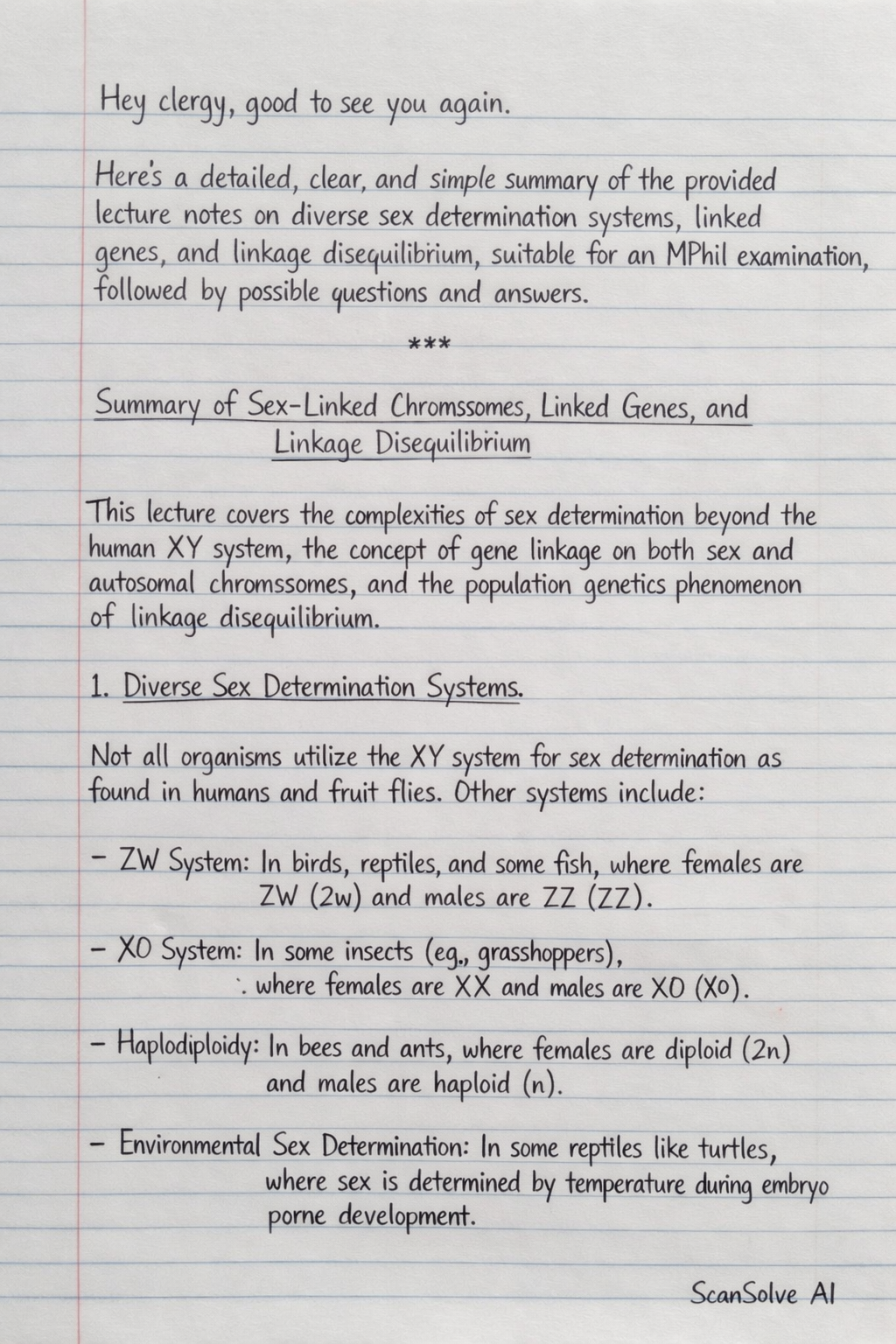
Here's a detailed, clear, and simple summary of the provided lecture notes on diverse sex determination systems, linked genes, and linkage disequilibrium, suitable for an MPhil examination, followed by possible questions and answers.
Summary of Sex-Linked Chromosomes, Linked Genes, and Linkage Disequilibrium
This lecture covers the complexities of sex determination beyond the human XY system, the concept of gene linkage on both sex and autosomal chromosomes, and the population genetics phenomenon of linkage disequilibrium.
1. Diverse Sex Determination Systems
Not all organisms utilize the XY system for sex determination as found in humans and fruit flies. Other systems include:
- X-0 System (e.g., Grasshoppers, Cockroaches):
- Females have two X chromosomes (XX).
- Males have only one X chromosome (X0), lacking a second sex chromosome.
- Male sperm may contain an X chromosome or no sex chromosome, determining the sex of the offspring.
- ZW System (e.g., Birds, Fish, some Insects):
- This system is the reverse of XY.
- Females are the heterogametic sex (ZW).
- Males are the homogametic sex (ZZ).
- Haploid-Diploid System (e.g., Ants, Bees):
- There are no specific sex chromosomes.
- Sex is determined by the number of chromosome sets.
- Fertilized eggs (diploid, 2n) develop into females.
- Unfertilized eggs (haploid, n) develop into males.
2. Linked Genes
Gene linkage refers to the phenomenon where genes located on the same chromosome tend to be inherited together. This concept extends beyond sex chromosomes to autosomal chromosomes.
- Violation of Mendel's Postulates: Linked genes do not assort independently, thus violating Mendel's law of independent assortment. Instead, they are inherited as a unit.
- Mechanism of Inheritance: Genes found on the same chromosome are usually inherited together unless homologous recombination (crossing over or gene conversion) occurs.
- Effect of Distance: The likelihood of crossing over breaking a gene linkage depends on the distance between the loci of the two genes.
- Unlinked Genes:
- Located on different chromosomes.
- Or, located on the same chromosome but far apart, allowing frequent crossing over to separate them.
- Linked Genes:
- Located on the same chromosome and are close to each other.
- They tend to assort together and are inherited as a block.
- Unlinked Genes:
- Crossing Over: While crossing over can break gene linkages, it is not always sufficient, especially when genes are very close.
3. Linkage Disequilibrium (LD)
Linkage disequilibrium (LD) measures the non-random association of alleles at two or more loci.
- Definition: It quantifies the degree to which alleles at different loci are found together in a population more or less often than would be expected by chance, based on their individual allele frequencies.
- Deviation from Independent Assortment: LD represents a deviation from the independent assortment postulate at the population level. If alleles at two loci were in perfect linkage equilibrium, their association would be purely random.
- Basis: LD is based on the comparison of observed allele frequencies at two loci with the expected frequencies if the loci were assorting independently.
Possible Questions and Answers for MPhil Examination
Question 1: Compare and contrast the X-0, ZW, and haploid-diploid sex determination systems, providing an example organism for each. Discuss how each system genetically determines the sex of an individual.
Answer:
- X-0 System (e.g., Grasshoppers, Cockroaches):
- Mechanism: Females are homogametic (XX), while males are heterogametic (X0), meaning they have only one X chromosome and lack a Y.
- Sex Determination: The presence of two X chromosomes results in a female, while a single X chromosome results in a male. Males produce two types of sperm: those carrying an X chromosome and those lacking a sex chromosome. Fertilization by an X-carrying sperm produces an XX female, while fertilization by a sperm lacking a sex chromosome produces an X0 male.
- ZW System (e.g., Birds, Fish, some Insects):
- Mechanism: This system is the inverse of the XY system. Females are heterogametic (ZW), and males are homogametic (ZZ).
- Sex Determination: The presence of a Z and a W chromosome determines a female, while two Z chromosomes determine a male. Females produce two types of eggs (Z or W), while males produce only Z-carrying sperm.
- Haploid-Diploid System (e.g., Ants, Bees):
- Mechanism: Sex is determined by the number of chromosome sets, not by specific sex chromosomes.
- Sex Determination: Fertilized eggs, which are diploid (2n), develop into females. Unfertilized eggs, which are haploid (n), develop into males. This means males arise from unfertilized eggs and have half the number of chromosomes as females.
Question 2: Explain the concept of gene linkage and how it deviates from Mendel's Law of Independent Assortment. Discuss the role of crossing over in influencing the inheritance patterns of linked genes.
Answer:
Gene linkage describes the phenomenon where genes located on the same chromosome tend to be inherited together during meiosis, rather than assorting independently. This directly deviates from Mendel's Law of Independent Assortment, which states that alleles for different genes assort independently of one another. Mendel's law holds true for genes on different chromosomes or genes located very far apart on the same chromosome. However, linked genes, being physically close on the same chromosome, are transmitted as a unit more often than not.
Crossing over, or homologous recombination, plays a crucial role in influencing the inheritance patterns of linked genes. During Prophase I of meiosis, homologous chromosomes exchange segments of genetic material. This exchange can break the linkage between alleles on the same chromosome, leading to the formation of recombinant chromatids.
- If two linked genes are very close to each other, crossing over between them is rare, and they are almost always inherited together.
- If two linked genes are farther apart on the same chromosome, the probability of a crossover event occurring between them increases, leading to a higher frequency of recombination and a greater chance that the alleles will not be inherited together. The frequency of recombination between linked genes is directly proportional to the physical distance between them, a principle used in genetic mapping.
Question 3: Define linkage disequilibrium (LD) and explain its significance in population genetics and genetic studies.
Answer:
Linkage disequilibrium (LD) is a non-random association of alleles at two or more loci in a population. It measures the extent to which the observed frequencies of combinations of alleles (haplotypes) at different loci deviate from the frequencies expected if the alleles at those loci were assorting independently. In other words, if alleles at two loci are in LD, they appear together on the same chromosome more or less often than would be predicted by chance based on their individual allele frequencies.
The significance of LD in population genetics and genetic studies is substantial:
- Tracing Evolutionary History: LD patterns can provide insights into the evolutionary history of populations, including migration, population bottlenecks, and selection pressures. Regions of high LD might indicate recent positive selection.
- Disease Gene Mapping: LD is a fundamental concept in genome-wide association studies (GWAS). If a disease-causing mutation is in LD with a nearby genetic marker (e.g., a Single Nucleotide Polymorphism or SNP), researchers can identify the approximate location of the disease gene by finding markers that are statistically associated with the disease, even if the marker itself is not the causative mutation.
- Understanding Recombination: The extent of LD in a region reflects the history of recombination in that region. Regions with low recombination rates tend to have higher LD.
- Population Structure: Differences in LD patterns between populations can reflect their genetic ancestry and population structure.
The final answer is
Still stuck on this one?
Ask a follow-up, and the answer starts from this question.
More Biology Questions
Handwritten Step-by-Step Solution
Get this as a handwritten image on WhatsApp — like a tutor wrote it for you.
Try on WhatsApp