
We read your photo as:
What are the answers to questions 8, 9, and 10, based on the provided information and scientific practices?
ScanSolve AI Answer
Answer
Step-by-step solution
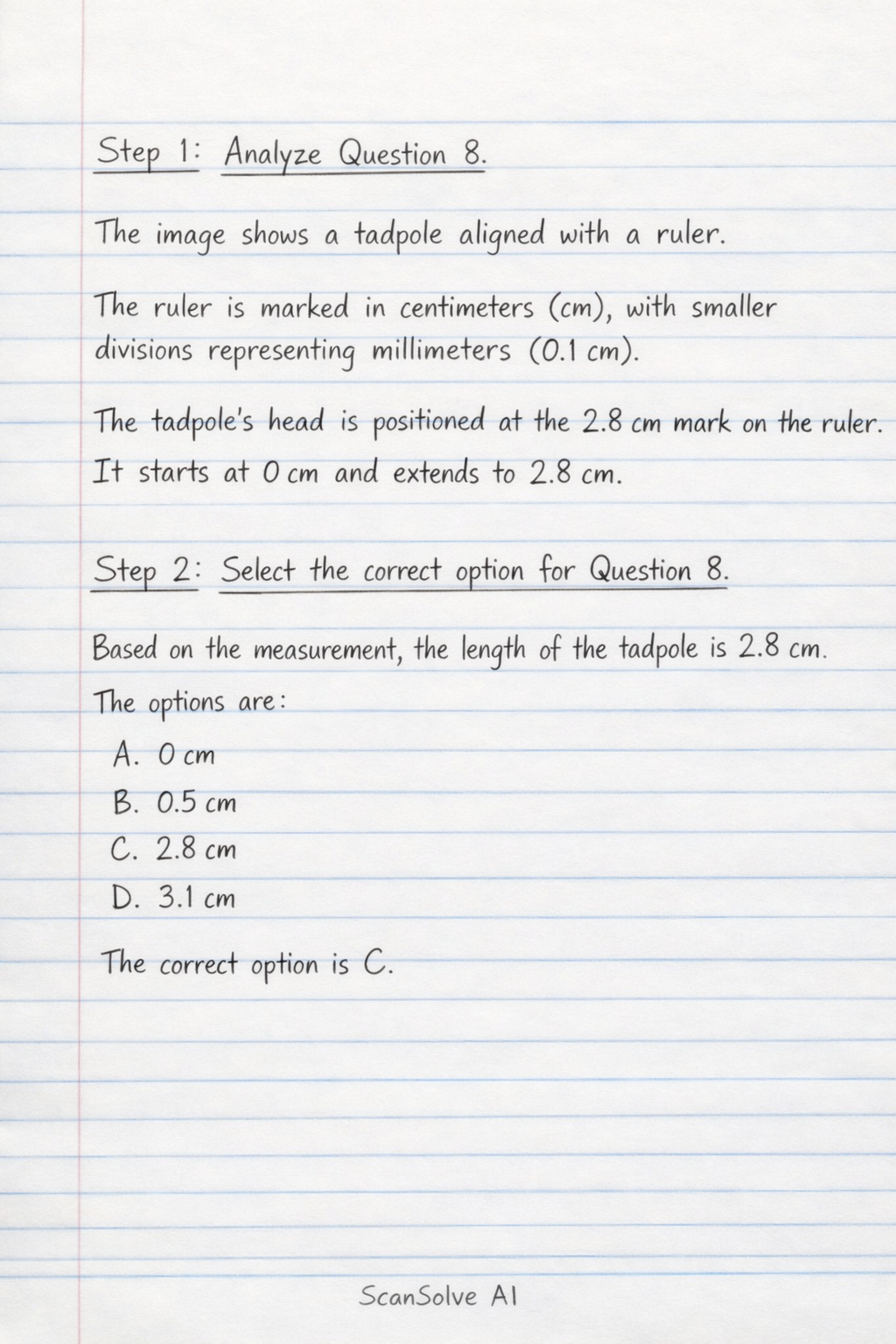
6 stepsAnalyze Question 8.
The image shows a tadpole aligned with a ruler. The ruler is marked in centimeters (cm), with smaller divisions representing millimeters (0.1 cm).
The tadpole's head is positioned at the 2.8 cm mark on the ruler. It starts at 0 cm and extends to 2.8 cm.Select the correct option for Question 8.
Based on the measurement, the length of the tadpole is 2.8 cm.
The options are:
A. 0cm
B. 0.5cm
C. 2.8cm
D. 3.1cm
The correct option is C.Analyze Question 9.
The students tested the effects of water on plant growth but forgot how much each plant grew daily. To practice good science, they needed a way to keep track of their observations.
- A. Making up explanations is not scientific.
- B. Recording daily information in a data table is essential for systematic observation and data collection, which directly addresses the problem of forgetting data.
- C. Conducting the experiment with more than one type of plant would be a different experiment, not a solution to the data recording issue.
- D. Discussing observations is part of scientific communication but doesn't replace the need for initial data recording.
Select the correct option for Question 9.
The most appropriate action for good scientific practice in this scenario is to record daily information in a data table.
The correct option is B.Analyze Question 10.
Three baseball players want to find out who can throw a baseball the farthest. To make this a fair test, all conditions that could affect the throwing distance, other than the player's ability, should be kept constant.
- A. Height of players: This is a characteristic of the players themselves, which is what is being compared. It should not be kept constant.
- B. Color of the baseballs thrown: The color of a baseball does not affect how far it is thrown. While using identical baseballs (same weight, size, material) is crucial, "color" specifically is not a critical variable to control.
- C. Spot from which players throw: To accurately compare throwing distances, all players must throw from the same starting point. If they throw from different spots, the measured distances will not be comparable. This is a critical control variable.
- D. All the players throw: This is a description of the experiment, not a variable to keep constant.
Select the correct option for Question 10.
To ensure a fair comparison of throwing distance, the spot from which players throw should be kept constant.
The correct option is C.The final answers are:
Question 8:
The length of the tadpole is .Question 9:
To practice good science, they should have .Question 10:
They should keep constant.
Try one yourself
A new problem that tests the same skill.
Still stuck on this one?
Ask a follow-up, and the answer starts from this question.
More Biology Questions
Handwritten Step-by-Step Solution
Get this as a handwritten image on WhatsApp — like a tutor wrote it for you.
Try on WhatsApp