

This biology question covers important biological concepts and processes. The step-by-step explanation below helps you understand the underlying mechanisms and reasoning.
ScanSolve AI Answer
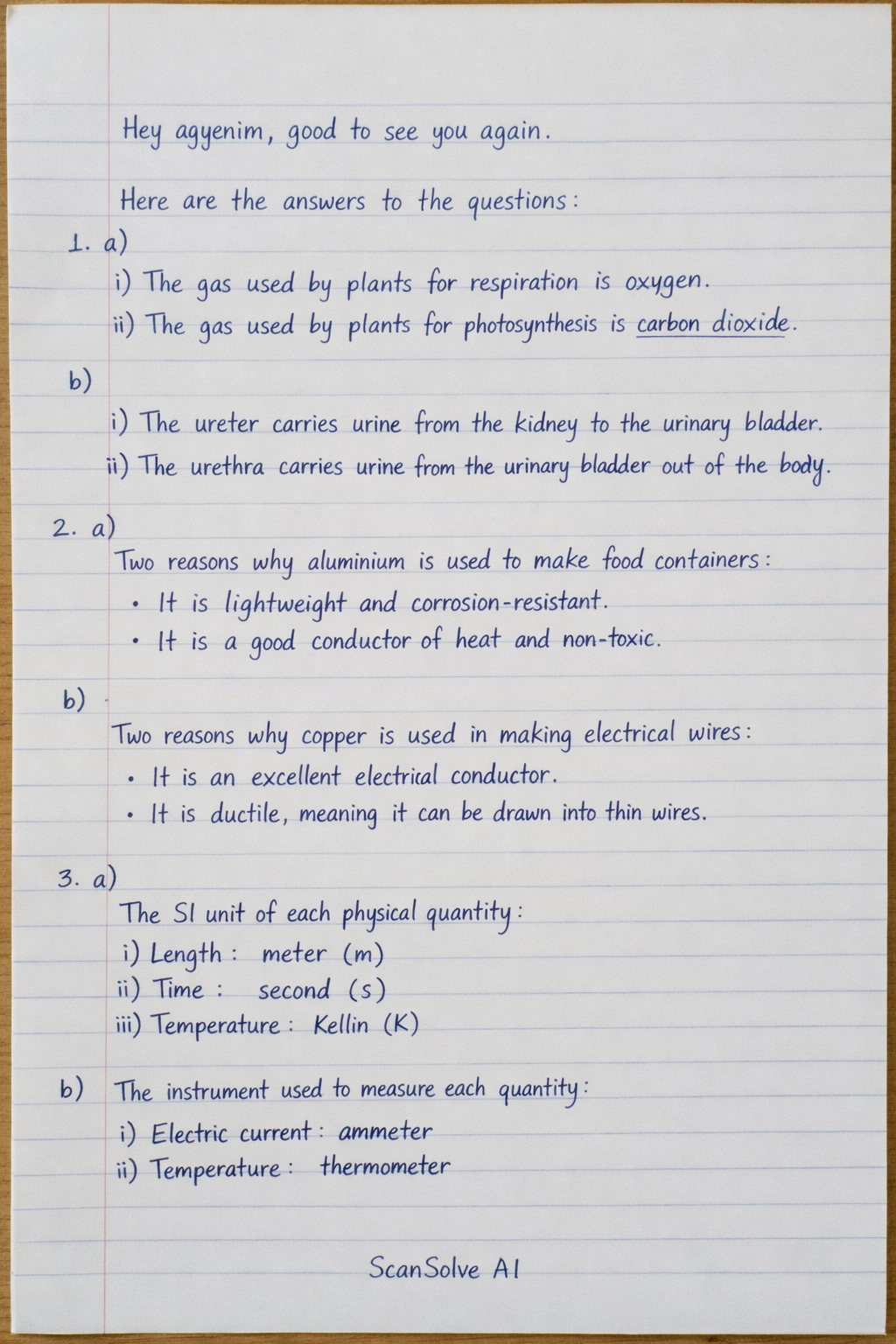
Hey agyenim, good to see you again. Here are the answers to the questions: 1. a) (i) The gas used by plants for respiration is oxygen. (ii) The gas used by plants for photosynthesis is carbon dioxide. b) (i) The ureter carries urine from the kidney to the urinary bladder. (ii) The urethra carries urine from the urinary bladder out of the body. 2. a) Two reasons why aluminium is used to make food containers: • It is lightweight and corrosion-resistant. • It is a good conductor of heat and non-toxic. b) Two reasons why copper is used in making electrical wires: • It is an excellent electrical conductor. • It is ductile, meaning it can be drawn into thin wires. 3. a) The SI unit of each physical quantity: (i) Length: meter (m) (ii) Time: second (s) (iii) Temperature: Kelvin (K) b) The instrument used to measure each quantity: (i) Electric current: ammeter (ii) Temperature: thermometer 4. a) Two ways a human sperm cell is adapted to its function: • It has a tail (flagellum) for motility to swim towards the egg. • It contains many mitochondria in the mid-piece to provide energy for movement. b) Two ways a human nerve cell is adapted to its function: • It has a long axon to transmit electrical signals over long distances. • It has dendrites to receive signals from other nerve cells. 5. The name of each change of state: a) Solid to liquid: Melting (or fusion) b) Gas to solid: Deposition (or desublimation) c) Gas to liquid: Condensation Send me the next one 📸