

This biology question covers important biological concepts and processes. The step-by-step explanation below helps you understand the underlying mechanisms and reasoning.
ScanSolve AI Answer
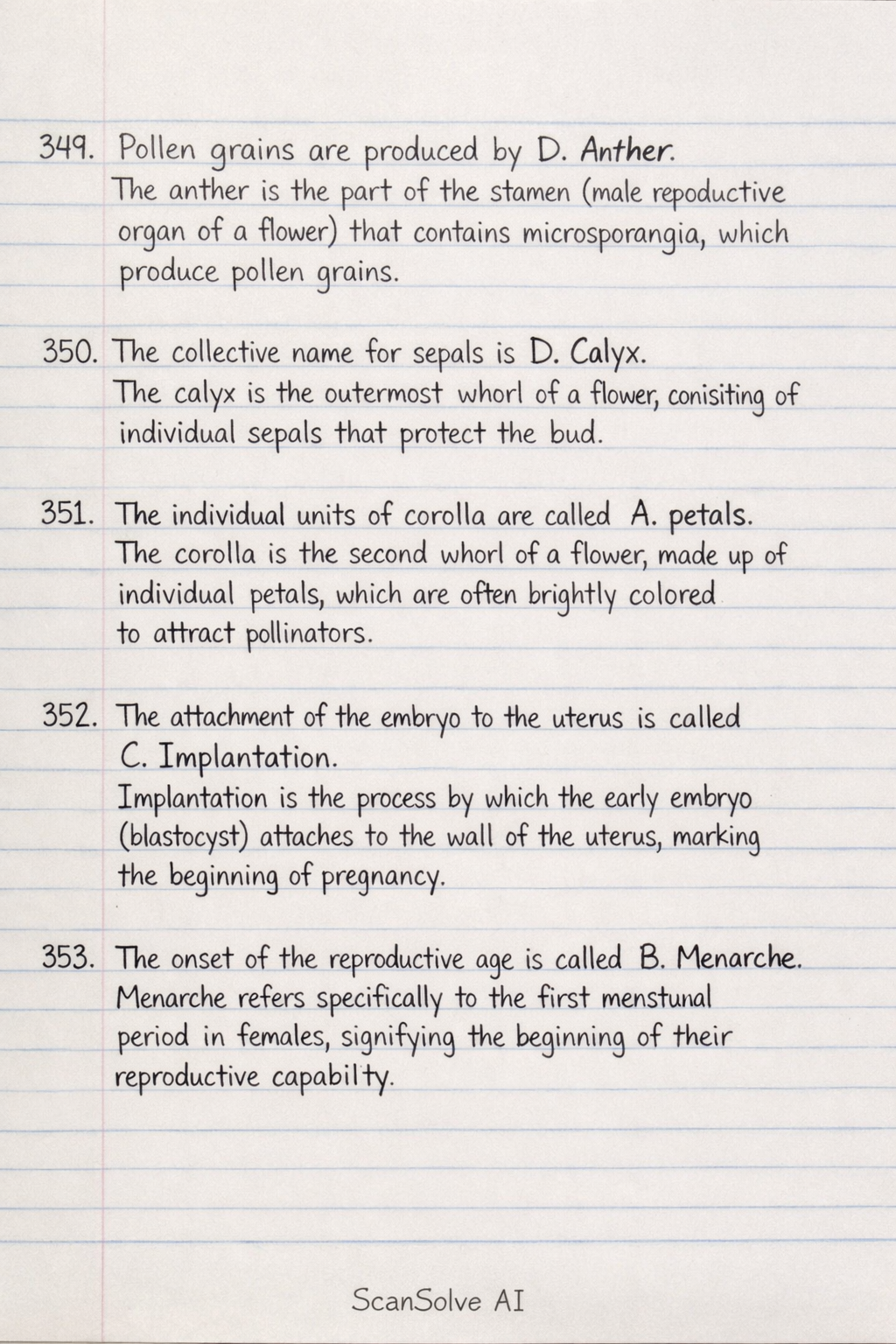
here are the answers to your questions: 349. Pollen grains are produced by D. Anther. The anther is the part of the stamen (male reproductive organ of a flower) that contains microsporangia, which produce pollen grains. 350. The collective name for sepals is D. Calyx. The calyx is the outermost whorl of a flower, consisting of individual sepals that protect the bud. 351. The individual units of corolla are called A. petals. The corolla is the second whorl of a flower, made up of individual petals, which are often brightly colored to attract pollinators. 352. The attachment of the embryo to the uterus is called C. Implantation. Implantation is the process by which the early embryo (blastocyst) attaches to the wall of the uterus, marking the beginning of pregnancy. 353. The onset of the reproductive age is called B. Menarche. Menarche refers specifically to the first menstrual period in females, signifying the beginning of their reproductive capability. 354. The first time that the monthly bleeding occurs is called B. Menarche. This is a rephrasing of the previous question; menarche is the term for the first menstrual bleeding. 355. The most important part of the plant for continuation of the life of the species is C. flower. The flower is the reproductive organ of angiosperms, responsible for producing seeds through sexual reproduction, which ensures the continuation of the species. 356. The type of vegetative propagation seen in chrysanthemum is B. sucker. Chrysanthemums commonly reproduce vegetatively through suckers, which are new shoots that arise from the base of the plant. 357. Successfully grafted plants bear the flowers and fruits characteristic of the A. Scion. In grafting, the scion is the upper part of the plant that is grafted onto the rootstock, and it determines the characteristics of the flowers and fruits. 358. Sugarcane is normally grown by A. Cutting. Sugarcane is typically propagated vegetatively by planting stem cuttings, which are sections of the stalk containing buds. What's next? Send 'em!