
We read your photo as:
The bending of a plant shoot towards an unidirectional light source is the result of:
ScanSolve AI Answer
Answer
Here are the solutions for the questions from the image:
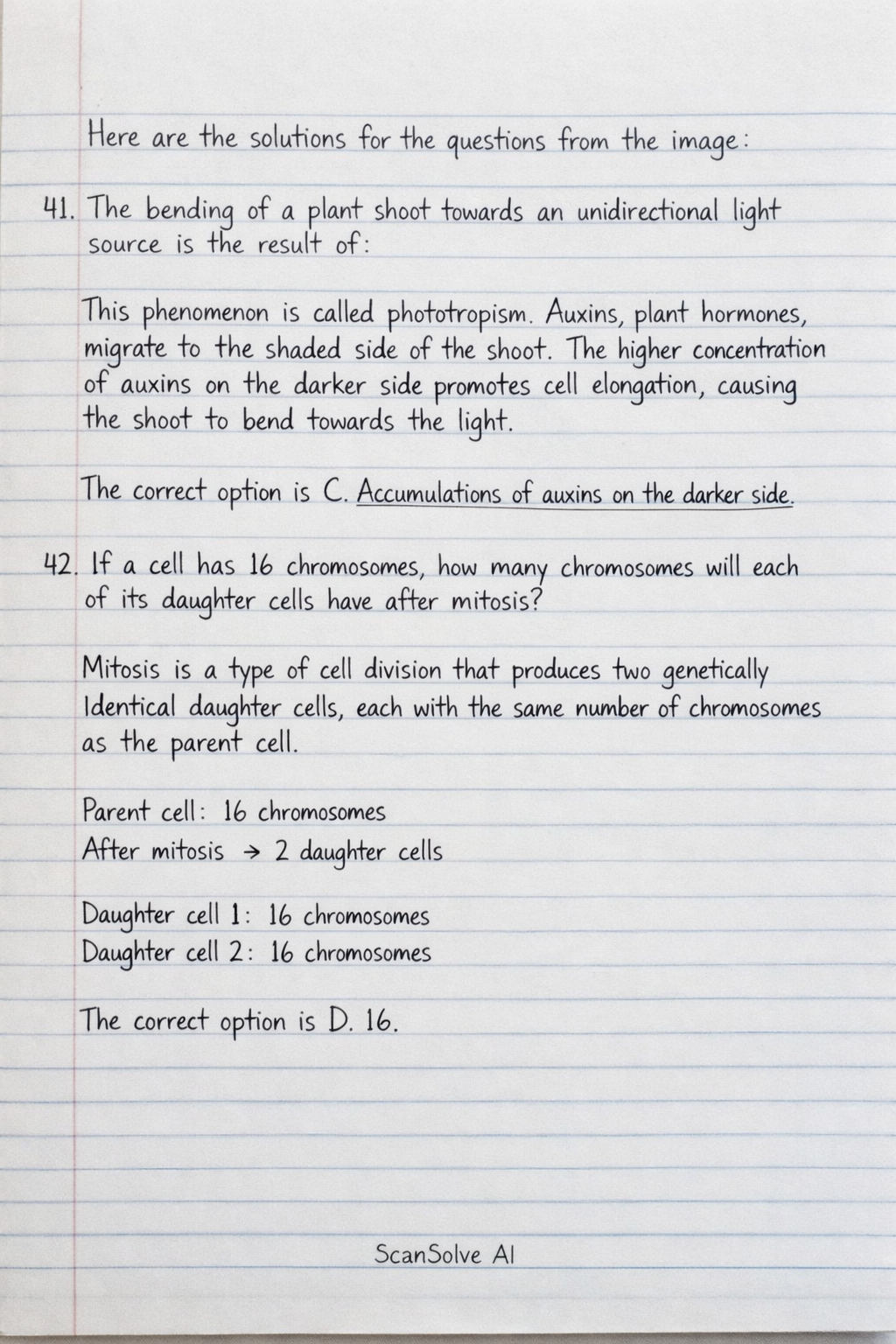
41. The bending of a plant shoot towards an unidirectional light source is the result of:
This phenomenon is called phototropism. Auxins, plant hormones, migrate to the shaded side of the shoot. The higher concentration of auxins on the darker side promotes cell elongation, causing the shoot to bend towards the light.
The correct option is C. Accumulations of auxins on the darker side.
42. If a cell has 16 chromosomes, how many chromosomes will each of its daughter cells have after mitosis?
Mitosis is a type of cell division that produces two genetically identical daughter cells, each with the same number of chromosomes as the parent cell.
The correct option is D. 16.
43. The graph below shows the effect of temperature on an enzyme catalyzed reaction. What will cause a fall in the curve at temperatures above 40°C?
Enzymes are proteins with specific three-dimensional structures. At temperatures significantly above their optimum, the high thermal energy causes the enzyme's structure to break down, particularly the active site. This process is called denaturation, which leads to a loss of enzyme activity.
The correct option is B. Enzymes are denatured.
44. What is the use of pyrogallic acid in the experiment to demonstrate the importance of oxygen during seed germination?
Pyrogallic acid is a chemical compound used as an oxygen scavenger. In experiments demonstrating the necessity of oxygen for seed germination, it is used to absorb oxygen from the air in a sealed container, creating an anaerobic environment.
The correct option is A. To absorb all oxygen present.
45. A seedling transplanted on a hot windy day withers because the:
When a seedling is transplanted, its roots are often damaged, reducing its ability to absorb water. A hot, windy day increases the rate of transpiration (water loss from the leaves). If the rate of water loss exceeds the rate of water absorption, the seedling will lose turgor and wither.
The correct option is C. Seedling loses more water.
46. A solution from crushed germinating maize seeds was heated with an equal amount of Benedict's solution in a test tube and a brick red colour appeared. The brick red colour indicates the presence of:
Benedict's solution is used to test for the presence of reducing sugars. A brick-red precipitate indicates a positive result, meaning reducing sugars are present. During germination, stored starch is broken down into simpler sugars to provide energy for the growing embryo.
The correct option is B. Sugar.
47. A food chain differs from a food web in that:
A food chain illustrates a single, linear pathway of energy flow from producers to consumers. A food web, however, consists of multiple interconnected food chains, showing that most organisms have more than one food source and are part of several feeding relationships.
The correct option is A. Each organism in a food web has more than one food source.
48. In an experiment to test for the presence of starch in a green leaf, the leaf is boiled in water, then in alcohol. Why must the leaf be boiled in alcohol?
Boiling the leaf in alcohol (ethanol) is done to extract and remove the chlorophyll. Chlorophyll is green and would mask the color change (blue-black) that indicates the presence of starch when iodine solution is applied.
The correct option is B. To remove chlorophyll.
Try one yourself
A new problem that tests the same skill.
Still stuck on this one?
Ask a follow-up, and the answer starts from this question.
More Biology Questions
Handwritten Step-by-Step Solution
Get this as a handwritten image on WhatsApp — like a tutor wrote it for you.
Try on WhatsApp