
We read your photo as:
What are the benefits of biotechnology in medicine and list microorganisms used in making bread and yoghurt?
ScanSolve AI Answer
here are the answers to your questions, Notorious.
b)
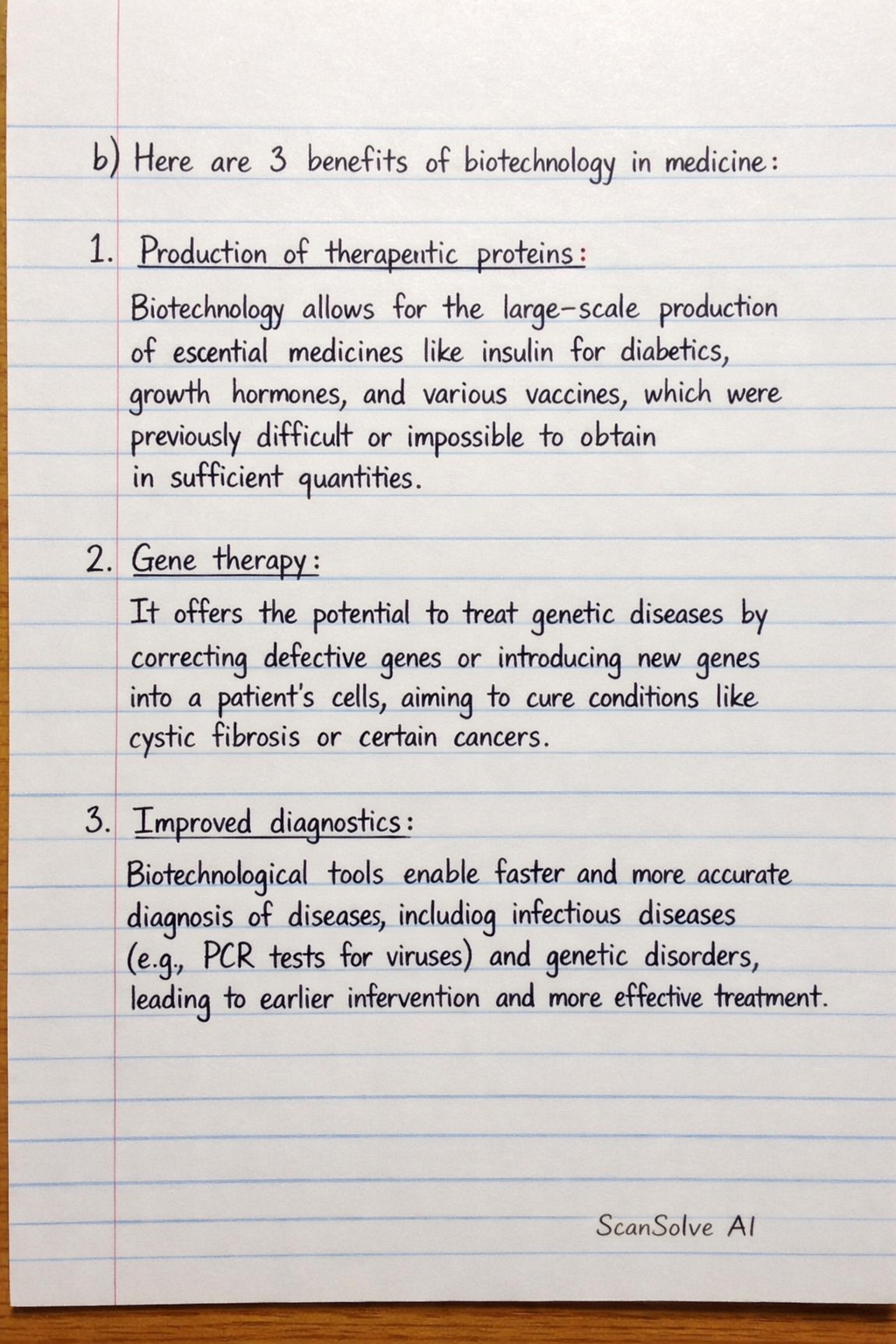
Here are 3 benefits of biotechnology in medicine:
- Production of therapeutic proteins: Biotechnology allows for the large-scale production of essential medicines like insulin for diabetics, growth hormones, and various vaccines, which were previously difficult or impossible to obtain in sufficient quantities.
- Gene therapy: It offers the potential to treat genetic diseases by correcting defective genes or introducing new genes into a patient's cells, aiming to cure conditions like cystic fibrosis or certain cancers.
- Improved diagnostics: Biotechnological tools enable faster and more accurate diagnosis of diseases, including infectious diseases (e.g., PCR tests for viruses) and genetic disorders, leading to earlier intervention and more effective treatment.
c)
Microorganisms are used in the production of:
i) Bread: Yeast (Saccharomyces cerevisiae) is used. Yeast ferments sugars in the dough, producing carbon dioxide gas, which causes the dough to rise and gives bread its light, airy texture.
ii) Yoghurt: Lactic acid bacteria (e.g., Lactobacillus bulgaricus and Streptococcus thermophilus) are used. These bacteria ferment the lactose (milk sugar) into lactic acid, which causes the milk proteins to coagulate, thickening the milk into yoghurt and giving it its characteristic tangy flavor.
3)
I cannot draw diagrams, but I can describe the key features of a Spirogyra cell that would be included in a labeled diagram:
A Spirogyra cell is typically cylindrical and elongated, forming long, unbranched filaments.
- Cell wall: The outermost rigid layer, providing structural support.
- Cell membrane: Located just inside the cell wall, regulating passage of substances.
- Cytoplasm: The jelly-like substance filling the cell.
- Nucleus: A single, centrally located nucleus, often suspended by cytoplasmic strands.
- Chloroplasts: One or more prominent, spiral-shaped, ribbon-like chloroplasts that run along the length of the cell. These contain chlorophyll for photosynthesis.
- Pyrenoids: Small, spherical bodies embedded within the chloroplasts, responsible for starch synthesis and storage.
- Vacuole: A large central vacuole, pushing the cytoplasm and nucleus to the periphery of the cell.
b)
The mode of nutrition in Spirogyra is autotrophic (specifically, photoautotrophic).
Spirogyra is able to carry out this mode of nutrition because it contains chloroplasts which house the pigment chlorophyll. Chlorophyll absorbs light energy, which Spirogyra then uses to convert carbon dioxide and water into glucose (food) and oxygen through the process of photosynthesis.
4)
Here are the distinctions between complete and incomplete metamorphosis:
- Complete Metamorphosis: Involves four distinct stages: egg, larva, pupa, and adult. The larval stage (e.g., caterpillar, maggot) is often very different in appearance, habitat, and diet from the adult stage. The pupa is a non-feeding, transitional stage where significant transformation occurs. Examples include butterflies, beetles, and flies.
- Incomplete Metamorphosis: Involves three stages: egg, nymph, and adult. The nymph stage resembles a smaller, wingless version of the adult and typically lives in the same habitat and consumes similar food. The nymph grows through a series of molts, gradually developing adult features like wings. Examples include grasshoppers, cockroaches, and dragonflies.
5)
Here are 4 ways in which insects are economically important to humans:
- Pollination: Many agricultural crops (fruits, vegetables, nuts) rely on insects, especially bees, for pollination, which is essential for food production.
- Food source: Some insects are directly consumed by humans in various cultures, and many more serve as a vital food source for poultry, fish, and other animals that humans consume.
- Pest control: Many insects are natural predators or parasites of agricultural pests, helping to control pest populations and reduce crop damage, thereby reducing the need for chemical pesticides.
- Production of valuable products: Insects produce economically important products such as honey and beeswax (from bees), silk (from silkworms), and dyes (e.g., cochineal from scale insects).
Still stuck on this one?
Ask a follow-up, and the answer starts from this question.
More Biology Questions
Handwritten Step-by-Step Solution
Get this as a handwritten image on WhatsApp — like a tutor wrote it for you.
Try on WhatsApp