

This biology question covers important biological concepts and processes. The step-by-step explanation below helps you understand the underlying mechanisms and reasoning.
ScanSolve AI Answer
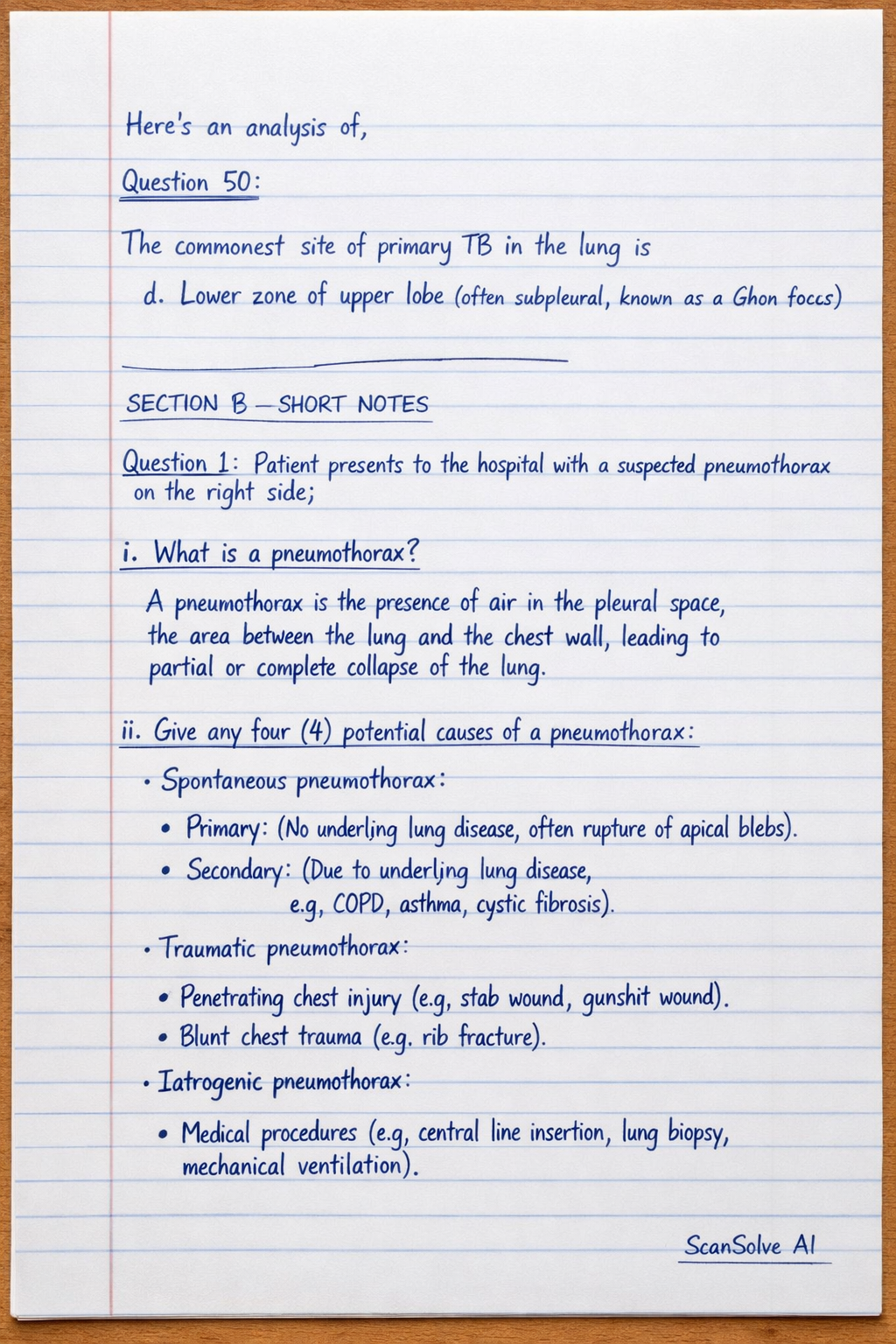
Question 50: The commonest site of primary TB in the lung is d. Lower zone of upper lobe (often subpleural, known as a Ghon focus). --- SECTION B – SHORT NOTES Question 1: Patient presents to the hospital with a suspected pneumothorax on the right side; i. What is a pneumothorax? A pneumothorax is the presence of air in the pleural space, the area between the lung and the chest wall, leading to partial or complete collapse of the lung. ii. Give any four (4) potential causes of a pneumothorax. • Spontaneous pneumothorax: • Primary (no underlying lung disease, often rupture of apical blebs). • Secondary (due to underlying lung disease, e.g., COPD, asthma, cystic fibrosis). • Traumatic pneumothorax: • Penetrating chest injury (e.g., stab wound, gunshot wound). • Blunt chest trauma (e.g., rib fracture). • Iatrogenic pneumothorax: • Medical procedures (e.g., central line insertion, lung biopsy, mechanical ventilation). iii. Give at least three (3) radiological features of a pneumothorax. • Visceral pleural line: A thin, sharp line representing the collapsed visceral pleura, separated from the chest wall. • Absence of lung markings: No vascular markings are visible peripheral to the visceral pleural line. • Deep sulcus sign: On a supine chest X-ray, air collects in the costophrenic sulcus, making it appear abnormally deep and lucent. • Mediastinal shift: In a tension pneumothorax, the mediastinum (heart, trachea) is pushed away from the affected side. Question 2: With regards to glomerular pathologies: i. Name or describe the characteristic morphological change associated with injury to podocytes. The characteristic morphological change is effacement of foot processes (also known as fusion of foot processes). ii. Give at least four (4) contrasting features of nephrotic and nephritic syndrome. | Feature | Nephrotic Syndrome | Nephritic Syndrome | | :------------------ | :----------------------------------------------- | :----------------------------------------------- | | Proteinuria | Massive (>3.5 g/day) | Mild to moderate (<3.5 g/day) | | Hematuria | Absent or microscopic | Present (often macroscopic, "cola-colored" urine) | | Edema | Severe, generalized (anasarca) | Mild to moderate, often periorbital | | Hypertension | Absent or mild | Prominent | | Serum Albumin | Low (hypoalbuminemia) | Normal or slightly reduced | | Lipids | High (hyperlipidemia, lipiduria) | Normal | | Azotemia | Absent | Present (elevated BUN/creatinine) | | Red Cell Casts | Absent | Present | iii. List at least four (4) causes of secondary glomerular diseases. • Systemic Lupus Erythematosus (SLE) (Lupus Nephritis) • Diabetes Mellitus (Diabetic Nephropathy) • Amyloidosis • Vasculitis (e.g., ANCA-associated vasculitis) • Post-infectious Glomerulonephritis (e.g., Post-streptococcal glomerulonephritis) • Hepatitis B or C virus infection Question 3: State and briefly describe the pathological stages of lobar pneumonia. Lobar pneumonia typically progresses through four pathological stages: Step 1: Congestion (Day 1-2) The lung is heavy, red, and boggy. Microscopically, there is vascular engorgement, intra-alveolar fluid containing scattered neutrophils, and numerous bacteria. Step 2: Red Hepatization (Day 2-4) The lung becomes firm, red, and liver-like in consistency. The alveoli are packed with red blood cells, neutrophils, and fibrin, giving the lung a solid appearance. Step 3: Gray Hepatization (Day 4-8) The lung remains firm but appears gray-brown. This stage is characterized by the disintegration of red blood cells and the persistence of fibrin and neutrophils within the alveolar spaces. Step 4: Resolution (Day 8 onwards) The exudate within the alveoli is enzymatically digested by macrophages, leading to its reabsorption or expectoration. The lung tissue gradually returns to normal, with restoration of alveolar architecture. Question 4: Define diarrhoea and describe its four (4) principle etiological mechanisms. Diarrhoea is defined as an increase in the frequency, fluidity, or volume of stool compared to an individual's normal bowel habits. The four principle etiological mechanisms are: 1. Secretory Diarrhoea: This occurs when there is increased active secretion of fluid into the intestinal lumen, or decreased absorption, often due to bacterial toxins (e.g., cholera toxin, E. coli enterotoxins) or certain hormones. The stool volume is typically large, and it persists even with fasting. 2. Osmotic Diarrhoea: This results from the presence of non-absorbable, osmotically active solutes in the intestinal lumen. These solutes draw water into the lumen, increasing stool volume and fluidity. Examples include lactase deficiency (lactose intolerance) or ingestion of poorly absorbed laxatives. It typically resolves with fasting. 3. Exudative/Inflammatory Diarrhoea: This type is caused by inflammation and damage to the intestinal mucosa, leading to the outpouring of blood, pus, and protein-rich fluid into the lumen. It is often associated with infectious agents (e.g., Shigella, Salmonella, Campylobacter) or inflammatory bowel diseases (e.g., Crohn's disease, ulcerative colitis). Stools often contain blood, mucus, and leukocytes. 4. Motility Disorders: Diarrhoea can result from abnormally rapid transit of intestinal contents through the bowel, which reduces the time available for fluid and electrolyte absorption. This can be due to conditions like irritable bowel syndrome (IBS) with diarrhoea-predominant features, hyperthyroidism, or post-gastrectomy syndromes. Question 5: Define hydronephrosis and give any four (4) potential causes of bilateral and any four potential causes of unilateral hydronephrosis. Hydronephrosis is the dilation of the renal pelvis and calyces due to obstruction of urine outflow from the kidney. This obstruction can occur anywhere from the renal pelvis to the urethra. Potential causes of bilateral hydronephrosis: • Benign Prostatic Hyperplasia (BPH): Enlarged prostate obstructs the bladder outlet in men. • Prostate Cancer: Malignant growth obstructing the bladder outlet or compressing ureters. • Urethral Stricture: Narrowing of the urethra, often due to trauma or infection. • Neurogenic Bladder: Dysfunction of bladder emptying due to neurological conditions. • Retroperitoneal Fibrosis: Inflammatory process causing fibrous tissue to encase and obstruct both ureters. • Bladder Tumors: Tumors at the bladder neck or trigone obstructing ureteral orifices. Potential causes of unilateral hydronephrosis: • Ureteropelvic Junction (UPJ) Obstruction: Narrowing or blockage at the junction of the renal pelvis and ureter. • Ureteral Calculi (Kidney Stones): A stone lodged in one ureter, blocking urine flow. • Ureteral Stricture: Narrowing of a single ureter due to inflammation, trauma, or surgery. • Extrinsic Compression of Ureter: Compression by an adjacent tumor (e.g., cervical cancer, colon cancer) or blood vessels. • Blood Clot in Ureter: A clot obstructing the ureter, often after renal trauma or surgery. That's all the questions from this image. What's next? 📸