

This biology question covers important biological concepts and processes. The step-by-step explanation below helps you understand the underlying mechanisms and reasoning.
ScanSolve AI Answer
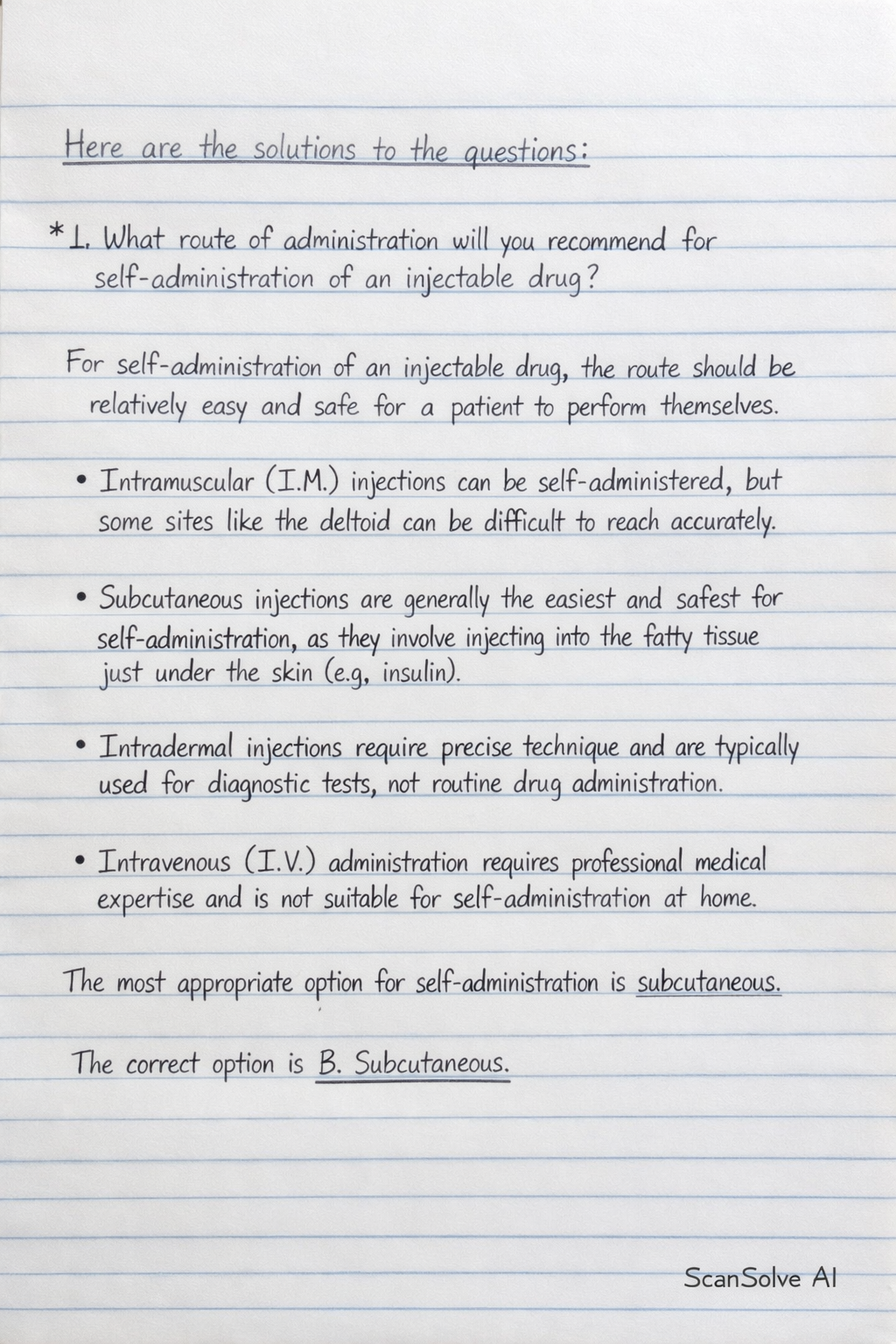
Here are the solutions to the questions: 1. What route of administration will you recommend for self-administration of an injectable drug? For self-administration of an injectable drug, the route should be relatively easy and safe for a patient to perform themselves. • Intramuscular (I.M) injections can be self-administered, but some sites like the deltoid can be difficult to reach accurately. • Subcutaneous injections are generally the easiest and safest for self-administration, as they involve injecting into the fatty tissue just under the skin (e.g., insulin). • Intradermal injections require precise technique and are typically used for diagnostic tests, not routine drug administration. • Intravenous (I.V) administration requires professional medical expertise and is not suitable for self-administration at home. The most appropriate option for self-administration is subcutaneous. The correct option is B. Subcutaneous. 2. What is the description of the part marked X? The graph shows the "Minimum toxic concentration" and the "Minimum effective concentration." The region between these two concentrations, where the drug is effective without causing significant toxicity, is known as the therapeutic window. The part marked X represents this range of concentrations. The correct option is B. Therapeutic window. 3. The following are concentrations of values of drugs based on the graph above. Which of the drugs is most toxic? A drug's toxicity is inversely related to its minimum toxic concentration. A lower minimum toxic concentration means that the drug becomes toxic at a smaller dose or concentration, indicating higher toxicity. Let's compare the "Minimum toxic concentration" for each drug: • Drug A: 20 • Drug B: 12 • Drug C: 20 • Drug D: 17 Drug B has the lowest minimum toxic concentration (12), meaning it is the most toxic among the given options. The correct option is B. 4. Two drugs compete for plasma protein binding sites. P has a higher affinity than Q for the binding sites. If they are administered together, which statement is true concerning these drugs? If drug P has a higher affinity for plasma protein binding sites than drug Q, P will displace Q from these sites. • When Q is displaced, more free (unbound) drug Q will be available in the plasma. Free drug is pharmacologically active and is also subject to metabolism and excretion. • An increase in free Q will lead to a greater pharmacological effect and potentially increased toxicity of Q. It will also lead to faster metabolism and excretion of Q, thus shortening its duration of action. • Drug P, having higher affinity, will bind more extensively. This means less free P is available for immediate metabolism and excretion, potentially leading to a longer half-life and thus a longer duration of action for P as it is slowly released from the binding sites. Therefore, P will have a longer duration of action than Q. The correct option is B. P has longer duration of action than Q. That's 2 down. 3 left today — send the next one.