
We read your photo as:
The diagram below shows the flow of energy through the organisms at different levels in a habitat.
ScanSolve AI Answer
Step-by-step solution
3 stepsSECTION C: ANSWER ONE QUESTION ONLY
19. The diagram below shows the flow of energy through the organisms at different levels in a habitat.
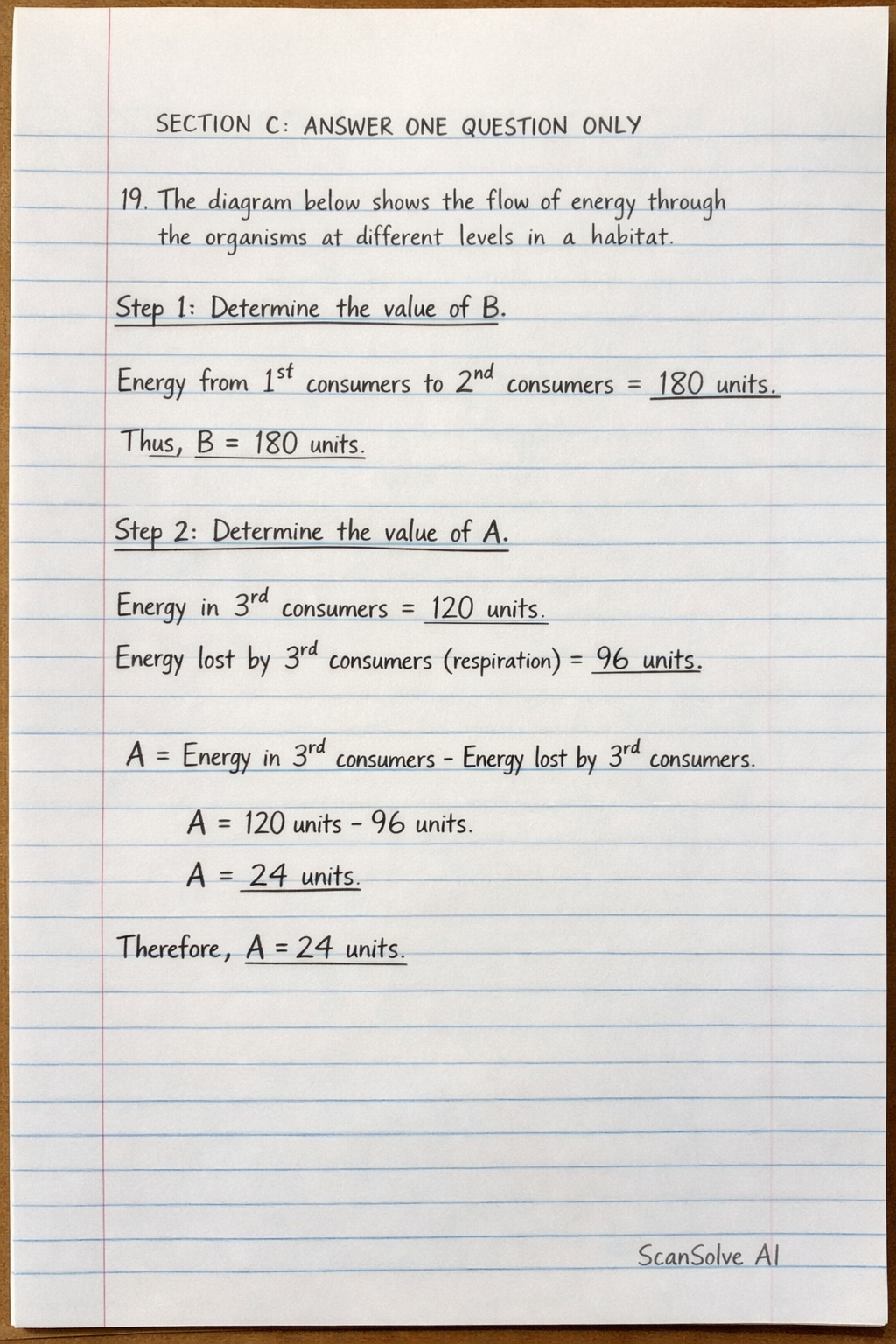
Determine the value of B.
The box labeled "2nd consumers" has "B units". The arrow indicating energy transfer from "1st consumers" to "2nd consumers" shows 180 units. This represents the energy assimilated by the 2nd consumers.
Therefore, B = 180 units.Determine the value of A.
The box labeled "3rd consumers" shows 120 units of assimilated energy.
The arrow indicating energy lost from "3rd consumers" due to respiration shows 96 units.
The energy transferred from "3rd consumers" to "Decomposers" is represented by A units. This is the remaining energy after respiration.Therefore, A = 24 units.
Explain the energy flow in the habitat.
The diagram illustrates the flow of energy through different trophic levels in an ecosystem.
- Solar energy is captured by producers (25,000 units).
- Energy is transferred to successive trophic levels (1st, 2nd, and 3rd consumers), with a significant reduction at each step. For example, only 1,500 units are transferred from producers to 1st consumers, and 180 units from 1st to 2nd consumers.
- A large portion of energy is lost from the food chain at each trophic level through respiration (e.g., 1,000 units by producers, 900 units by 1st consumers, 300 units by 2nd consumers, 96 units by 3rd consumers). This energy is dissipated as heat.
- Decomposers receive energy from all trophic levels by breaking down dead organic matter and waste products, recycling nutrients back into the ecosystem.
The calculated values are:
- B = 180 units
- A = 24 units
Still stuck on this one?
Ask a follow-up, and the answer starts from this question.
More Biology Questions
Handwritten Step-by-Step Solution
Get this as a handwritten image on WhatsApp — like a tutor wrote it for you.
Try on WhatsApp