
We read your photo as:
What are the differences between Gram-positive and Gram-negative bacteria cell walls, and what are the laboratory tools used for observing bacteria?
ScanSolve AI Answer
-
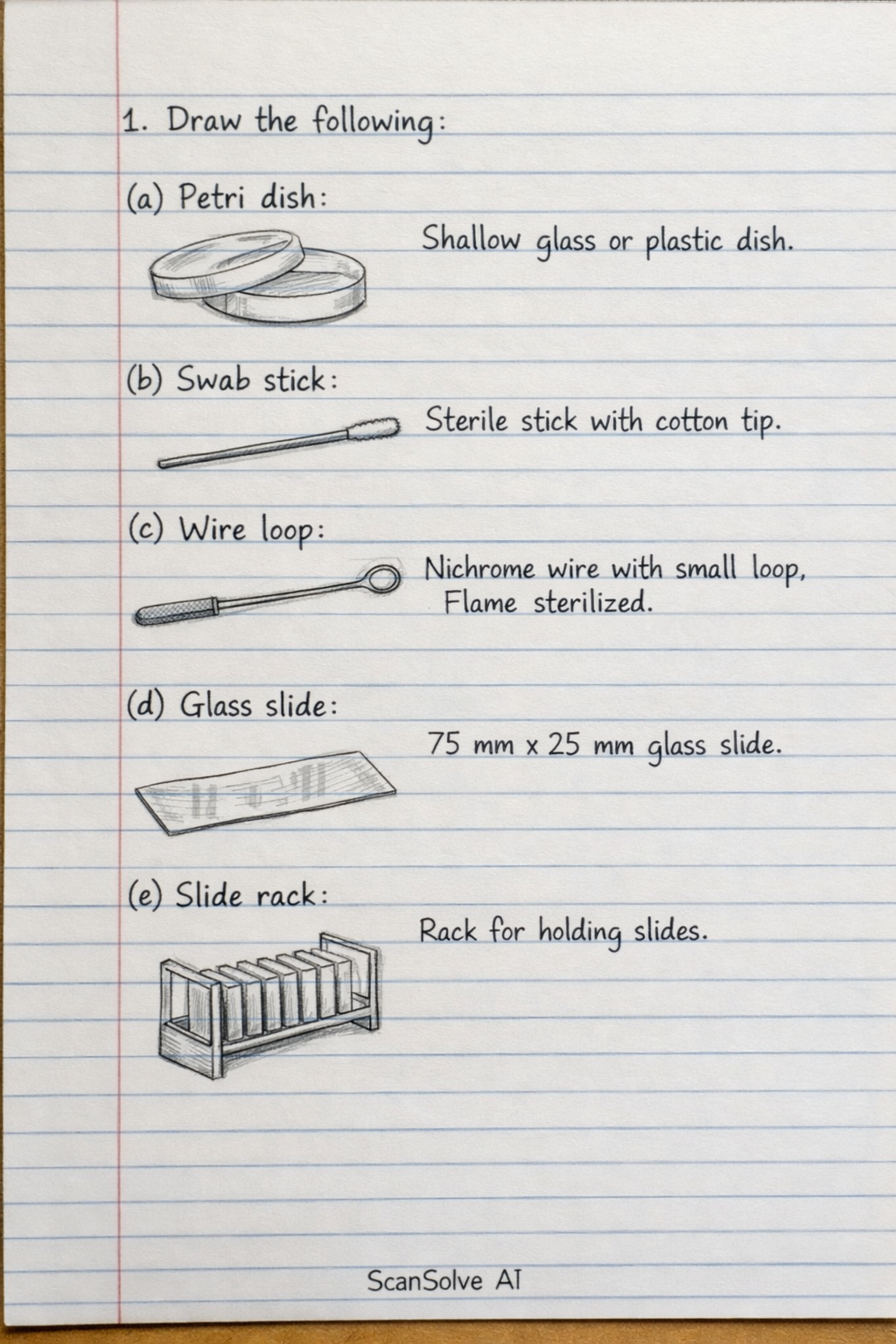
Draw the following: a) Petri dish: A shallow, cylindrical, lidded dish used to culture cells or small mosses. It is typically made of glass or plastic. b) Swab stick: A sterile stick with an absorbent tip (often cotton) used to collect samples from surfaces or biological specimens. c) Wire loop: A thin wire, often made of nichrome or platinum, with a small loop at one end, used to transfer small amounts of microbial cultures. It is typically sterilized by flaming. d) Glass slide: A thin, flat piece of glass, typically 75 mm by 25 mm, used to hold specimens for examination under a microscope. e) Slide rack: A holder, often made of metal or plastic, designed to hold multiple microscope slides upright for staining, drying, or storage.
-
Write the difference between the cell wall of Gram-positive and Gram-negative bacteria. The primary difference lies in the composition and structure of their cell walls.
- Gram-positive bacteria have a thick peptidoglycan layer and lack an outer membrane. They also contain teichoic acids and lipoteichoic acids.
- Gram-negative bacteria have a thin peptidoglycan layer located between two membranes: an inner cytoplasmic membrane and an outer membrane. The outer membrane contains lipopolysaccharides (LPS), phospholipids, and proteins.
Still stuck on this one?
Ask a follow-up, and the answer starts from this question.
More Biology Questions
Handwritten Step-by-Step Solution
Get this as a handwritten image on WhatsApp — like a tutor wrote it for you.
Try on WhatsApp